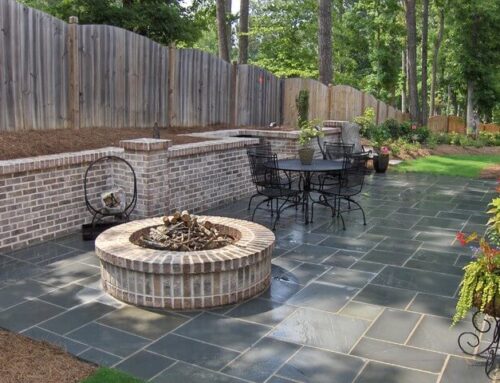
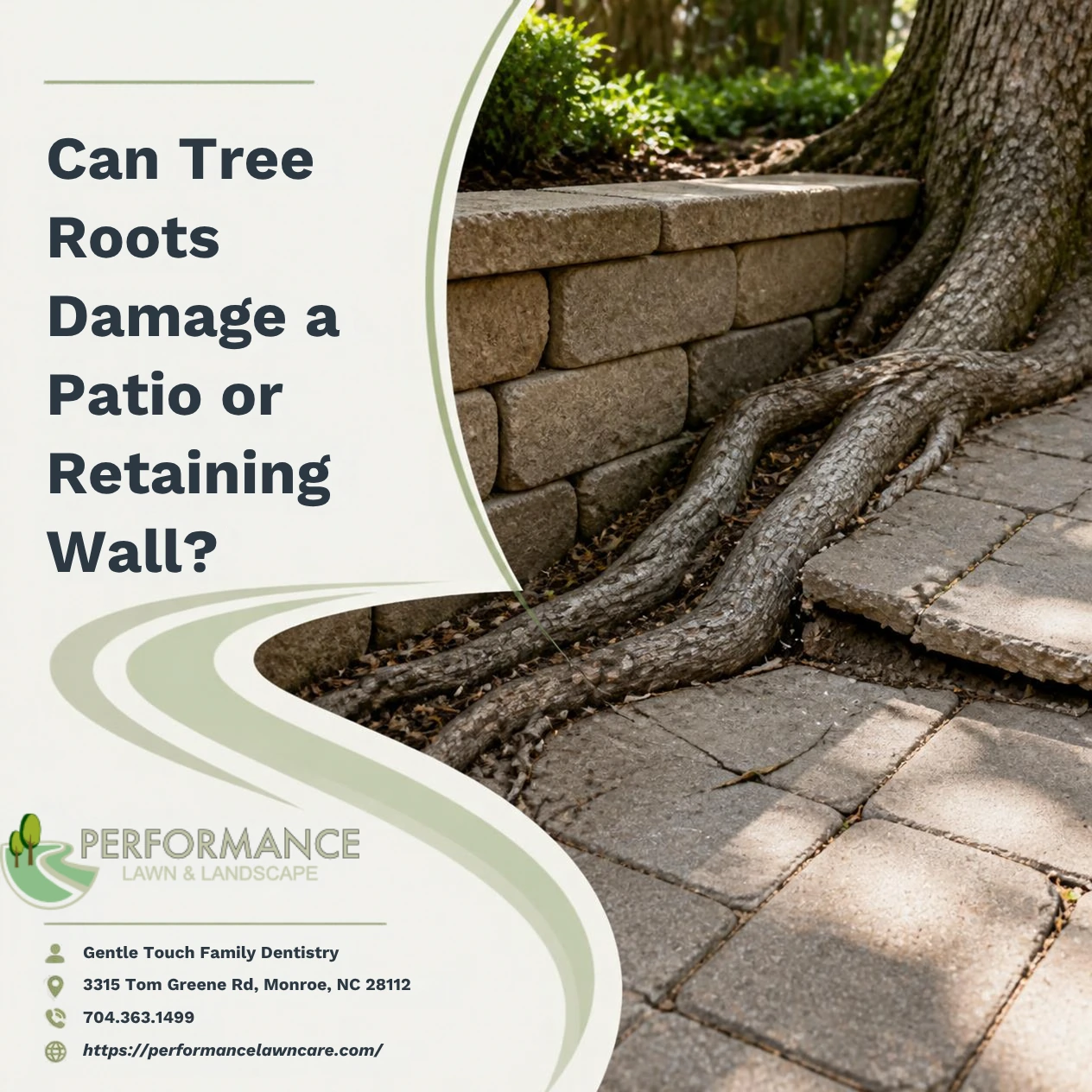
Yes, tree roots can damage patios and retaining walls when growing roots push against hardscape materials, alter the surrounding soil, or interfere with the base supporting the structure. Problems may appear as lifted pavers, cracked concrete, uneven patio sections, displaced wall blocks, or gradual retaining wall movement.
At Performance Lawn & Landscape, we recommend looking at the entire landscape before assuming the tree itself is the only problem. Drainage, soil settlement, construction methods, tree location, and root growth can all contribute to hardscape movement.
Can Tree Roots Damage a Patio or Retaining Wall?
Tree roots can contribute to hardscape damage, particularly when a large tree is growing close to a patio, walkway, retaining wall, driveway, or similar structure.
However, roots do not always “break through” concrete or walls in the way homeowners sometimes imagine. More often, a root grows into an area where there is already space, loose soil, moisture, or a weakness in the hardscape base. As the root increases in diameter, it may gradually lift or displace the material above it.
Several factors influence how serious the problem becomes:
- Distance between the tree and hardscape
- Tree species and mature size
- Root size and direction of growth
- Available soil volume
- Soil compaction
- Drainage conditions
- Patio or wall construction
- Existing cracks or settlement
A patio beside a mature tree may therefore behave very differently from the same patio installed in an open area.
How Do Tree Roots Affect Hardscape Surfaces?
Roots need access to water, oxygen, nutrients, and usable soil. They commonly spread outward through the upper portions of the soil rather than simply growing straight down.
That spreading growth becomes important when patios and walls occupy the same space.
As a woody root becomes larger, it may place pressure on surrounding soil and hardscape components. A shallow root underneath a paver patio, for example, can gradually create a raised area.
Roots can also affect the conditions supporting the hardscape indirectly. Soil can shift as roots grow, decay, or compete for available moisture.
Hardscape problems are particularly likely where trees have very limited rooting space. Penn State Extension notes that confined planting areas around sidewalks and patios can increase the likelihood of hardscape damage, especially when large trees are expected to grow in inadequate soil volumes.
What Are the Signs of Root Damage Under a Patio?
Root-related patio damage is usually gradual.
A patio may look perfectly level for years before small changes begin appearing.
Possible warning signs include:
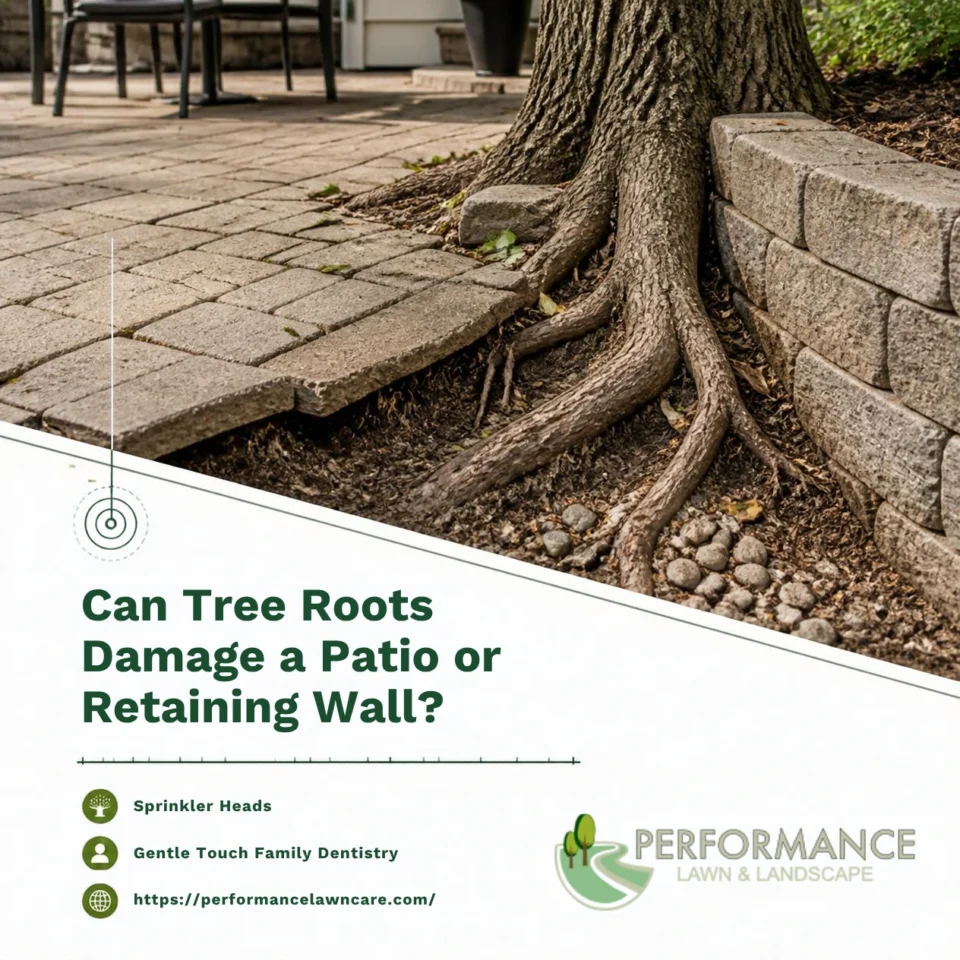
- Individual pavers becoming higher than surrounding pavers
- Long raised areas that appear to follow a root
- Concrete developing cracks near a tree
- Patio slabs becoming uneven
- Pavers separating or shifting
- Edging beginning to move
- Water pooling where the patio previously drained normally
- Changes becoming progressively worse as the tree grows
A raised area that seems to form a line leading toward a nearby tree is one clue that roots may be involved.
However, uneven patios can also result from poor base preparation, erosion, soil settlement, freeze-and-thaw cycles, drainage problems, or heavy loads.
That is why diagnosis should come before repair.
How Can Tree Roots Affect a Retaining Wall?
Retaining walls are more complicated because they are designed to resist pressure from the soil behind them.
When roots grow near a retaining wall, they may interact with both the wall and the soil it is holding back.
Potential problems include:
- Blocks shifting out of alignment
- Sections of wall beginning to bulge
- Capstones becoming uneven
- Cracks developing in masonry or concrete
- Soil pressure becoming uneven
- Roots growing between wall components
- Drainage pathways becoming disrupted
Large roots may contribute to movement when they occupy soil directly behind or underneath the wall.
However, a leaning or bulging retaining wall should not automatically be blamed on a nearby tree.
Poor drainage, hydrostatic pressure, inadequate reinforcement, improper base preparation, erosion, or excessive soil loads are also common contributors.
Sometimes several problems occur at once.
Which Tree Locations Create the Highest Risk?
Trees generally create greater concerns when they are planted very close to structures without enough space for their mature size.
Situations worth watching include trees growing:
Immediately Beside a Patio
A mature tree only a short distance from a patio may eventually have structural roots extending underneath the hardscape.
Behind a Retaining Wall
Large trees growing immediately above a retaining wall can complicate the conditions behind the wall as their root systems develop.
Below a Retaining Wall
Trees at the base of a wall can also interact with the foundation area, depending on their location and root structure.
In Narrow Landscape Beds
Trees confined between buildings, patios, walls, sidewalks, or driveways have fewer directions in which roots can expand.
Near Older Hardscaping
Older patios and walls may already contain small gaps, deteriorated joints, settlement, or drainage problems that make movement easier.
Tree selection and placement matter. Providing adequate rooting space and choosing a tree appropriate for the site can reduce future conflicts between trees and built surfaces.
Can Roots Cause Pavers or Concrete to Lift?
Yes.
Pavers are particularly susceptible because individual units can move independently.
A root growing beneath a paver may slowly lift it above adjacent sections. Over time, the raised paver may become noticeable or even create a tripping hazard.
The good news is that paver patios can sometimes be easier to repair than solid concrete.
Affected pavers may be temporarily removed so the conditions underneath can be inspected. Depending on what is found, the area may be regraded and rebuilt after an appropriate plan has been developed for the root.
Concrete behaves differently.
A concrete slab cannot flex around an enlarging root very easily. Pressure or changes in the supporting soil may therefore contribute to:
- Cracking
- Tilting
- Uneven slab sections
- Raised joints
Simply pouring new concrete over the problem usually does not address the underlying cause.
Can Root Growth Contribute to Retaining Wall Movement?
It can, but retaining wall movement needs to be evaluated carefully.
Large roots occupying soil behind a wall can alter soil conditions and place localized pressure on wall components. Roots may also enter spaces between blocks or around drainage components.
But homeowners should avoid assuming that visible roots are automatically responsible for a leaning wall.
Water is often an equally important consideration.
A wall that cannot properly drain may experience increasing pressure behind it, particularly after heavy rain. Erosion around the base or improper construction can also contribute to movement.
Look for additional warning signs such as:
- Wall sections leaning outward
- Horizontal displacement between courses
- Bulging near the middle
- Soil washing through joints
- Standing water behind the wall
- Drainage outlets that no longer function
- Separation at wall corners
- Changes occurring near a large tree
Identifying the actual cause determines whether the solution involves the tree, the retaining wall, drainage improvements, or a combination of these measures.
What Repair Options Are Available for Root Damage?
The right repair depends on the type and severity of the damage.
Resetting Pavers
If only a small portion of a paver patio has moved, affected pavers can sometimes be removed and reset after the underlying conditions are addressed.
Rebuilding the Patio Base
More extensive movement may require removing a larger patio section and rebuilding the aggregate or bedding base.
Rerouting the Hardscape
Sometimes changing the shape of a walkway or patio is preferable to repeatedly fighting a large, healthy tree’s root system.
Repairing Concrete
Cracked or displaced concrete sections may need replacement. The root situation should be assessed first so that the same problem does not quickly return.
Repairing a Retaining Wall
Minor wall movement may involve rebuilding an affected section.
More substantial leaning, bulging, drainage failure, or foundation movement may require partial or complete reconstruction.
Improving Drainage
Drainage corrections may be necessary when erosion or excessive soil moisture is contributing to hardscape movement.
A successful repair should address why the structure moved, not simply make the surface look level again.
Should Tree Roots Be Removed Near Hardscaping?
Do not automatically cut a tree root simply because it is underneath a patio or beside a wall.
Large structural roots help support the tree. Severing important roots can reduce tree health and, in some circumstances, affect stability.
Penn State Extension warns that severing roots during construction can significantly affect tree health, survival, and structural stability. The International Society of Arboriculture similarly recommends protecting critical root areas and involving a qualified arborist when construction may damage important roots.
The risk depends on factors such as:
- Root diameter
- Distance from the trunk
- Number of roots affected
- Tree species
- Tree age
- Existing tree health
- Soil conditions
- Overall root structure
Small roots and major structural roots should not be treated the same way.
Before cutting significant roots, particularly close to a mature tree, have the situation evaluated by a qualified tree professional.
In some situations, changing the patio or wall may be safer than significantly altering the root system.
How Can You Prevent Future Root Damage?
Prevention begins with planning the landscape and hardscape together.
Give Trees Enough Room
Consider how large the tree will become at maturity rather than its size when planted.
Select Trees Appropriate for the Site
A narrow landscape bed surrounded by concrete may not be suitable for a tree that eventually develops a large canopy and extensive root system.
Plan Hardscaping Around Existing Mature Trees
If a valuable mature tree already occupies the property, patio and walkway layouts can sometimes be adjusted around important root areas.
Build a Proper Hardscape Base
Correct excavation, compaction, base materials, edging, and grading help patios resist ordinary settlement and movement.
Manage Drainage
Keep water moving where it should.
Poor drainage can weaken the soil supporting patios and place unnecessary pressure behind retaining walls.
Consider Root Management During the Design Stage
In appropriate situations, professionals may recommend structural soils, expanded planting areas, root-management strategies, or redesigned hardscape locations.
These approaches are usually much easier to incorporate before the patio or wall is constructed.
When Should You Request a Professional Assessment?
A professional assessment is worthwhile whenever the damage is progressing, the cause is unclear, or repairing the area could interfere with a mature tree.
Consider requesting help if you notice:
- Large sections of a patio lifting
- Repeated patio movement after previous repairs
- Large roots directly underneath hardscaping
- Significant cracks in concrete
- A retaining wall beginning to lean
- Bulging or displaced wall blocks
- Drainage problems behind a retaining wall
- Soil washing away near a wall
- A mature tree extremely close to the damaged area
- Large roots that may need to be cut
- Signs that the tree itself is leaning or unstable
Cracks or soil movement around a tree can sometimes indicate problems involving the root system or tree stability, which should be evaluated by a qualified arborist rather than treated as a simple landscaping issue.
The goal is to determine whether the hardscape, tree, soil, drainage system, or several factors together are causing the problem.
Protect Your Hardscape and Landscape With Performance Lawn & Landscape
A lifted patio or moving retaining wall does not automatically mean a nearby tree needs to be removed. The best solution starts with determining what is actually causing the movement.
At Performance Lawn & Landscape, we look at the relationship between your hardscape, grading, drainage, soil conditions, and surrounding landscape before recommending repairs. Whether you are dealing with uneven pavers, patio settlement, drainage concerns, or a retaining wall that is beginning to shift, identifying the underlying cause can help prevent the same damage from returning.
If tree roots appear to be involved, we can also help determine when additional evaluation from a qualified tree professional may be appropriate rather than unnecessarily cutting important roots.
Contact Performance Lawn & Landscape to discuss your patio, retaining wall, drainage, or landscape concerns and find a practical path forward.
FAQs
Do tree roots always damage patios?
No. Many trees grow near patios for years without creating noticeable problems. Risk depends on the tree species, mature size, available rooting space, distance from the patio, soil conditions, patio construction, and drainage. Problems become more likely when large trees have limited space and roots extend directly underneath hardscape surfaces.
How can I tell whether a tree root is lifting my pavers?
Root-related lifting often appears as a localized raised section or a line of uneven pavers extending toward a nearby tree. However, poor base preparation, erosion, settlement, and drainage problems can produce similar symptoms. Removing a few affected pavers may allow a professional to inspect the underlying conditions.
Can I cut a root that is lifting my patio?
You should not cut a significant tree root without first determining how important it is to the tree. Large roots, especially those close to the trunk, may contribute to tree health and structural stability. An arborist may need to evaluate the tree before roots are removed.
Does a tree near a leaning retaining wall mean the roots caused it?
Not necessarily. Roots can contribute to wall movement, but drainage problems, poor construction, soil pressure, erosion, inadequate reinforcement, and foundation settlement can also cause retaining walls to lean. A proper assessment should consider all of these possibilities before deciding on repairs.
Can a patio be repaired without removing the tree?
Often, yes. Depending on the situation, pavers may be reset, the base may be reconstructed, or the layout may be adjusted around important roots. The best option depends on the size and location of the roots, the condition of the tree, and the extent of the patio damage.
How far should trees be planted from patios and retaining walls?
There is no single distance that works for every tree. Appropriate spacing depends heavily on the species and its expected mature size, root characteristics, available soil volume, and surrounding structures. Planning for the tree’s mature dimensions is more useful than choosing spacing based only on how small the tree is when planted.