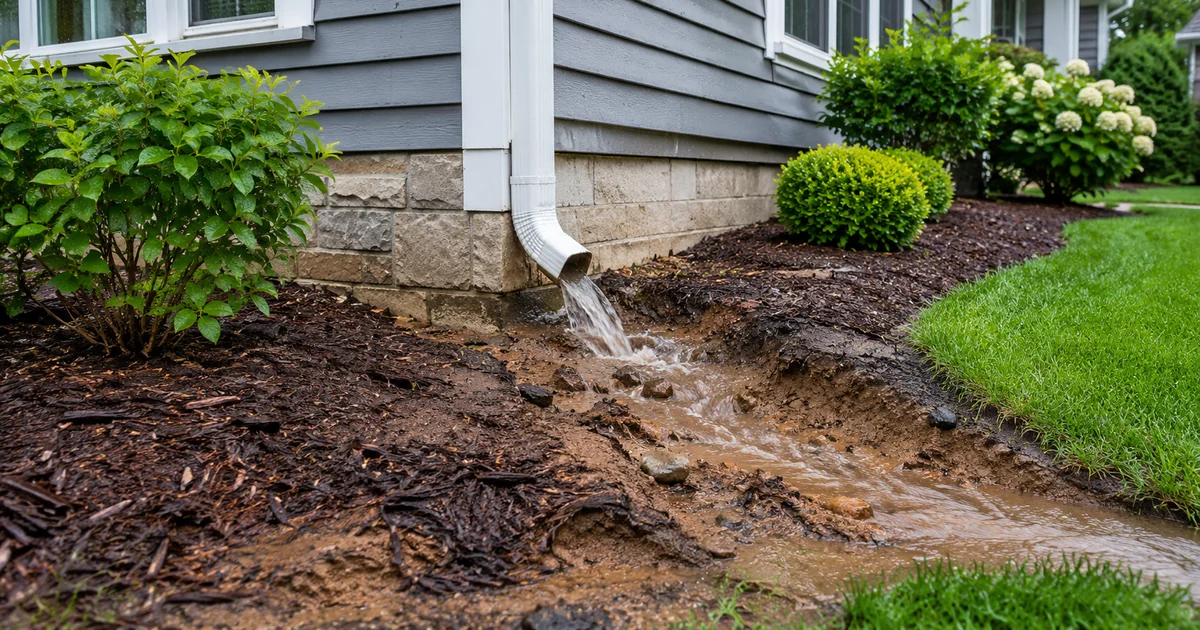
Have you noticed small holes forming beneath your downspouts or soil washing away after heavy rain? Maybe mulch keeps disappearing from your landscape beds, or you’re finding dirt scattered across the sidewalk. These problems might seem minor at first, but repeated erosion can gradually change the ground around your home.
If you’re dealing with soil erosion around downspouts, the problem often starts with how rainwater leaves your roof and enters the yard.
The good news is that not every erosion problem requires major landscaping work. Identifying where the water goes and how it’s affecting the soil can help you determine what needs to change.
Quick Answer: Why Is Soil Eroding Around My Downspouts?
Soil erosion around downspouts happens when concentrated roof runoff strikes the ground or flows across exposed soil with enough force to carry particles away. Heavy rainfall, sloped ground, compacted soil, and poor grading can make erosion worse. Long-term solutions focus on redirecting, slowing, or spreading runoff before replacing the lost soil.
How Downspout Runoff Causes Soil Erosion
Your roof collects rainwater across a large surface area. Gutters gather that water and direct it into downspouts, which release it at specific locations around your home.
During heavy rainfall, a substantial amount of water can exit through a single downspout.
If that water falls directly onto exposed soil, the impact can loosen soil particles and carry them away.
Why concentrated water causes damage
Rain falling naturally across your lawn is spread over a relatively large area.
A downspout concentrates water from part of your roof into one discharge point.
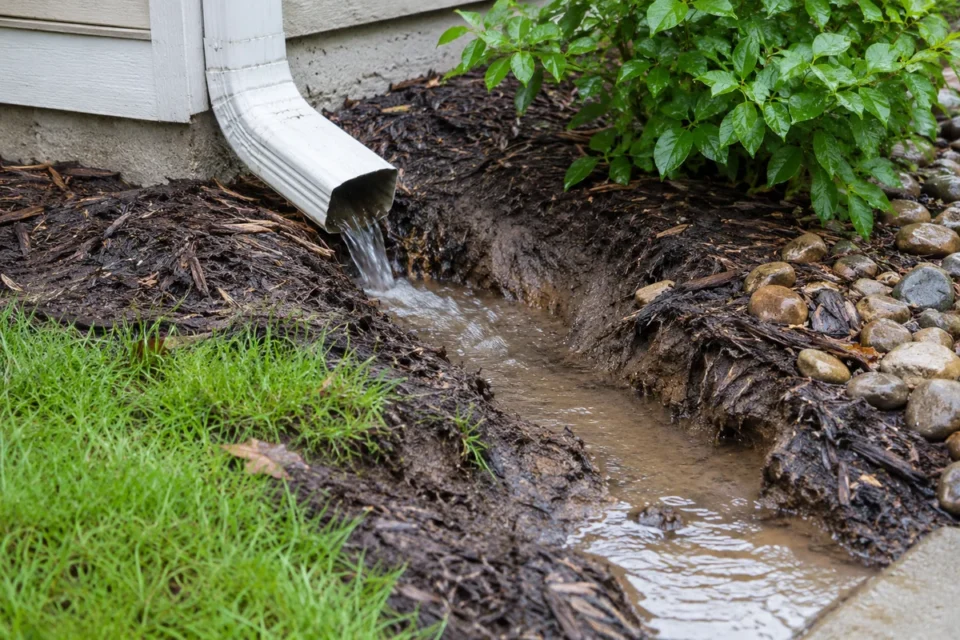
Without a suitable outlet or drainage path, that water may hit the ground with enough force to create a small depression.
As the water continues flowing, it can carry loosened soil downhill.
Over time, that process may create:
- Small holes beneath downspout outlets
- Narrow channels running through the yard
- Exposed roots near landscape beds
- Soil collecting along sidewalks
- Uneven ground around the foundation
According to NC State Extension, slowing runoff and allowing water to soak into the soil can help reduce erosion.
The important step is controlling how water reaches the ground and where it travels afterward.
Why erosion keeps returning
You might fill an eroded area with fresh soil and find that it looks fine for a few days.
Then another storm arrives, and the same hole reappears.
That’s because replacing soil doesn’t change the force or direction of the water.
Unless the runoff is managed, the erosion may continue.
What Warning Signs Show the Problem Is Getting Worse?
A small amount of displaced soil after an unusually heavy storm doesn’t always indicate a serious drainage problem.
However, recurring erosion deserves attention, especially when it occurs near your home’s foundation.
Small holes are becoming deeper
A shallow depression beneath a downspout may gradually develop into a larger hole as additional water removes more soil.
If the opening becomes deeper or wider after every storm, the discharge needs to be evaluated.
Erosion channels are spreading
Water often follows the same downhill path.
As soil washes away, small channels may become deeper and extend farther across the yard.
These channels can eventually expose roots or interfere with grass growth.
Soil is collecting on paved surfaces
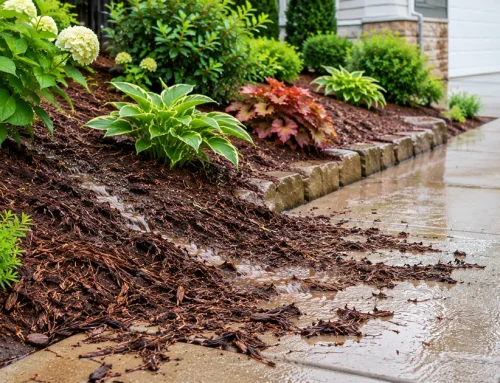
If dirt repeatedly washes onto your driveway, sidewalk, or patio, runoff may be carrying sediment away from the landscape.
This is a useful clue because the deposited soil often reveals where water travels.
Foundation areas are becoming exposed
Soil loss near your home’s foundation should be taken seriously.
Erosion may expose parts of the foundation that were previously covered or create low areas where water collects.
This doesn’t automatically mean structural damage has occurred, but it warrants prompt evaluation.
Standing water is developing
Some erosion problems involve both soil loss and poor drainage.
Water may wash soil out of one location and collect in another, creating muddy or saturated areas.
If you notice several of these warning signs, correcting the water discharge should become a priority.
How Soil Type Affects Erosion Around Downspouts
The type and condition of soil around your home influence how water behaves after leaving a downspout.
Different soils absorb water at different rates and vary in how easily their particles become detached.
Sandy soil
Sandy soil often allows water to infiltrate relatively quickly.
However, loose sand particles can be displaced by concentrated water, especially when vegetation is sparse.
A strong downspout discharge may create depressions or carry sand downhill.
Clay-rich soil
Clay-rich soil is common throughout the Charlotte region, including parts of Matthews.
Clay can resist erosion when well-structured and protected, but compacted or saturated clay may absorb water slowly.
When water cannot soak into the ground quickly enough, more of it moves across the surface.
That runoff can carry loosened soil and create erosion channels.
Loose or disturbed soil
Recently graded areas and newly installed planting beds may contain soil that hasn’t settled or developed protective vegetation.
These locations can be especially vulnerable when downspouts release concentrated water nearby.
Soil compaction also matters
Compacted soil has fewer spaces for water to move through.
This can increase surface runoff, even when the ground appears relatively level.
If your soil is both compacted and exposed, the combination may make erosion more likely.
Why Yard Slope Can Increase Runoff Damage
Water naturally moves downhill, so the slope of your yard can influence how quickly erosion develops.
On a relatively level surface, runoff may spread across a wider area.
On a slope, water often travels in a more defined direction and may gain speed.
Steeper slopes can increase erosion
If a downspout empties near the top of a sloped landscape bed, water may flow downhill through the mulch and exposed soil.
As the flow continues, it can loosen and transport more material.
You might notice bare strips forming near the discharge point and soil collecting at the bottom of the hill.
Longer slopes can create additional runoff problems
Water traveling down a long slope may collect additional runoff along the way.
This increases the volume moving through lower sections of the landscape.
Even a modest slope can experience erosion when water repeatedly follows the same narrow path.
Vegetation helps stabilize the soil
Healthy grass and established groundcover plants can reduce erosion by protecting the soil surface and supporting it with their roots.
However, vegetation alone may not withstand a powerful stream of water released directly from a downspout.
The discharge may need to be redirected or slowed before plants can provide lasting protection.
Can Poor Grading Make Downspout Erosion Worse?
Yes. Poor grading can cause downspout water to collect in unsuitable locations or travel through areas vulnerable to erosion.
Grading refers to the shape and slope of the ground around your property.
Ideally, the ground immediately surrounding your home should direct surface water away from the foundation and toward an appropriate drainage area.
When the yard slopes toward the foundation
If the ground near your house slopes inward, downspout runoff may flow back toward the building.
This can lead to persistent moisture around the foundation, localized erosion, or water collecting in low spots.
When runoff has no suitable outlet
Even if water initially moves away from the house, it may enter a depression where it cannot drain effectively.
Repeated runoff can leave the area muddy and gradually change the soil surface.
When the grade directs water across planting beds
Poorly positioned drainage paths can send concentrated water through landscape beds.
This may wash away mulch, expose plant roots, and remove topsoil.
Correcting the grade may help in some situations, but not every downspout erosion problem requires regrading.
Sometimes, adjusting the discharge location is enough.
What Safe Temporary Checks Can Homeowners Make?
Before making changes, inspect the area to understand what happens when it rains.
You don’t need to dig around your foundation or modify your drainage system to identify several common warning signs.
1. Inspect the downspout outlet
Check whether the downspout releases water directly onto bare soil, mulch, or an already eroded area.
Look for missing splash blocks, disconnected extensions, or damaged outlets.
2. Look for visible blockages
From the ground, check for obvious debris near accessible gutter or downspout openings.
Avoid climbing onto the roof or using ladders in unsafe conditions.
If the system is blocked or difficult to access, consider having it inspected.
3. Follow the runoff path
During rainfall, observe water movement from a safe location.
Look for where the water strikes the ground and which direction it travels.
Don’t enter flooded areas, approach unstable slopes, or inspect electrical equipment in standing water.
4. Check surrounding soil conditions
Notice whether the soil is compacted, bare, sloped, or already forming channels.
These conditions can help explain why erosion is occurring.
5. Document changes after storms
Take photos of the affected area after significant rainfall.
Comparing them can help you determine whether the erosion is getting worse.
6. Consider temporary erosion protection
If safe and appropriate, a properly positioned splash block may help reduce the direct impact of discharge.
However, it must direct water toward a suitable location away from the foundation.
Temporary measures should not redirect runoff toward neighboring properties or areas where it could create additional damage.
Why Replacing Lost Soil Alone May Not Solve the Problem
When soil washes away, adding more dirt might seem like the quickest fix.
While restoring lost soil can be part of the repair, it doesn’t address the cause of erosion.
If concentrated runoff continues striking the same location, newly added soil may wash away during the next storm.
Fresh soil may be especially vulnerable
Loose soil without established vegetation can be easily displaced.
If the replacement soil is simply placed over the damaged area without stabilizing it, runoff may remove it again.
Excess soil can interfere with drainage
Adding soil without considering the surrounding grade may change how water moves.
For example, creating a raised mound near a downspout could send runoff toward the foundation or another vulnerable part of the landscape.
Covering erosion doesn’t correct water movement
Mulch, pine straw, or decorative stone may temporarily conceal exposed soil.
However, strong runoff can displace loose landscape materials or undermine them.
The better approach is to control the water first, stabilize the affected area, and then restore the soil and vegetation as needed.
What Permanent Landscape Solutions Can Help?
The most effective correction depends on the location of the downspout, the amount of water being discharged, and the conditions of the surrounding yard.
Not every property needs a major drainage installation.
Redirecting downspout discharge
A properly planned downspout extension may carry roof runoff farther from the foundation to a suitable drainage area.
The outlet should release water where it can safely disperse or infiltrate without creating additional erosion.
Installing splash blocks
Splash blocks can help direct discharge away from the foundation and reduce the force of water striking bare soil.
However, they may be insufficient when a downspout handles a large volume of water or drains onto a steep slope.
Improving drainage paths
Where runoff repeatedly travels through vulnerable areas, an appropriately designed swale or other drainage feature may help guide water toward a suitable outlet.
The design should account for the volume of water, soil conditions, and nearby structures.
Stabilizing the soil
After water movement has been corrected, exposed areas may benefit from grass establishment, suitable groundcover, or erosion-control materials.
Plants can help protect the surface once their roots become established.
Adjusting the landscape grade
If the surrounding ground directs runoff toward the home or creates persistent erosion, localized grading improvements may be appropriate.
More extensive grading changes should be evaluated carefully to avoid shifting the problem elsewhere.
Managing larger volumes of stormwater
Some properties may require additional features, such as engineered drainage systems or appropriately located rain gardens.
These solutions depend on available space, soil infiltration, groundwater conditions, and a safe overflow route.
A rain garden should not be placed where collected water could threaten a foundation.
The priority is to correct where and how the runoff is discharged. Once water is moving safely, restoring the affected landscape becomes much more effective.
Drainage and Landscape Help in Matthews, NC
Heavy rainfall can create challenges for properties throughout Matthews, NC, particularly where downspouts discharge onto sloped planting beds, compacted ground, or areas with exposed soil.
If you’ve noticed erosion forming beneath your downspouts, it’s worth addressing the issue before more soil washes away.
At Performance Lawn & Landscape, we help residential and commercial property owners maintain functional, attractive outdoor spaces throughout Matthews and surrounding communities.
Our team provides landscape maintenance and landscape design services, including planting area preparation and landscape improvements.
We understand that keeping your landscape healthy involves more than maintaining grass and shrubs. Soil conditions, slope, and water movement also affect how well outdoor areas perform over time.
If downspout runoff is damaging your landscape beds or creating bare patches, we can discuss your property’s landscaping needs and whether additional drainage assessment or erosion-control improvements may be appropriate.
For significant foundation erosion or complex stormwater problems, evaluation by a qualified drainage or structural specialist may be necessary.
Concerned about soil washing away around your downspouts?
Contact Performance Lawn & Landscape at 704-363-1499 to discuss your landscaping concerns and request a quote in Matthews, NC.
FAQs About Downspout Erosion
Why is there a hole forming under my downspout?
A hole may develop when concentrated roof runoff repeatedly strikes the same area and carries soil particles away. The problem can worsen when the soil is loose, exposed, or located on a slope. Controlling the discharge is important before replacing lost soil.
Can downspout erosion damage my foundation?
Yes, persistent erosion near a foundation can remove supporting surrounding soil, change drainage conditions, or allow water to collect near the building. However, erosion doesn’t automatically mean structural damage has occurred. Deep soil loss, cracking, or foundation movement should be evaluated promptly.
Will adding rocks around my downspout stop erosion?
Properly sized and installed stone may help protect a discharge area by reducing water’s impact. However, placing loose rocks over an existing erosion hole may not solve the problem. Water can still flow beneath or around the material unless the outlet and drainage path are properly designed.
How far should downspouts drain away from the house?
Downspouts should discharge far enough from the foundation to prevent water from returning toward the building. The appropriate distance depends on grading, soil conditions, building design, and local requirements. A commonly recommended starting point is several feet, but the actual discharge location matters more than a fixed distance.
Does clay soil make downspout erosion worse?
Compacted or saturated clay soil can absorb water slowly, increasing surface runoff. While clay particles may hold together under certain conditions, concentrated flowing water can still erode exposed soil. Both soil structure and runoff intensity affect the risk.
Can mulch prevent erosion beneath downspouts?
Mulch can help protect soil from ordinary rainfall, but concentrated downspout discharge may wash it away. Correcting the water flow is usually necessary before mulch can provide reliable protection.
When should I call a professional about downspout erosion?
Consider professional evaluation when erosion repeatedly returns, channels become deeper, roots or foundation areas become exposed, or water collects near the house. A specialist can help determine whether discharge adjustments, erosion control, or broader drainage corrections are necessary.
Soil erosion around downspouts isn’t something you have to keep repairing after every storm. When you identify where the water comes from and how it travels through your yard, you can address the cause rather than repeatedly replacing lost soil.
Some properties need only a targeted downspout correction, while others may benefit from drainage or landscape improvements.
At Performance Lawn & Landscape, we help Matthews homeowners maintain outdoor spaces that work with their property’s conditions. Contact our team to discuss your landscaping concerns and explore the appropriate next steps.