
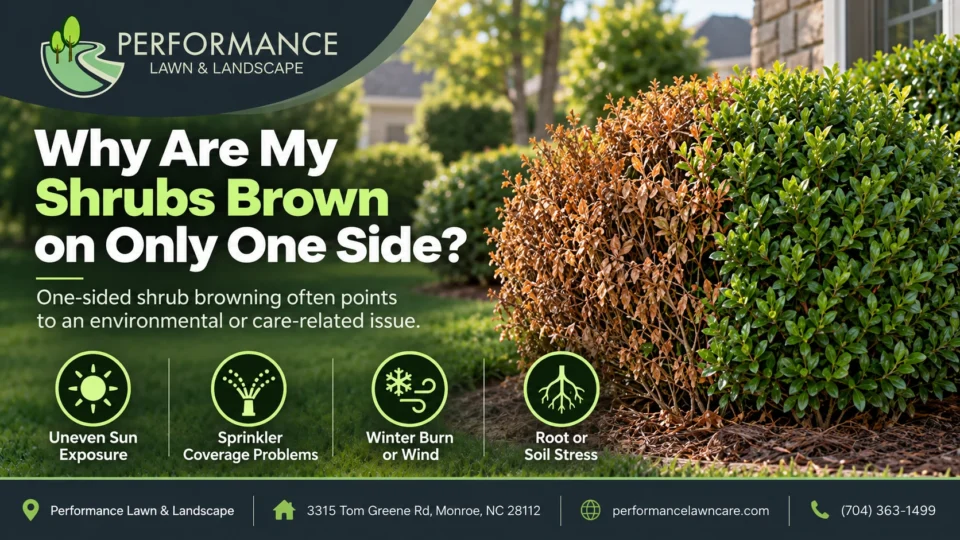
When a shrub turns brown on only one side, the cause is often something affecting that particular part of the plant, such as intense sunlight, uneven irrigation, wind exposure, trimming damage, pests, or disease. The pattern of browning can provide useful clues about what is happening.
Before assuming the shrub is dying, look closely at where the damage starts, how quickly it appeared, and whether the affected branches are still alive. Many cases of uneven browning can be corrected once the underlying stress is identified.
Why Are My Shrubs Brown on Only One Side?
One-sided browning usually means conditions are different on the damaged side of the shrub.
A shrub growing beside a house, driveway, fence, lawn, or neighboring plant may experience dramatically different conditions from one side to the other. One half might receive six hours of direct afternoon sun while the opposite side stays shaded. An irrigation head may reach one side but barely wet the other.
Common causes include:
- Strong afternoon sunlight or reflected heat
- Uneven sprinkler or drip irrigation coverage
- Drying winds
- Recent hedge trimming or pruning
- Spider mites, scale insects, or other pests
- Cankers, root problems, or fungal diseases
- Physical damage to stems or roots
- Winter or seasonal weather injury
The location of the brown foliage is often more informative than the color itself. For example, browning on the exposed exterior of a hedge suggests a different problem from a single brown branch extending deep into otherwise healthy growth.
Can Too Much Sun or Heat Cause One-Sided Browning?
Yes. Sun and heat stress can cause foliage on the most exposed side of a shrub to turn yellow, bronze, tan, or brown.
This often happens when the affected side faces strong afternoon sun or is positioned beside something that reflects additional heat, such as pavement, brick, stone, siding, or a light-colored wall.
Heat increases the amount of moisture leaves lose. If the plant’s roots cannot replace that moisture quickly enough, leaf tips and margins may begin drying.
Look for a pattern such as:
- Browning concentrated on the sunniest side
- Dry or crispy leaf edges
- Damage appearing during or shortly after hot weather
- Healthier foliage deeper inside the shrub
- Greater damage near pavement, walls, or other heat-reflecting surfaces
A similar pattern can occur during winter. Extension guidance notes that evergreen winter injury is frequently worse on sides exposed to sun and wind because foliage loses moisture faster than roots can replace it.
Sun exposure does not automatically mean the shrub was planted in the wrong location. Extended heat, drought, reflected heat, and limited soil moisture can sometimes overwhelm plants that normally tolerate sunny conditions.
How Does Uneven Irrigation Affect Shrub Health?
Uneven watering is one of the first things worth checking when only part of a shrub or hedge is declining.
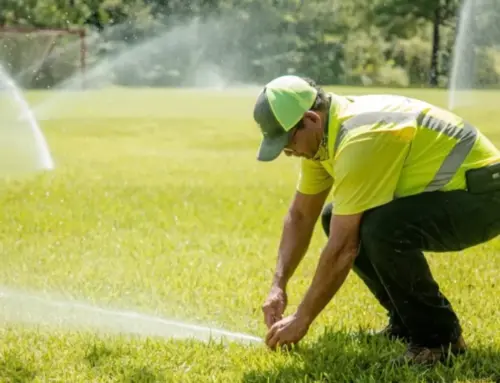
Sprinkler systems do not always distribute water as evenly as they appear to. A sprinkler head may be clogged, misaligned, blocked by another plant, or positioned so most of its water falls on the lawn instead of the shrub’s root zone.
Drip irrigation can develop similar problems if:
- An emitter becomes clogged
- A drip line has moved away from the root zone
- One emitter releases significantly less water
- Roots have expanded beyond the original watering area
- Part of the soil drains much faster than the rest
Do not diagnose water stress simply by looking at the surface. Push a screwdriver or soil probe several inches into the soil around multiple sides of the shrub. If one side is consistently dry while another remains moist, irrigation coverage deserves a closer look.
Too much water can also cause problems. Saturated soil limits oxygen around the roots and can contribute to root decline. Poor drainage and excessive moisture are also associated with several shrub root diseases.
Rather than increasing watering automatically because foliage is brown, determine what the soil is actually doing first.
Can Wind Exposure Cause Shrubs to Turn Brown?
Yes. A side that repeatedly faces strong wind can lose moisture faster than the protected side.
Evergreen shrubs can be especially noticeable because they retain foliage throughout periods when drying winds occur. Wind exposure combined with sunlight can cause foliage to dry faster than the roots can supply replacement moisture. Extension resources identify wind and sun exposure as common contributors to evergreen browning and desiccation.
Wind damage may appear as:
- Brown tips on exposed branches
- Dry foliage facing an open yard, street, or field
- Damage concentrated above a fence or wall
- Healthy foliage on the protected side
- Repeated damage in approximately the same location
Sometimes homeowners notice this problem after nearby trees, fences, or structures are removed. A shrub that previously grew in a protected environment may suddenly be exposed to significantly more wind and sunlight.
Newly planted shrubs can be particularly sensitive because their root systems have not yet expanded enough to access moisture from a large area.
Can Trimming Stress Cause Uneven Browning?
Trimming can contribute to uneven browning, particularly when one section has been cut harder than another or pruning exposes previously shaded foliage to stronger sun and heat.
A heavily sheared hedge may look green on the outside but contain older, shaded foliage underneath. Removing too much exterior growth at once can suddenly expose that interior section.
Timing also matters.
Different shrubs respond differently to pruning. For example, the University of Minnesota Extension notes that pruning requirements vary substantially among evergreen species, and some conifers should not be cut back beyond areas capable of producing new growth.
Look for:
- Browning that appeared shortly after trimming
- Damage following the exact shape of a pruning cut
- Bare stems underneath the outer foliage
- One side having been trimmed significantly harder
- Torn or damaged branches
Avoid immediately trimming the shrub again simply because some foliage turned brown. Additional cutting can make diagnosis more difficult and may remove living tissue the plant could have used for recovery.
What Pest Problems Can Cause One-Sided Damage?
Pests do not always spread evenly across a shrub.
An infestation may begin on a few branches, particularly where conditions are warmer, drier, more sheltered, or otherwise favorable to the pest.
Two problems worth checking for are spider mites and scale insects.
Spider mites feed by piercing plant tissue and can cause stippling, dull coloration, browning, premature leaf or needle drop, and eventual branch decline. Some species affect commonly planted shrubs such as junipers, arborvitae, azaleas, camellias, and hollies.
Scale insects attach to foliage, twigs, or stems and remove plant sap. Heavy infestations can result in yellow foliage, reduced vigor, branch dieback, and gradual decline.
When examining the brown side, look closely for:
- Tiny bumps attached to stems or leaves
- Fine webbing
- Small pale or yellow speckles
- Sticky residue
- Black sooty material on leaves
- Bags or cases hanging from branches
- Chewed or distorted foliage
- Unusual insects underneath leaves
Do not treat a brown shrub with an insecticide simply because insects seem possible. Browning caused by drought, disease, root stress, or weather injury will not improve with unnecessary pest treatments.
Identifying the pest first is much more useful.
Can Plant Disease Cause Localized Browning?
Yes. Certain diseases can affect an individual branch or section before symptoms spread elsewhere.
Canker diseases are a good example. A canker can damage the water-conducting tissue of a branch. Foliage beyond the damaged area may wilt, brown, and die while nearby branches remain green.
Botryosphaeria canker, which affects numerous woody ornamentals, can produce sunken or dark areas on stems, discolored wood beneath the bark, wilting leaves, and progressive branch dieback. Drought-stressed and wounded plants can be particularly susceptible.
Other disease symptoms may include:
- Circular or irregular leaf spots
- Blackened stems
- Sunken areas on branches
- Unusual discoloration beneath the bark
- White or gray fungal growth
- Premature leaf drop
- Several branches dying progressively
- Rapidly expanding areas of damage
Some vascular diseases can even cause symptoms predominantly on one side of a plant because they interfere with water movement through specific portions of the vascular system.
Disease identification can become complicated because drought stress, root damage, insects, and disease often produce similar-looking symptoms.
How Can You Tell Water Stress From Disease?
The easiest approach is to look at the entire pattern rather than relying on one symptom.
Water stress commonly follows environmental conditions. Browning may appear after prolonged heat, missed irrigation, sprinkler problems, transplanting, or unusually dry weather.
Disease is more likely when you see additional abnormalities such as lesions, cankers, spotted foliage, discolored wood, unusual fungal growth, or progressive branch-by-branch dieback.
Signs that point more toward water or environmental stress:
- Soil is consistently dry
- Damage corresponds with the sunniest or windiest exposure
- Leaf edges are uniformly dry or scorched
- Several nearby plants show similar stress
- Damage followed a period of extreme heat or drought
- Irrigation coverage is visibly uneven
Signs that may point toward disease:
- Individual branches die suddenly
- Bark is sunken, cracked, or discolored
- Spots or lesions appear on leaves
- Wood beneath the bark looks abnormally dark
- Browning continues despite appropriate soil moisture
- Damage spreads from one branch to neighboring branches
It is also possible for both problems to occur together. Environmental stress can weaken a shrub and make it more vulnerable to disease or insect damage. Clemson Extension, for example, identifies drought and general plant stress as important factors associated with several diseases affecting landscape shrubs.
When Can a Brown Shrub Recover?
A shrub’s ability to recover depends on whether the branches themselves are still alive.
Brown leaves or needles generally will not turn green again. Recovery occurs when living branches and buds produce new growth.
You can perform a simple check by gently scratching a very small section of bark on a questionable twig with a fingernail. Green, moist tissue underneath generally indicates living tissue. Dry, brittle brown tissue often indicates that portion of the branch has died.
Before removing large sections, however, consider the shrub species and season. Some evergreens recover slowly, and damage that looks severe immediately after winter or another stressful period may be easier to evaluate once new growth begins.
Recovery is more likely when:
- Browning is limited to foliage rather than major stems
- Buds remain healthy
- Most of the shrub is still green
- Roots remain healthy
- The original stress can be corrected
- Dieback is not continuing to spread
If major stems, the root crown, or a significant portion of the root system has been compromised, recovery becomes less predictable.
When Should You Have the Shrub Professionally Evaluated?
Professional evaluation makes sense when the cause is unclear or when the browning continues despite correcting obvious problems.
It is especially worthwhile when:
- Browning is spreading rapidly
- Multiple shrubs are developing similar symptoms
- Large branches are dying
- The shrub has noticeable cankers or bark damage
- Soil remains wet for long periods
- Irrigation coverage appears inconsistent
- Insect activity is suspected but unidentified
- A valuable mature shrub is declining
- More than one potential problem appears to be involved
An experienced landscape professional can evaluate more than the foliage. Plant placement, drainage, soil moisture, irrigation coverage, root-zone conditions, pruning history, pest activity, and surrounding landscape features may all provide clues.
That broader inspection is often important because treating the visible brown foliage without correcting the reason it developed rarely solves the problem.
A Brown Side Does Not Always Mean a Dying Shrub
Seeing one side of a favorite shrub turn brown can make it look as though the entire plant is on its way out. Fortunately, uneven browning often gives you a fairly useful clue: something may be different on that particular side of the plant.
Start by comparing sunlight, soil moisture, irrigation coverage, wind exposure, and recent trimming. Then inspect the leaves and branches closely for insects, spotting, cankers, or other unusual symptoms.
The goal is to identify the cause before deciding on the solution.
At Performance Lawn & Landscape, we help homeowners look beyond the obvious symptoms and evaluate the landscape conditions contributing to plant decline. If your shrubs are browning unevenly, losing branches, or simply do not look as healthy as they should, a professional landscape assessment can help determine the next practical step.
FAQs
Why is only half of my bush turning brown?
One half may be receiving different sunlight, water, wind, or heat exposure. Localized pest infestations, branch damage, and certain diseases can also cause one section of a shrub to decline while the rest remains healthy.
Should I cut the brown side off my shrub?
Not immediately. First determine whether the branches are actually dead and what caused the browning. Removing dead wood may eventually be appropriate, but unnecessary pruning can remove living buds and make recovery more difficult.
Will brown shrub leaves turn green again?
Usually not. Once plant tissue has died and turned completely brown, that particular foliage will generally remain brown. A surviving shrub can still recover by producing healthy new foliage from living buds and branches.
Can sprinklers cause shrubs to brown on one side?
Yes. A blocked, damaged, poorly positioned, or misaligned sprinkler can leave part of a shrub’s root zone substantially drier than the rest. Checking soil moisture around several sides of the plant can help reveal uneven irrigation.
How do I know if my shrub has spider mites?
Look for tiny pale speckles, bronze or grayish foliage, premature leaf or needle drop, and sometimes fine webbing. Because mites are extremely small, shaking a branch over a sheet of white paper can sometimes make moving mites easier to see. Clemson Extension recommends identifying the pest before beginning treatment.
Can a shrub come back after one side dies?
Possibly. If the roots, main stems, and enough healthy branches remain alive, some shrubs can produce new growth and gradually fill in. Recovery depends on the species, severity of damage, and whether the original cause has been corrected.