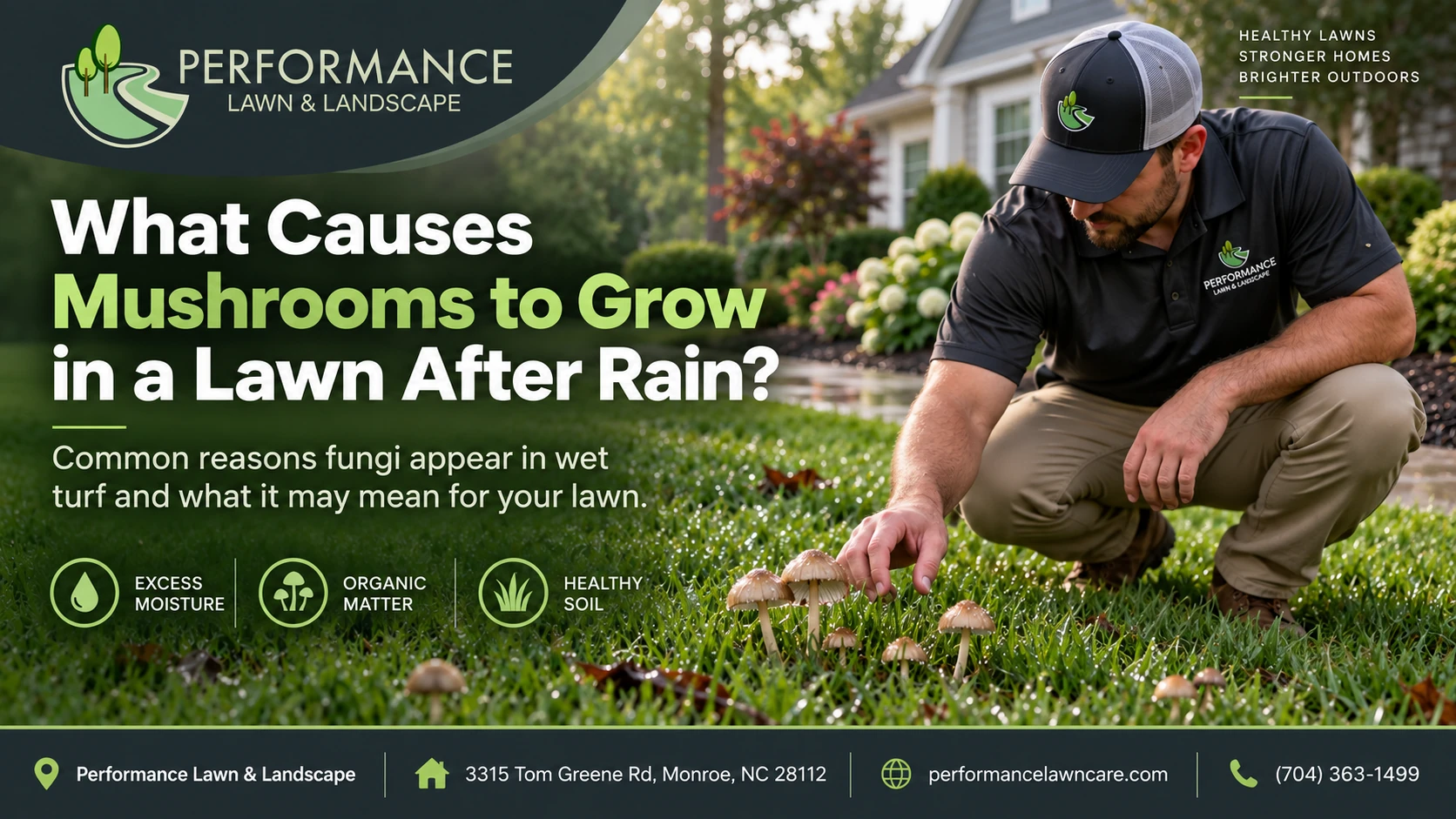
Mushrooms often appear in lawns after rain because wet soil, humid conditions, and decaying organic matter create an ideal environment for fungi to grow. In many cases, the mushrooms themselves are only the visible part of a much larger fungal network already living in the soil.
Seeing mushrooms does not automatically mean your lawn is unhealthy or diseased. Fungi play a natural role in breaking down dead roots, leaves, wood, and other organic material. However, repeated mushroom growth in the same areas can sometimes point to excess moisture, poor drainage, buried organic matter, or other lawn conditions worth investigating.
Why Do Mushrooms Appear in a Lawn After Rain?
Rain provides the moisture fungi need to produce mushrooms.
Many fungi live quietly in soil for long periods without producing visible mushrooms. After several days of rain or high humidity, conditions may become favorable enough for fruiting bodies to emerge above the grass.
Mushrooms are especially common when:
- Soil remains damp for extended periods
- Temperatures are mild or warm
- Humidity stays high
- Organic material is decomposing underground
- Grass receives frequent irrigation
- Shaded areas dry slowly
The mushrooms may appear suddenly and disappear just as quickly once the lawn dries.
Their presence often reflects temporary environmental conditions rather than a new problem that developed overnight.
How Moisture Encourages Mushroom Growth
Moisture is one of the biggest factors behind mushroom activity.
Fungi need water to grow and reproduce. After rainfall, the soil may stay moist long enough for fungal networks below the surface to become more active.
Areas that remain wet longer than the rest of the lawn are especially likely to produce mushrooms.
These areas may include:
- Low spots
- Shaded sections
- Soil near downspouts
- Poorly drained areas
- Places with heavy thatch
- Irrigated zones that receive too much water
- Areas beside patios or retaining walls where runoff collects
A single flush of mushrooms after heavy rain is usually not unusual.
Repeated growth in the same soggy area, however, may indicate that the lawn is staying wet longer than it should.
What Role Does Organic Matter Play?
Fungi feed on organic material.
In lawns, that material can include:
- Dead grass roots
- Leaves
- Thatch
- Old tree roots
- Buried wood
- Decaying mulch
- Stumps
- Animal waste
- Other decomposing plant material
Mushrooms often appear where fungi are breaking this material down.
This is why mushroom growth sometimes becomes noticeable after a tree has been removed. Roots can remain underground for years, slowly decomposing and providing food for fungi.
Similarly, buried construction wood or old landscaping debris can support recurring mushroom growth in one specific area.
The mushrooms may continue appearing periodically until much of the underground material has decomposed.
Do Lawn Mushrooms Mean the Soil Is Unhealthy?
Not necessarily.
Fungal activity is a normal part of healthy soil. Fungi help break down organic material and recycle nutrients.
A few mushrooms appearing after rain can simply mean the soil contains organic matter and enough moisture for fungi to become active.
However, mushroom growth can sometimes help reveal other conditions.
For example, large numbers of mushrooms repeatedly appearing in one area may suggest:
- Excess soil moisture
- Poor drainage
- Overwatering
- Heavy shade
- Buried organic debris
- A decomposing root system
The mushrooms themselves may not be the problem. They can simply be a visible clue about what is happening below the surface.
Can Mushrooms Damage or Kill Grass?
Most mushrooms that appear in lawns do not directly kill healthy grass.
They usually grow among the turf while feeding on decomposing organic material underground.
Grass problems may still occur in the same area, but the mushrooms are not necessarily responsible.
For example, excess moisture that encourages mushrooms can also contribute to:
- Weak root development
- Soil compaction
- Thinning turf
- Poor oxygen availability
- Certain turf diseases
Some fungal growth patterns, such as fairy rings, can also affect grass appearance by producing unusually green, thin, or damaged rings in the lawn.
If the turf remains healthy and mushrooms only appear temporarily after rain, there may be little reason for concern.
Are Lawn Mushrooms a Sign of Lawn Disease?
Not always.
Mushrooms and lawn disease both involve fungi, but they are not the same thing.
Many mushrooms grow because fungi are decomposing dead organic material rather than attacking living grass.
Lawn disease is more likely when you notice symptoms such as:
- Brown or yellow patches
- Circular areas of damaged turf
- Rapidly thinning grass
- Discolored grass blades
- Dead patches that continue expanding
- Unusual growth directly on grass blades
Mushrooms appearing without turf damage are more likely related to moisture and decomposition.
Applying fungicide simply because mushrooms are present may not solve the underlying issue, especially when moisture or buried organic matter is responsible.
How Can You Safely Remove Mushrooms From a Lawn?
If mushrooms are unwanted, they can usually be removed manually.
You can:
- Pick them by hand while wearing gloves
- Rake them up
- Mow them before they fully mature
- Dispose of them with yard waste where permitted
Removing mushrooms does not eliminate the fungal network below the soil, so new mushrooms may still appear when conditions become favorable again.
If children or pets use the lawn, removing unfamiliar mushrooms promptly is a sensible precaution because some mushroom species can be toxic if eaten.
Avoid relying on appearance alone to determine whether a mushroom is safe.

When Do Mushrooms Indicate a Drainage Problem?
Mushrooms may point to drainage concerns when they repeatedly appear in areas that stay wet for long periods.
Watch for other signs such as:
- Standing water
- Soil that feels soft or soggy
- Water remaining several days after rain
- Grass thinning in wet areas
- Moss developing nearby
- A musty smell
- Water flowing into the lawn from another area
Drainage problems may be related to:
- Poor grading
- Compacted soil
- Low areas
- Heavy soil
- Downspout discharge
- Irrigation leaks
- Excess watering
- Blocked drainage systems
If mushrooms appear across the entire lawn only after major rain, drainage may not be a concern.
If they continually return in the same wet section while the rest of the yard dries normally, that area deserves closer inspection.
How Can You Reduce Repeated Mushroom Growth?
Because mushrooms depend on moisture and organic material, reducing the conditions that favor them can make repeated growth less likely.
Helpful steps may include:
- Avoiding unnecessary irrigation
- Watering early enough for the lawn to dry during the day
- Correcting low areas where water collects
- Improving drainage
- Removing excessive thatch
- Clearing fallen leaves and debris
- Removing decaying stumps where appropriate
- Improving airflow and sunlight where practical
- Fixing leaking irrigation equipment
If buried roots or wood are the main food source, mushroom activity may continue until the organic material decomposes.
It is usually more practical to manage moisture and lawn conditions than to try to eliminate all fungi from the soil.
When Should You Have the Lawn Professionally Evaluated?
Professional assessment may be useful when mushroom growth occurs alongside other lawn problems.
Consider having the lawn evaluated if:
- Mushrooms repeatedly return in the same location
- The soil remains soggy between rain events
- Standing water is common
- Grass is thinning or dying
- The lawn smells unusually musty
- You suspect an irrigation leak
- Large rings or unusual turf patterns appear
- Drainage problems are getting worse
- You are unsure whether the issue is fungal disease or excess moisture
A lawn professional can look at the entire area instead of treating the mushrooms as an isolated problem.
At Performance Lawn & Landscape, we can evaluate drainage, irrigation, soil conditions, turf health, and other factors that may be contributing to repeated mushroom growth. The goal is to determine whether the mushrooms are simply responding to normal wet weather or revealing a lawn condition that needs attention.
FAQs
Why do mushrooms suddenly grow overnight after rain?
The fungal network may already be present underground. Rain, humidity, and suitable temperatures can trigger the fungus to produce visible mushrooms very quickly.
Will mowing mushrooms spread them?
Mowing can scatter mushroom pieces and spores, but fungi are already widespread in soil and the surrounding environment. Removing mushrooms before mowing can help keep the lawn looking cleaner, but it usually will not eliminate the fungus underground.
Does overwatering cause mushrooms?
It can contribute. Frequent watering keeps soil moist, which can create favorable conditions for mushroom production, especially when organic material is available.
Should I use fungicide to get rid of lawn mushrooms?
Usually not as a first step. Most lawn mushrooms are associated with decomposing organic material rather than a turf disease. Addressing excess moisture, drainage, irrigation, and organic debris is often more useful.
Why do mushrooms keep growing where a tree used to be?
Old tree roots may still be decomposing underground. Fungi feed on that wood, so mushrooms can continue appearing around the former tree location for years as the roots gradually break down.
Are mushrooms harmful to pets?
Some wild mushrooms can be toxic if eaten. Because identification can be difficult, it is safest to remove mushrooms from areas where pets or young children may ingest them.
Do mushrooms mean my lawn has too much thatch?
Not always. Thatch can contribute to moisture retention and provide organic material, but mushrooms may also be associated with old roots, buried wood, wet soil, or other decomposing material.
When should I be concerned about mushrooms in my lawn?
Concern is more warranted when mushrooms are accompanied by persistent soggy soil, standing water, thinning grass, unusual rings, recurring turf damage, or other signs of drainage or lawn health problems.