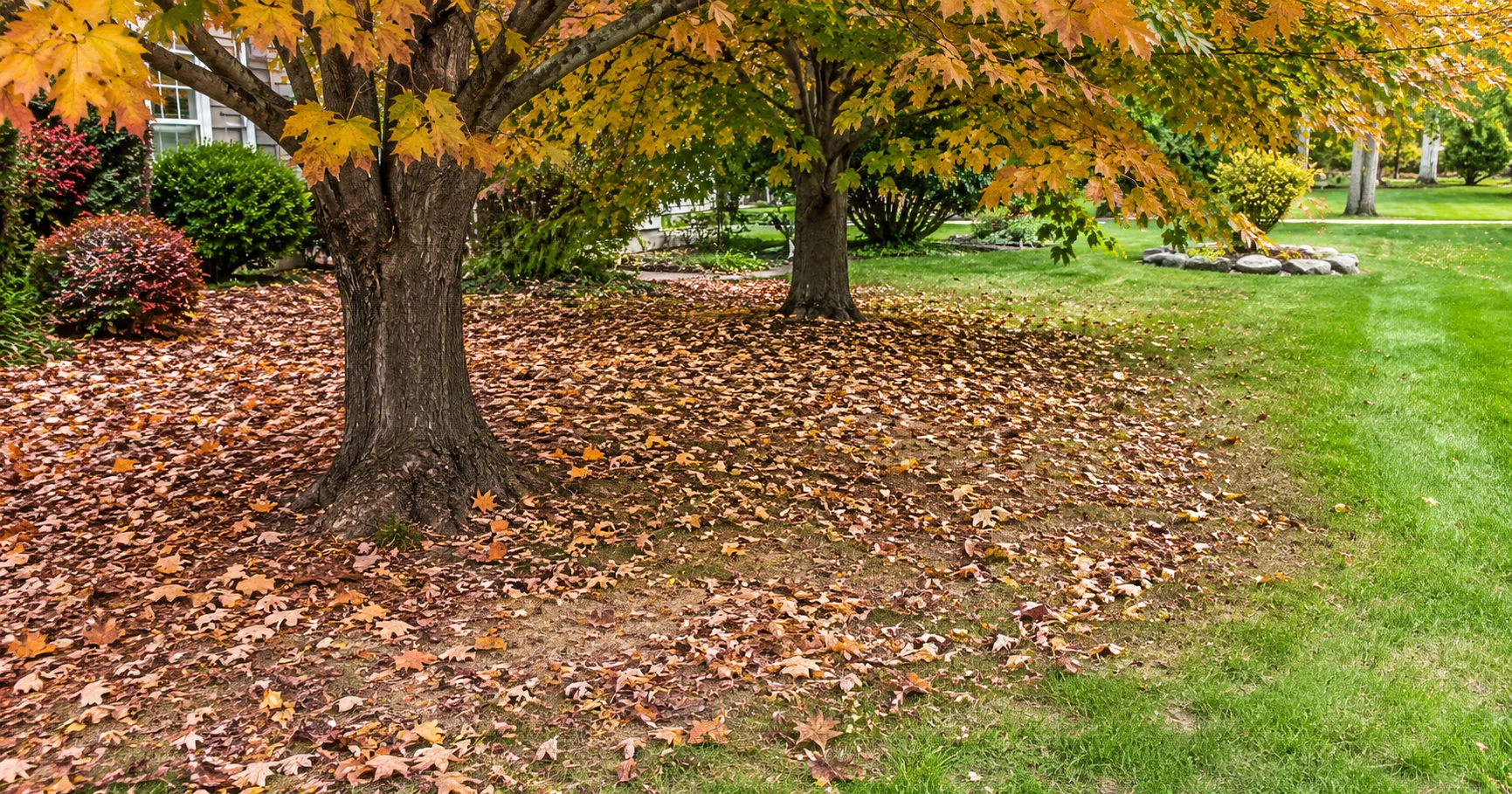
A few fallen leaves on your lawn are usually nothing to worry about. But when leaves start piling up beneath your trees, they can create problems for the grass growing underneath. Thick, wet layers block sunlight, hold moisture, and make it harder for already shaded turf to stay healthy.
If you’ve noticed yellow patches, thinning grass, or bare spots under your trees, fallen leaves could be contributing to the problem. The good news is that you don’t need to remove every leaf to protect your lawn. Knowing when to mulch, clear, or leave them alone can make a real difference.
Quick Answer: Can Leaves Smother Grass?
Yes, thick layers of fallen leaves can smother grass by blocking sunlight, limiting air movement, and trapping moisture against the turf. Grass growing beneath trees is especially vulnerable because it already receives less sunlight. Light leaf coverage is usually harmless, but dense, wet, or compacted leaves should be mulched or removed before they weaken the lawn.
How Thick Leaf Cover Blocks Light and Air
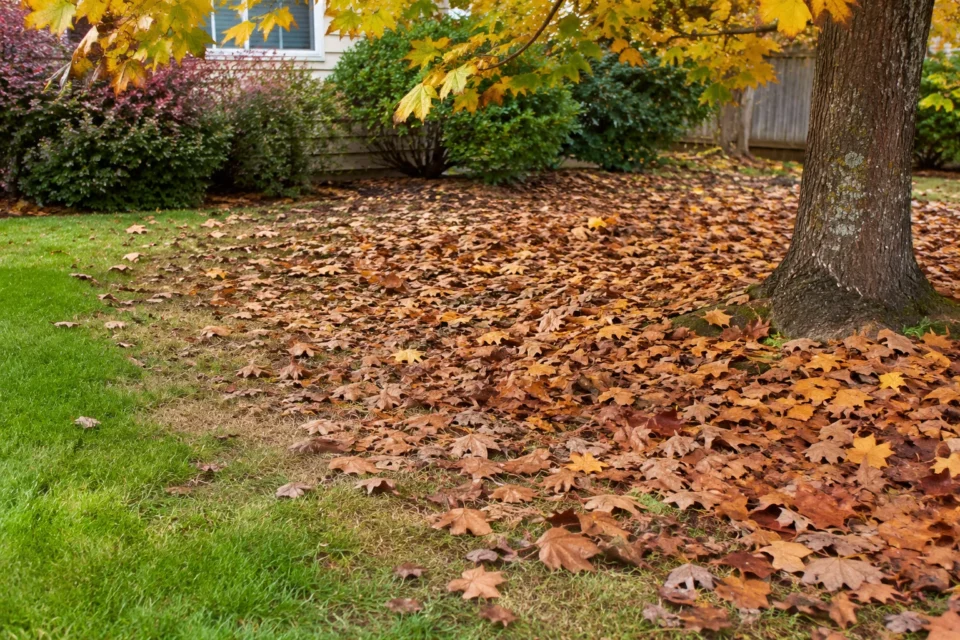
Grass needs sunlight to produce the energy required for healthy growth. When fallen leaves accumulate across the lawn, they create a barrier between the grass and the light it needs.
A few scattered leaves generally won’t cause much harm. Problems develop when several layers overlap, particularly after rain causes them to settle into a dense mat.
Heavy leaf coverage can affect your lawn in several ways:
- Reduced sunlight: Covered grass cannot photosynthesize as effectively, gradually weakening its growth.
- Restricted air circulation: Compacted leaves limit airflow around grass blades and create a damp environment.
- Slower drying: Moisture remains trapped between leaves and grass instead of evaporating normally.
- Physical pressure: Dense layers can flatten grass blades and interfere with upright growth.
The amount of damage depends on how thick the leaf cover becomes and how long it stays in place.
According to NC State Extension’s guidance on managing grass in shaded areas, accumulated leaves can form a mat that restricts light, air, and water movement, particularly affecting newly established turf.
NC State Extension Publications
Why Grass Under Trees Is Already More Vulnerable
Grass growing under trees faces different conditions than grass in open areas.
Tree canopies reduce the amount of direct sunlight reaching the ground. At the same time, tree roots compete with grass for available water and nutrients.
Even a well-maintained lawn may struggle beneath large, mature trees.
Several factors make these areas particularly sensitive to leaf buildup.
Limited sunlight
Shaded grass receives less energy for growth and recovery. Adding a thick layer of fallen leaves reduces that light even further.
Some grasses tolerate shade better than others. For example, tall fescue generally handles moderate shade better than bermudagrass, which performs best with abundant sunlight.
Competition for water and nutrients
Tree roots and grass roots often occupy overlapping areas of soil. During dry conditions, this competition can leave turf stressed and less capable of recovering from additional damage.
Slower growth and recovery
Grass in shaded locations often grows less vigorously. When leaf coverage damages its blades, it may take longer to recover than grass growing in a sunnier part of your yard.
This is why homeowners sometimes notice healthy grass across most of their property but persistent thinning directly beneath their trees.
Leaves may be contributing to the problem, but shade and root competition can also be significant factors.
How Trapped Moisture Can Damage Turf
Wet leaves are usually more concerning than dry, scattered leaves.
After rainfall, fallen leaves absorb moisture and settle against the grass. If the leaf layer is thick enough, the ground underneath may remain damp even after surrounding areas have dried.
This creates several potential problems.
Prolonged leaf wetness
Grass blades that stay wet for extended periods may become more susceptible to certain fungal diseases, especially when weather conditions favor infection.
Reduced drying beneath the canopy
Shaded areas receive less direct sunlight, which can slow evaporation. Dense leaf coverage makes drying even more difficult.
Soft, matted grass
Grass pressed beneath wet leaves may become flattened, discolored, and weakened.
However, moisture alone doesn’t necessarily mean your lawn is unhealthy. Grass needs water to survive, and a thin layer of chopped leaves can be beneficial.
The concern is prolonged moisture combined with reduced sunlight and poor air movement.
If leaves feel soggy, stick together, or form a continuous layer that hides the grass, it’s a good time to clear or mulch them.
Can Leaves Encourage Lawn Disease?
Yes. Heavy leaf buildup can create conditions that favor certain lawn diseases, although leaves themselves do not automatically cause an infection.
Many turf diseases develop when susceptible grass, disease-causing organisms, and favorable environmental conditions occur together.
A thick layer of leaves can contribute to those conditions by keeping grass damp for longer periods.
Watch for symptoms such as:
- Yellowing or browning grass beneath leaf-covered areas
- Irregular patches that continue expanding after leaves are removed
- Matted grass that does not return to its normal position
- Thin or weakened turf in consistently damp locations
- Unusual discoloration affecting individual grass blades
These signs don’t necessarily confirm a fungal disease. Shade stress, poor drainage, dormancy, and other lawn problems can produce similar symptoms.
Removing excess leaves may improve growing conditions, but it won’t necessarily resolve an established disease.
If discoloration continues spreading after the lawn has been cleared, a professional assessment can help determine what is actually affecting the grass.
Is Mulching Leaves Better Than Removing Them?
Both mulching and removing leaves can protect your lawn. The better option depends on how many leaves have fallen and whether your grass can remain visible beneath them.
When mulching makes sense
Mulching involves using a lawn mower to chop fallen leaves into small pieces.
These pieces can settle between grass blades and gradually decompose, returning organic matter and some nutrients to the soil.
Mulching works best when:
- Leaves are relatively dry.
- The coverage is light to moderate.
- Your mower can shred them into fine pieces.
- The chopped leaves settle between grass blades instead of forming a thick layer.
- The grass remains visible after mowing.
You may need more than one mowing pass to break leaves into sufficiently small pieces.
When leaf removal is better
Removing leaves becomes the better choice when the amount of debris exceeds what your lawn can reasonably absorb.
Consider removal when:
- Thick layers completely cover the grass.
- Leaves are wet, packed together, or difficult to shred.
- Multiple mowing passes still leave large clumps.
- Grass beneath the trees is already thin or stressed.
- Newly seeded areas are covered.
A useful rule is to look at the lawn after mulching. If the grass is visible and chopped leaves are scattered between the blades, the coverage is generally manageable.
If the surface remains buried, remove the excess material.
You don’t need to choose one method for your entire property. Mulching may work well in open areas while heavier buildup beneath mature trees requires removal.
How Often Should Leaves Be Cleared From the Lawn?
There isn’t one perfect schedule for every yard.
The appropriate frequency depends on how quickly leaves fall, the types of trees on your property, rainfall, and the condition of your grass.
For homeowners dealing with leaves smothering grass under trees, the most practical approach is to monitor coverage rather than follow a rigid calendar.
Consider these general guidelines:
- Light leaf fall: Check the lawn during regular mowing and mulch leaves when necessary.
- Moderate leaf fall: Inspect shaded areas weekly during peak leaf drop.
- Heavy leaf fall: Clear accumulating layers more frequently, especially after windy weather.
- Wet conditions: Pay closer attention to piles that become compacted after rain.
- Newly seeded lawns: Remove leaf coverage more carefully and frequently to protect emerging seedlings.
In Wesley Chapel, NC, many deciduous trees shed leaves throughout autumn. The timing and volume can vary depending on tree species and weather.
A property with several mature hardwood trees may need more frequent attention than a yard with only a few smaller trees.
The important thing is to prevent leaves from remaining in thick, damp layers for extended periods.
What Happens If Leaves Stay on Grass Too Long?
When heavy leaf cover remains undisturbed, damage can gradually become more noticeable.
The first signs may be subtle. Grass can appear flattened or slightly yellow after the leaves are removed.
If unfavorable conditions continue, the damage may progress.
Grass begins to thin
With less sunlight available, grass produces less energy for growth. Weakened blades may gradually die, reducing turf density.
Bare patches develop
When grass remains covered for too long, some areas may die completely.
These bare patches can become more noticeable during spring green-up or as surrounding grass resumes active growth.
Weeds may establish
Thin turf provides less competition against opportunistic weeds. Once bare soil is exposed, weed seeds may have an easier time establishing.
Recovery becomes more difficult
Grass that has only been temporarily flattened may recover on its own.
However, grass that has died will need to be replaced through appropriate seeding, sod installation, or natural spreading, depending on the turf species.
The longer damaging conditions persist, the greater the possibility that simple leaf removal won’t be enough to restore the lawn.
How to Help Damaged Turf Recover
If you’ve already discovered yellow or bare patches beneath your trees, don’t assume the entire area needs to be replaced.
Start by identifying how much damage has occurred and whether the remaining grass is still alive.
- Remove excess leaves carefully.
Clear thick debris without aggressively scraping the soil or pulling out weakened grass. A lightweight rake or leaf blower may be appropriate, depending on turf condition.
- Give the grass time to recover.
Once the covering is removed, surviving grass may regain its color and upright growth during its active growing season.
Keep in mind that warm-season grasses may naturally turn brown during winter dormancy.
- Check moisture and drainage.
Examine whether the soil remains consistently wet or whether water collects beneath the tree.
Avoid unnecessary watering when the ground is already moist.
- Evaluate sunlight exposure.
If the location receives very little sunlight throughout the growing season, leaf removal alone may not solve the problem.
A shade-tolerant grass variety or a different landscape design may be more appropriate.
- Repair bare areas at the right time.
If grass has died, repair methods should match the existing turf and season.
For example, fall is typically a suitable establishment period for tall fescue in North Carolina, while warm-season grasses such as bermudagrass and zoysiagrass are generally established during warmer months.
- Consider alternatives beneath dense tree canopies.
Some areas simply don’t receive enough sunlight to support healthy turf.
In these locations, a properly maintained mulch bed or shade-tolerant planting may be more sustainable than repeatedly reseeding grass.
Keep mulch away from direct contact with tree trunks and avoid burying exposed root flares.
The goal isn’t necessarily to grow grass beneath every tree. It’s to create ground coverage that suits the conditions and protects your landscape.
Leaf Removal in Wesley Chapel, NC
Fallen leaves are a normal part of the changing seasons, but managing them properly can make a significant difference in your lawn’s health.
Here in Wesley Chapel, properties with mature shade trees can experience uneven leaf buildup. Open areas may remain relatively clear while dense piles accumulate beneath trees, along fence lines, and in sheltered parts of the yard.
At Performance Lawn & Landscape, we help homeowners manage these conditions through lawn maintenance and leaf removal services.
Our team can assist with clearing excess leaf coverage, maintaining healthy turf, and addressing lawn areas that need additional care.
Whether your grass is beginning to thin beneath a large tree or you’re trying to prevent recurring damage, we’ll help you determine a practical approach for your property.
We provide leaf removal services and ongoing lawn care maintenance for Wesley Chapel and surrounding communities.
Performance Lawn Care+2
Contact Performance Lawn & Landscape at 704-363-1499 to discuss your lawn’s needs and request a quote.
FAQs About Leaves Smothering Grass
Will grass grow back after being covered by leaves?
Grass may recover if the leaves have only caused temporary stress. Remove the covering and allow surviving turf to receive adequate light and air. If the grass has died completely, the affected area may need reseeding or other restoration.
How long can leaves stay on grass before causing damage?
There is no fixed number of days. Light, dry coverage may remain without noticeable harm, while thick, wet layers can cause problems sooner. Leaf depth, moisture, sunlight, and grass health determine the risk.
Should I rake leaves from under every tree?
Not necessarily. Scattered leaves can decompose naturally or be mulched. Focus on areas where leaves form dense piles, cover most of the grass, or remain wet for extended periods.
Can mulched leaves kill grass?
Yes, if too many chopped leaves accumulate and form a thick layer. Properly shredded leaves distributed thinly between grass blades are generally beneficial, but excessive material can still block sunlight and weaken turf.
Why is my grass dying under trees even after I remove the leaves?
Shade, tree-root competition, drainage problems, and unsuitable grass varieties may also contribute to thinning turf. If the lawn continues declining after leaf removal, the growing conditions may need further evaluation.
Is it better to leave fallen leaves on the lawn over winter?
A thin layer of finely mulched leaves can be beneficial. However, thick or compacted leaves should generally be cleared because they can continue blocking light and trapping moisture. The best approach depends on your lawn’s condition and the amount of leaf coverage.
Protecting your grass doesn’t mean keeping every fallen leaf off the ground. It means preventing heavy buildup from creating conditions your lawn can’t tolerate.
If your lawn is developing weak, thin, or bare patches beneath its trees, Performance Lawn & Landscape can help you manage excess leaves and improve the conditions affecting your turf. With the right maintenance, you can protect your grass while keeping the mature trees that make your property attractive.