

Weeds growing in one part of your yard often indicate that the area has different soil, moisture, sunlight, or grass-growing conditions than the rest of the lawn. Compacted soil, poor drainage, excessive shade, and thinning turf can create openings where certain weeds establish more easily. Even when the entire lawn receives the same maintenance, individual sections may respond differently.
Understanding these differences helps homeowners address the actual cause instead of repeatedly treating visible weeds. At Performance Lawn & Landscape, we focus on identifying the conditions that make specific areas vulnerable so lawn care decisions support healthier, more consistent grass growth.
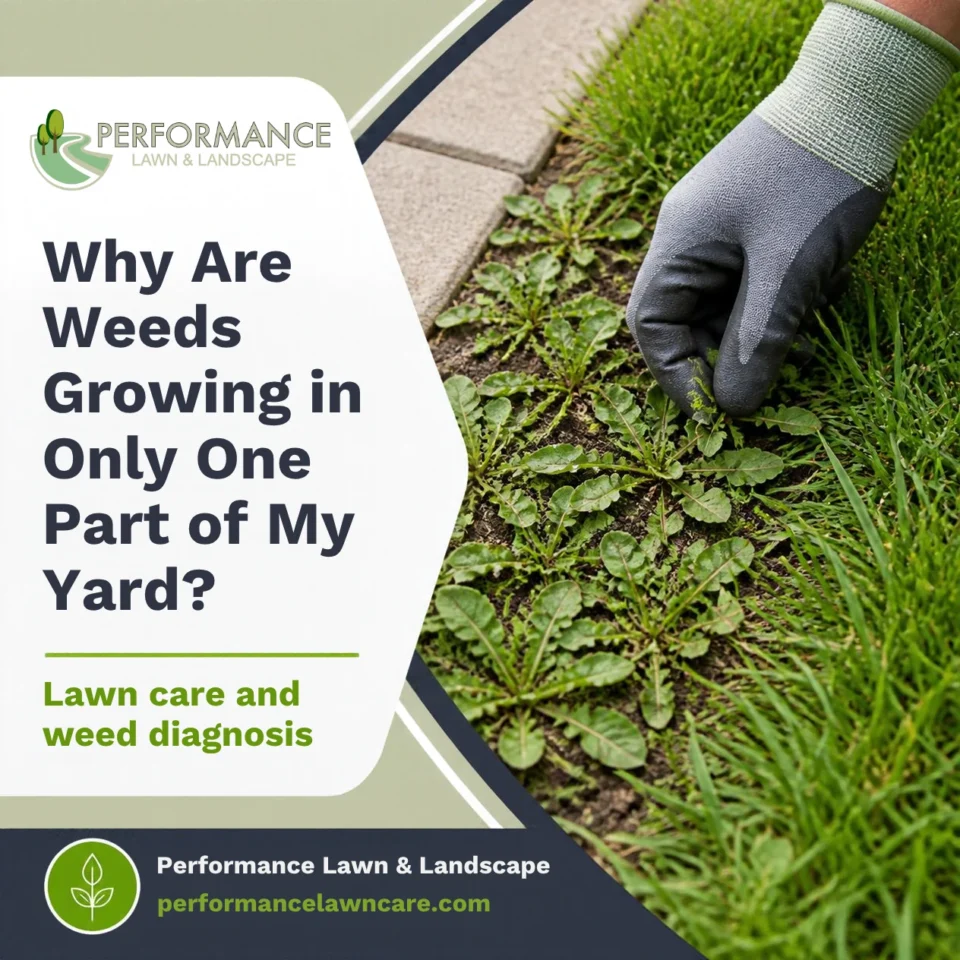
Why Are Weeds Growing in Only One Part of My Yard?
When weeds repeatedly grow in the same section of a lawn, the problem often involves localized growing conditions.
One area may receive less sunlight, retain more moisture, or experience heavier foot traffic than surrounding sections. These differences can weaken desirable grass while creating favorable conditions for certain weed species.
Common causes include:
- Soil compaction: Heavy traffic limits root growth and water movement.
- Poor drainage: Water accumulates in low areas, weakening grass and favoring moisture-tolerant weeds.
- Uneven sunlight: Shade prevents some turfgrass species from growing densely.
- Soil differences: Changes in texture, pH, and nutrient availability affect grass health.
- Thin turf: Bare patches allow weed seeds to germinate with less competition.
- Uneven irrigation: Certain areas receive too much or too little water.
Weeds may also develop in areas disturbed by construction, landscaping changes, or repeated equipment traffic.
The location of the weeds often provides the first clue.
For example, weeds growing near a downspout may suggest excess moisture, while those appearing along a frequently used walkway may indicate soil compaction.
What Can Uneven Weed Growth Reveal About Lawn Conditions?
Uneven weed growth can reveal where your lawn experiences environmental stress.
Different weed species tolerate different growing conditions. Some establish in compacted soil, while others thrive in damp areas or locations where grass receives insufficient sunlight.
Observing where the weeds appear can help narrow down the possible cause.
| Weed Growth Pattern | Possible Underlying Problem |
| Weeds concentrated near downspouts | Excess water or poor drainage |
| Weeds along sidewalks or walking paths | Compacted soil or heat stress |
| Weeds beneath trees | Insufficient sunlight or root competition |
| Weeds in low sections of the yard | Persistent moisture or saturated soil |
| Weeds in thin, dry patches | Drought stress or weak grass coverage |
| Weeds near recently disturbed ground | Exposed soil and new seed germination |
These patterns are diagnostic clues, not definitive evidence.
For example, plantain often grows in compacted soil, while yellow nutsedge may be common in moist areas.
However, neither weed proves that a specific soil problem exists.
The most useful approach is to examine the growing conditions and identify the weeds before selecting a treatment.
Can Soil Differences Cause More Weeds in One Area?
Yes. Soil conditions can vary considerably within a single yard.
One section may contain dense clay, while another has sandy soil, additional organic matter, or compacted fill material.
These differences affect how easily grass roots obtain water, oxygen, and nutrients.
Soil Texture and Structure
Clay-rich soils can retain substantial moisture but may drain slowly when compacted.
Sandy soils generally allow water to move through more quickly, although they may also dry out faster.
Areas containing construction debris or poorly prepared fill soil may restrict grass roots.
When grass struggles to establish, weeds have more opportunities to occupy the available space.
Soil pH and Nutrient Availability
Soil pH affects how readily plants can access certain nutrients.
If one section has unsuitable pH or nutrient levels, the grass may remain thin despite receiving the same fertilizer as the rest of the yard.
However, weeds alone cannot reliably identify a nutrient deficiency.
Applying additional fertilizer without confirming the cause may not improve the situation.
For homeowners around Charlotte and Monroe, North Carolina, examining soil conditions can be particularly useful when one section consistently performs worse than surrounding turf.
How Do Drainage Problems Encourage Weed Growth?
Poor drainage can create conditions where desirable grass struggles while moisture-tolerant weeds continue growing.
Grass roots need oxygen as well as water.
When soil remains saturated for extended periods, oxygen availability decreases and root growth can suffer.
Weak roots make it harder for grass to compete with established weeds.
Common Signs of Drainage Problems
Look for:
- Standing water after rainfall
- Soil that remains wet longer than surrounding areas
- Muddy sections despite several days without rain
- Thin grass in low-lying areas
- Persistent weed growth near downspouts or drainage channels
Certain plants, including yellow nutsedge, may become more noticeable in consistently moist sections.
However, the presence of these plants should prompt further investigation rather than an automatic conclusion.
What Should Homeowners Check?
Observe how water moves during and after rainfall.
Determine whether runoff collects in one area or whether an irrigation system is delivering excessive water.
Check nearby downspouts, sprinkler heads, and landscape grading.
If drainage is the underlying problem, weed control alone will not correct it.
The lawn may also need irrigation adjustments, improved surface drainage, or other site-specific changes.
Can Compacted Soil Create Weed-Prone Areas?
Yes. Compacted soil is a common reason weeds concentrate in frequently used sections of a lawn.
Compaction occurs when pressure compresses soil particles and reduces the pore spaces needed for air and water movement.
This limits root growth and can make it harder for desirable grass to establish.
Areas vulnerable to compaction include:
- Walkways between the house and backyard
- Places where children or pets frequently run
- Lawn sections crossed by maintenance equipment
- Areas near patios and driveways
- Sections disturbed by construction vehicles
Compacted soil can also contribute to surface runoff because water may have difficulty entering the ground.
Some weeds tolerate these conditions better than turfgrass.
Broadleaf plantain, for example, is frequently associated with compacted soil.
Does Aeration Help?
Core aeration can help relieve soil compaction by removing small plugs of soil.
This creates openings that support air and water movement and can improve the growing environment for grass roots.
However, aeration should be scheduled according to the grass species and growing season.
It also may not fully correct severe compaction caused by construction or buried materials.
The underlying source of repeated pressure should be addressed whenever possible.
How Does Sun and Shade Affect Which Weeds Appear?
Sunlight has a significant effect on grass density and weed competition.
Most lawn grasses require adequate light to support photosynthesis and healthy growth.
When one area receives substantially less sunlight, the grass may become thinner and less competitive.
Weeds in Shaded Areas
Sections beneath dense tree canopies or beside buildings may remain shaded for much of the day.
These areas may develop weak grass growth, exposing soil where shade-tolerant weeds can establish.
Ground ivy and certain violets may occur in shaded lawn areas, depending on moisture and other conditions.
Moss may also appear in damp, shaded locations, although moss is not a true weed.
Weeds in Full Sun
Sunny areas can support vigorous grass growth when soil and moisture conditions are suitable.
However, full sunlight also favors certain weeds.
Crabgrass, for example, often establishes in sunny, thin turf where soil is exposed.
What If Grass Cannot Grow in the Shade?
If the area receives too little sunlight for the existing turfgrass species, repeated seeding may provide only temporary results.
A more shade-tolerant grass may be suitable where sufficient light remains.
In heavily shaded sections, an appropriately designed mulched bed or alternative groundcover may be more practical than maintaining turf.
The goal is to select vegetation that matches the location’s conditions.
Can Thin or Stressed Grass Make One Area More Vulnerable?
Yes. Thin grass is one of the most important factors behind localized weed growth.
Healthy, dense turf occupies space and uses resources that weed seedlings also need.
When grass becomes weak or sparse, more sunlight reaches the soil surface, allowing some weed seeds to germinate.
Several conditions may create localized thinning:
- Repeated mowing too short
- Insect or disease damage
- Drought stress
- Excessive foot traffic
- Inconsistent irrigation
- Previous lawn renovation or soil disturbance
For example, an irrigation system may provide adequate water to most of the yard but leave a corner consistently dry.
Grass in that section may thin during hot weather, creating an opportunity for weeds.
Similarly, a shaded area may receive enough water but insufficient sunlight to maintain dense turf.
Treating existing weeds can temporarily improve the appearance of these sections.
However, the area will remain vulnerable until the grass-growing conditions improve.
Should You Test the Soil Before Treating the Area?
Soil testing can be useful when weeds repeatedly appear in one section and the surrounding grass shows signs of poor growth.
A soil test can help identify differences in pH and nutrient availability that may affect turfgrass performance.
However, soil testing is not necessary for every isolated weed patch.
Start by examining visible conditions such as drainage, sunlight, compaction, and grass density.
When Is Soil Testing Helpful?
Consider testing when:
- Grass remains weak despite appropriate maintenance.
- One section responds differently to fertilization.
- Soil texture or appearance varies across the property.
- The same area repeatedly fails after reseeding.
- Soil amendments are being considered.
NC State Extension recommends collecting separate samples when lawn areas have noticeably different soil characteristics or growing conditions.
For a localized problem, it may be useful to compare a representative sample from the affected area with one from healthy turf.
Keep the samples separate and follow the laboratory’s collection instructions.
Soil testing can identify chemical conditions affecting plant growth, but it does not directly diagnose drainage problems, compaction, or inadequate sunlight.
Those issues require separate observations or evaluations.
How Do You Choose the Right Treatment for a Localized Weed Problem?
The appropriate treatment depends on both the weeds present and the condition of the affected area.
Applying weed control without investigating the growing environment may produce temporary results.
A practical approach involves three steps.
1. Identify the Weeds
Determine whether the affected plants are broadleaf weeds, grassy weeds, or sedges.
Different weed groups may require different control methods.
Some can be removed manually when infestations are small. Others may require properly selected herbicides or repeated control efforts.
2. Correct the Growing Conditions
If weeds are concentrated in compacted soil, improving soil structure may be necessary.
If drainage is the problem, correcting excess moisture should be a priority.
If shade is weakening the grass, modifying the landscape or selecting suitable vegetation may help.
3. Restore Healthy Grass Coverage
Once the underlying condition improves, thin sections may benefit from seeding, sod installation, or an appropriate lawn maintenance adjustment.
Timing matters because cool-season and warm-season grasses have different establishment requirements.
For established weeds, targeted treatment may be appropriate instead of applying products across the entire lawn.
Any herbicide used should be labeled for the identified weed and the existing turfgrass.
Also consider reseeding restrictions because some weed control products can affect new grass establishment.
The most effective approach combines appropriate weed control with improvements to the conditions that allowed weeds to establish.
How Can You Prevent Weeds From Returning in the Same Spot?
Preventing recurring weeds requires monitoring the affected area’s growing conditions throughout the year.
A section that struggles during summer heat may require different attention than one that remains wet during cooler months.
Several maintenance practices can help.
Monitor Water Distribution
Check whether irrigation reaches the entire lawn evenly.
Look for sprinkler heads that overspray sidewalks, miss sections, or leave soil excessively wet.
Maintain Suitable Mowing Heights
Avoid repeatedly scalping grass, particularly in already stressed sections.
Proper mowing supports stronger turf and reduces exposed soil.
Reduce Repeated Compaction
Limit unnecessary equipment traffic and avoid using saturated sections as regular walking paths.
Where appropriate, schedule core aeration during the grass’s active growing season.
Restore Bare Areas
Bare patches are especially vulnerable to new weed growth.
Repair damaged grass when soil and seasonal conditions are suitable.
Watch for Returning Patterns
Photograph the problem area during different seasons.
Notice whether weeds appear after rainfall, during drought, or following periods of heavy shade.
These observations can help your lawn care provider identify recurring site problems.
Long-term prevention does not mean eliminating every weed seed from the soil.
It means maintaining conditions that allow desirable grass to compete more successfully.
FAQs
Why do weeds grow on one side of my yard but not the other?
One side may receive different sunlight, moisture, foot traffic, or soil conditions. These differences can weaken grass and allow certain weeds to establish more easily.
Do weeds in one area mean the soil is unhealthy?
Not necessarily. Weeds may indicate compacted soil, excess moisture, shade, or thin turf. Their presence alone does not confirm a soil deficiency or specific problem.
Why do weeds keep growing in the same spot after treatment?
The underlying conditions may still favor weed growth. Dormant seeds, surviving roots, poor drainage, or weak grass coverage can contribute to repeated infestations.
Can poor drainage cause weeds to grow in patches?
Yes. Areas that remain wet can weaken desirable grass and favor certain moisture-tolerant weeds. Improving drainage may help reduce recurring problems.
Will aeration stop weeds from growing in compacted soil?
Aeration can improve compacted soil and support healthier turf, but it does not directly eliminate weeds. Additional weed control or lawn repair may still be necessary.
Should I treat the entire lawn if weeds are growing in one area?
Not always. A localized infestation may be suitable for targeted treatment. The appropriate approach depends on the weed species, infestation size, and underlying lawn conditions.
Address Recurring Weed Problems With Performance Lawn & Landscape
If weeds continue growing in one section of your yard, treating the visible plants may not solve the entire problem. Differences in drainage, soil compaction, sunlight, and grass density can make the same area vulnerable season after season.
At Performance Lawn & Landscape, we help homeowners and commercial property owners throughout Charlotte, Monroe, Matthews, Waxhaw, Indian Trail, and surrounding North Carolina communities maintain healthier lawns.
Our services include weed control, lawn fertilization, mowing, aeration, seeding, and landscape maintenance. We understand that individual properties have different growing conditions, and maintaining healthy turf requires attention to those differences.
Whether you are dealing with weeds near a drainage area, compacted soil along a walkway, or recurring bare patches, identifying the contributing conditions is an important first step.
Contact Performance Lawn & Landscape at 704-363-1499 to discuss your lawn’s condition and explore appropriate weed control and lawn maintenance services.