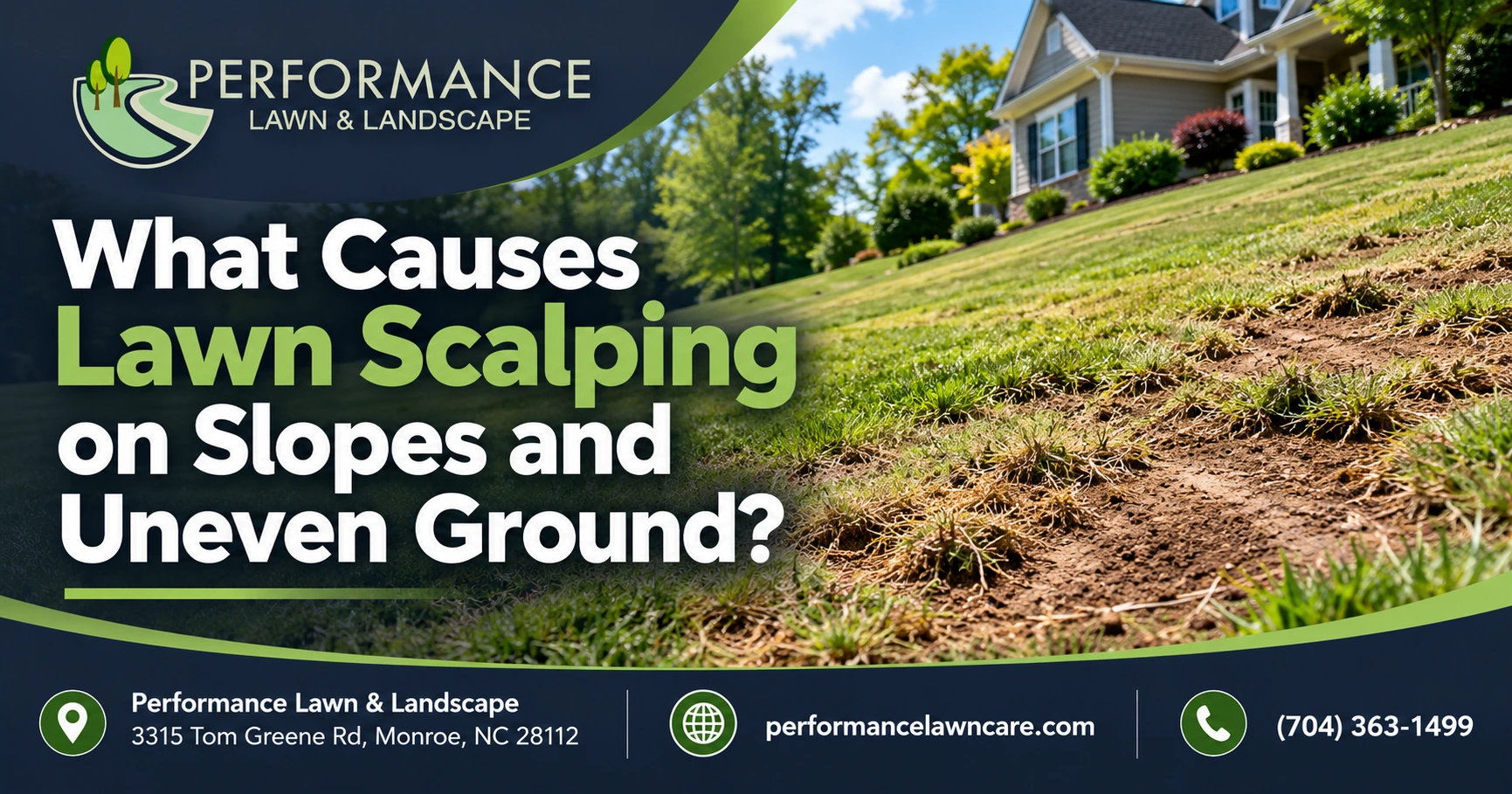
Lawn scalping on slopes and uneven ground happens when a mower deck or blade cuts much closer to the soil than intended as the mower travels over changes in elevation. Slopes, dips, raised areas, uneven soil, mower-deck settings, and wide cutting decks can all contribute to the problem.
A scalped lawn may look yellow, brown, or almost bare immediately after mowing. In many cases, the mower itself is working properly. The problem is that the mowing setup does not match the terrain.
At Performance Lawn & Landscape, we encourage homeowners to look at how the mower moves across each section of the property instead of assuming one cutting height or mowing pattern will work everywhere. Understanding why certain areas get cut too short can help protect the grass and reduce repeated damage.
What Does Lawn Scalping Look Like?
Lawn scalping occurs when too much of the grass blade is removed at once, sometimes exposing the lower stems, crowns, thatch, or even bare soil.
Common signs include:
- Yellow or brown patches appearing immediately after mowing
- Areas where the grass looks noticeably shorter than the surrounding lawn
- Bare-looking strips across raised areas
- Circular or irregular patches on bumps
- Thin spots along the crest of a slope
- Soil or thatch becoming visible after mowing
- Repeated damage in exactly the same areas
Scalping is different from grass that turns brown because of drought, disease, insects, or nutrient problems. When scalping is the cause, the damage typically follows the mower’s path and becomes noticeable shortly after the lawn is cut.
A homeowner may also notice that the affected areas correspond with small rises or changes in grade that are difficult to see when standing in the yard.
Why Are Slopes More Likely to Be Scalped?
Slopes change the relationship between the mower deck and the soil.
On level ground, the mower wheels and deck generally remain at a relatively consistent distance from the grass. On a slope, however, the mower can tilt as it travels uphill, downhill, or across the grade.
When the front or rear of the mower crosses a transition between flat ground and a slope, part of the deck may temporarily move closer to the turf.
This is especially noticeable near:
- The top of a hill
- The bottom of a slope
- Drainage swales
- Berms
- Raised landscape areas
- Changes between one grade and another
For example, a mower traveling over the crest of a rounded hill may have its front and rear wheels on slightly lower ground while the center of the mower sits over the highest point. The blade can then cut the grass on that high point much shorter than intended.
The steeper and more irregular the grade, the more carefully mowing technique needs to be adjusted.
How Does Uneven Ground Cause Mower Scalping?
Even lawns that appear relatively flat can contain small bumps, depressions, settling areas, tree-root zones, and irregular grading.
A mower follows the ground through its wheels, but the cutting deck covers a larger area between those contact points. When the wheels drop into a low area or pass on either side of a raised spot, the blades may get unusually close to the turf.
This can happen around:
- Tree roots
- Utility repairs
- Old planting beds
- Settled soil
- Drainage channels
- High spots created during grading
- Areas disturbed by construction
- Animal activity
- Repeated equipment traffic
Small irregularities can sometimes cause more obvious scalping than a gradual slope because the mower deck has less time to follow the change in terrain.
If the same patch is scalped every time the lawn is mowed, examine the soil surface before assuming the cutting height is the only problem. A subtle mound or depression may be causing the deck to move differently in that location.
Can the Wrong Mower-Deck Height Make Scalping Worse?
Yes. Mower-deck height can significantly affect how severely uneven terrain is scalped.
A mower set very low has little room for changes in ground elevation. When it crosses a bump or slope, the blades may quickly reach the lower part of the grass canopy.
Raising the cutting height can provide more clearance, but that does not mean the entire lawn should automatically be cut much higher simply because one section is uneven.
The better approach is to consider the grass type, current growth, terrain, mower design, and conditions in each part of the property.
Avoid removing an excessive amount of grass during a single mowing. Cutting too much at once can place additional stress on the lawn even when scalping does not occur.
If grass has grown unusually tall, gradually returning it to the desired mowing height may be preferable to making one very aggressive cut.
Also check that the mower deck is properly adjusted. An uneven deck can cut one side noticeably shorter, creating streaks or making existing terrain problems more visible.
How Do Mower Size and Deck Width Affect Uneven Terrain?
Larger mower decks can cover more lawn quickly, but wider decks may have difficulty following small changes in uneven terrain.
Consider a narrow mower and a wide mower crossing the same rounded bump. A smaller mower may follow the contour more closely because its wheels and cutting area cover a shorter distance.
A wider deck can bridge the high point. The wheels may remain on lower areas while the center of the deck passes directly over the bump, allowing the blade to cut much closer to the soil.
Wide decks can be particularly noticeable around:
- Rolling lawns
- Berms
- Drainage swales
- Rounded hills
- Raised septic areas
- Properties with inconsistent grading
This does not mean a large mower is unsuitable for every uneven lawn. Deck design, anti-scalp wheels, operator technique, speed, tire pressure, and cutting height all affect performance.
Anti-scalp wheels can help prevent the deck from dropping excessively close to the turf in some situations, but they are not a substitute for proper mower setup or appropriate mowing practices.
For properties with complicated terrain, different sections of the lawn may require different approaches.
Can Mowing Direction Reduce Scalping on Slopes?
Changing mowing direction can sometimes reduce lawn scalping on slopes and uneven ground.
Approaching a rise from one direction may cause the mower deck to bridge the high point differently than approaching it from another angle.
Homeowners may find that changing the mowing pattern helps around gradual slopes, rolling terrain, or uneven sections.
Alternating directions can also help prevent the same wheels from repeatedly traveling over identical paths.
However, mowing direction should always be chosen with mower safety in mind. Slopes can create rollover, sliding, or loss-of-control hazards depending on the equipment being used.
Always follow the mower manufacturer’s instructions regarding slope limits and recommended operating procedures. Do not use a mowing pattern simply because it produces a cleaner cut if that pattern is unsafe for the equipment or terrain.
Where it can be done safely, slowing down as the mower approaches changes in elevation may also help the deck follow the terrain more smoothly.
What Should You Do After Grass Has Been Scalped?
If an area has been scalped, avoid trying to immediately correct its appearance by mowing surrounding grass equally short.
Instead, give the affected turf an opportunity to recover.
Start by determining why the scalping occurred. Look for:
- A mower set too low
- An uneven mower deck
- A raised area in the soil
- A sudden change in slope
- Excessive mowing speed
- Tire-pressure differences
- A mowing direction that puts the deck too close to the ground
Continue normal lawn care without placing unnecessary additional stress on the area.
Avoid repeatedly mowing the damaged grass before it has regained enough growth. Scalped sections contain less leaf surface, which means the grass has less tissue available for photosynthesis.
Adequate moisture can support recovery, but do not overwater simply because the grass has been scalped. Water according to the needs of the lawn and current weather conditions.
Fertilizer should not automatically be applied as an emergency response either. More fertilizer does not instantly repair mower damage and may create additional stress when used unnecessarily.

How Long Does a Scalped Lawn Take to Recover?
Recovery time depends on how severely the lawn was scalped, the grass species, growing conditions, season, soil health, moisture, and whether the growing points were damaged.
Light scalping may become less noticeable as new grass blades develop during active growth.
Severe scalping can take longer, especially when bare soil is exposed or the crowns of the plants have been damaged.
Recovery is generally easier when:
- The grass is actively growing
- Temperatures suit the grass species
- Soil moisture is adequate
- The root system remains healthy
- Scalping does not continue with every mowing
Repeated scalping is more concerning than a single accidental incident. Cutting the same area excessively short over and over can weaken the turf and make it easier for weeds or thin areas to develop.
If a section fails to recover while the surrounding lawn improves, there may be another issue involved, such as compaction, poor soil conditions, drainage problems, disease, or significant physical damage.
When Should Uneven Ground Be Leveled or Corrected?
Not every minor bump requires major lawn renovation.
Small variations in grade are normal in many yards. Adjusting mowing speed, direction, or cutting practices may be enough to prevent occasional scalping.
Correction becomes more worth considering when uneven ground creates ongoing problems.
Possible reasons to evaluate leveling include:
- The same areas are scalped during nearly every mowing
- Depressions hold water
- High spots interfere with mowing
- Soil has settled significantly
- Erosion is changing the grade
- Surface roots are creating substantial irregularities
- Drainage problems are affecting the lawn
- Previous construction left the surface uneven
The cause matters.
For example, simply adding soil to a low area without understanding why it settled may provide only a temporary solution. Likewise, changing the grade around structures, drainage systems, mature trees, or utilities without proper planning can create new problems.
Tree-root areas require particular care. Adding significant amounts of soil over established roots or cutting major roots to flatten a lawn can damage the tree.
When uneven ground is substantial, a lawn and landscape professional can help determine whether mowing adjustments, minor surface corrections, drainage work, or more extensive grading should be considered.
How Can You Prevent Lawn Scalping From Happening Again?
Preventing lawn scalping on slopes and uneven ground usually requires matching mowing practices to the property rather than using exactly the same technique everywhere.
Start by identifying the areas that repeatedly get cut too short.
Then consider several factors.
Check Your Cutting Height
Make sure the mower is set appropriately for the grass type and current growing conditions. Avoid cutting unnecessarily low.
Inspect the Deck
Confirm that the mower deck is level and operating correctly. A deck that sits lower on one side can create uneven cutting.
Check Tire Pressure
Uneven tire pressure can change how the mower sits and alter cutting height from one side to the other.
Slow Down on Uneven Ground
Moving more slowly across bumps and grade changes may allow the mower to follow the surface more consistently.
Change Your Approach
Where safe and appropriate, try approaching troublesome areas from another direction rather than repeating the same path every week.
Pay Attention to Deck Width
If a large mower repeatedly bridges bumps and scalps high spots, the terrain may require a different mowing strategy or equipment in that section.
Correct Significant Terrain Problems
Persistent depressions, high spots, erosion, and drainage issues may need to be addressed rather than continually compensated for with the mower.
Most importantly, avoid treating the entire lawn as though every area has identical conditions. A flat front yard may mow differently from a sloped side yard, drainage swale, or rolling backyard.
At Performance Lawn & Landscape, we look at the lawn as a complete site. Grass type matters, but so do grading, drainage, terrain, equipment, and the way the lawn is maintained.
FAQs
What causes a mower to scalp grass on a hill?
A mower may scalp grass on a hill because the deck gets closer to the turf as the machine crosses a slope or change in grade. High spots and slope transitions are especially vulnerable.
Should I raise my mower if my lawn keeps getting scalped?
Raising the mower may help, especially if the cutting height is very low, but it should not be the only adjustment considered. Deck setup, ground unevenness, mowing direction, speed, and mower size can also contribute.
Why does my mower scalp only certain spots?
Repeated scalping in the same areas usually indicates a local terrain issue such as a bump, depression, slope transition, root, or uneven grade. Watch how the mower deck moves when crossing that section.
Are wider mower decks more likely to scalp uneven lawns?
They can be. A wide deck may bridge across depressions or pass over high spots differently than a smaller deck. Actual performance also depends on mower design, anti-scalp wheels, deck height, speed, and terrain.
Will scalped grass grow back?
Many lightly scalped areas can recover if the roots and crowns remain healthy and the grass is actively growing. Severe or repeated scalping can take longer to recover and may result in thinning.
Can uneven ground be fixed to prevent scalping?
In some cases, yes. Minor low or high areas may be correctable, while significant grading, drainage, erosion, or tree-root issues require more careful evaluation.
Keep Your Lawn Cutting Even Across Changing Terrain
A lawn does not have to be perfectly flat to look consistently maintained. The key is recognizing where slopes, bumps, drainage areas, and changes in grade require a different mowing approach.
If certain areas keep getting scalped, adjusting the mower height alone may not solve the problem. Deck width, mowing direction, speed, surface irregularities, drainage, and soil conditions can all contribute.
Performance Lawn & Landscape helps homeowners evaluate lawn conditions and develop maintenance strategies suited to the actual property. If uneven terrain, thinning grass, drainage problems, or repeated mower damage is affecting your lawn, our team can help identify the underlying issue and recommend practical next steps.