If you have sloped landscape beds, you’ve probably noticed how quickly heavy rain can move pine needles or mulch out of place. What looked neat and evenly covered one day can turn into exposed soil, scattered material, and piles collecting at the bottom of the hill.
Choosing between pine needles and mulch isn’t just about appearance. Both materials can protect your soil, but they behave differently when water moves downhill.
Before deciding which one belongs in your landscape, consider the steepness of your slope, how rainwater drains through the area, and how much maintenance you’re willing to handle.
Quick Answer: Pine Needles vs. Mulch on Slopes
Pine needles often stay in place better than large bark nuggets on slopes because their long, flexible shape allows them to interlock. Finely shredded hardwood mulch can also perform well because its fibers settle together and resist movement. However, neither material is completely resistant to heavy runoff. The best option depends on slope steepness, drainage, installation depth, and bed edging.
How Pine Needles Behave on Sloped Beds
Pine needles, often called pine straw, are commonly used in sloped landscape beds throughout North Carolina.
One reason they’re popular is their ability to overlap and interlock after installation.
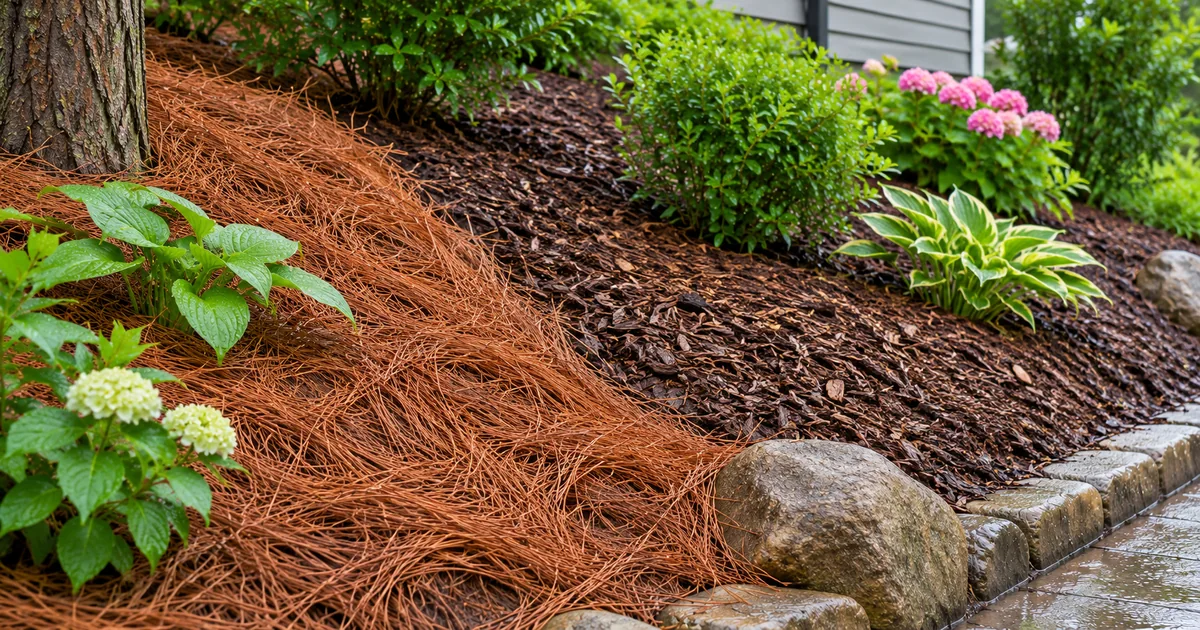
Unlike individual pieces of bark, long pine needles form a loose network across the soil surface. This helps the material remain together when wind or light runoff moves across the bed.
Why pine needles can resist movement
When pine straw is spread evenly, the needles overlap in different directions. Their length and flexibility help create a layer that is less likely to separate into individual pieces.
This makes pine needles useful for:
- Gently to moderately sloped planting beds
- Landscaped areas beneath trees
- Shrub beds along sloping yards
- Areas where loose bark nuggets frequently move downhill
Pine straw also allows water to pass through the layer into the soil, provided the ground underneath can absorb it.
When pine needles may still wash away
Pine straw isn’t completely resistant to erosion.
Strong runoff can lift or push the needles downhill, especially if water enters the bed from a driveway, downspout, or nearby paved surface.
Thin coverage can also leave gaps where rain directly strikes exposed soil.
If you regularly find pine straw piled at the bottom of your slope, check how water travels through the area before adding more material.
How Mulch Behaves on Sloped Beds
Wood mulch is another popular option for landscape beds, but not every type performs the same way on a slope.
The size, shape, and texture of the material affect how easily it moves.
Shredded hardwood mulch
Shredded hardwood mulch contains fibrous pieces that can settle and interlock.
This texture can help it resist movement on moderately sloped beds.
It also provides a consistent appearance around trees, shrubs, and ornamental plants.
However, very fine material applied too thickly may compact or form a dense surface that limits water penetration.
Pine bark nuggets
Pine bark nuggets are larger, individual pieces of bark.
Although attractive and relatively long-lasting, they can be more vulnerable to movement during heavy rainfall.
Some bark nuggets float when water collects, making them easier to carry downhill.
This is particularly noticeable in beds with concentrated runoff.
Wood chips
Wood chips vary considerably in size and shape.
Irregular, fibrous chips may settle together more effectively than smooth, rounded bark pieces. However, coarse chips can still move when water flows rapidly over the bed.
The important distinction is that mulch isn’t one uniform material.
A finely shredded hardwood product may perform very differently from large pine bark nuggets, even when both are installed on the same slope.
Which Material Handles Heavy Rain Better?
The answer depends on how rainwater reaches and moves through your landscape bed.
Pine needles and shredded hardwood mulch are often better choices for slopes than large bark nuggets because they can form overlapping or interlocking layers.
However, strong runoff can displace either material.
Pine needles vs. mulch on slopes: A practical comparison
| Factor | Pine needles | Shredded hardwood mulch | Large bark nuggets |
| Ability to interlock | Good | Good | Limited |
| Performance on gentle slopes | Generally good | Generally good | Depends on runoff |
| Heavy rain resistance | Can shift under concentrated flow | Can resist movement when properly installed | More likely to float or wash away |
| Typical coverage | 2–3 inches | Often 1–2 inches for finely shredded hardwood | Typically 2–3 inches |
| Maintenance | Periodic redistribution and replenishment | Periodic leveling and replenishment | May require replacement after washout |
These are general comparisons, not guarantees. The same material can perform well on one property and repeatedly wash away on another.
What matters most during heavy rain?
Three conditions have a major influence:
- Rainfall intensity: Heavy downpours can create runoff faster than soil can absorb water.
- Slope steepness: Water generally travels downhill more quickly on steeper grades.
- Drainage patterns: Concentrated streams can move mulch more easily than evenly distributed rainfall.
For a moderately sloped bed with good drainage, either pine needles or shredded hardwood mulch may be suitable.
For a steep bed receiving water from several surrounding surfaces, neither material may stay in place without additional drainage or erosion-control measures.
How Runoff Affects Pine Needles and Mulch
Runoff is often the deciding factor when choosing ground coverage for a slope.
Even a material that normally stays in place can wash away when enough water moves across the surface.
Concentrated runoff creates problems
Imagine a sloped bed beside your driveway.
During heavy rain, water flows off the pavement and enters the bed at one location.
Instead of spreading evenly, it follows a narrow downhill path.
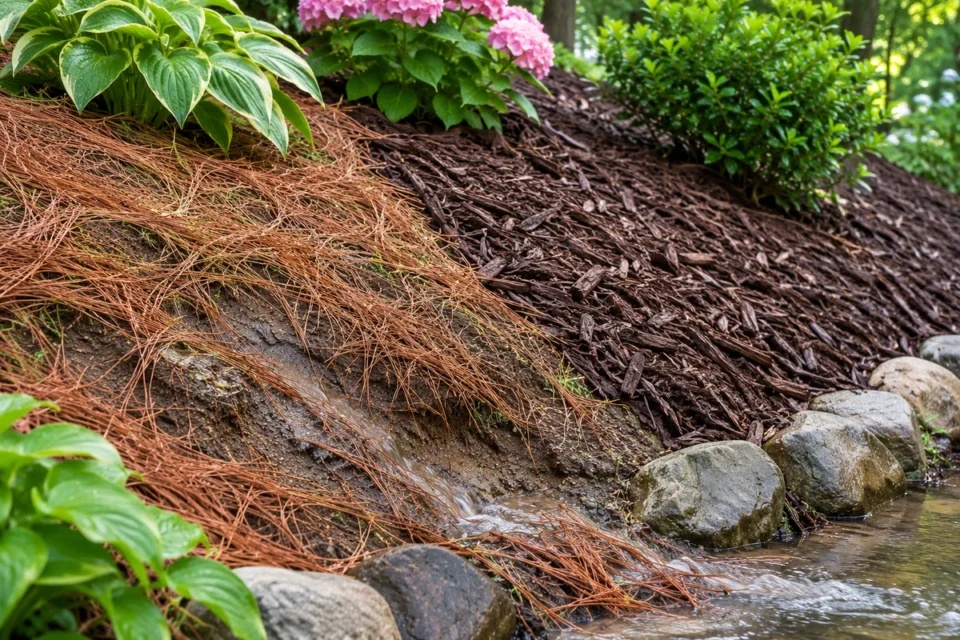
That flow may lift pine needles, carry bark nuggets away, or create channels through shredded mulch.
Repeated runoff can eventually expose the soil underneath.
Soil conditions also matter
If your soil is compacted, water may have difficulty soaking into the ground.
This increases the likelihood of surface runoff.
Similarly, already saturated soil may absorb additional rainfall slowly, allowing more water to travel across the bed.
Look for patterns after rainfall
You can often identify runoff problems by checking where the material has moved.
Watch for:
- Bare strips running downhill
- Mulch collected along the bottom edge
- Pine needles caught against edging
- Exposed roots or soil
- Small erosion channels
- Debris accumulating near walkways
If washout follows the same path after every storm, correcting that water movement will usually be more effective than switching materials repeatedly.
Does Installation Depth Affect How Well They Stay in Place?
Yes. Proper installation depth helps both pine needles and mulch provide consistent soil coverage.
Too little material leaves gaps, while excessive material can create other problems.
Pine needle installation depth
NC State Extension recommends approximately 2 to 3 inches of pine needles for many ornamental landscape beds.
At this depth, the needles can overlap and provide consistent coverage without excessive piling.
On slopes, even distribution is especially important. Thin areas may become exposed during rainfall, while loose piles can move downhill.
Wood mulch installation depth
The appropriate depth varies depending on the mulch type.
For example:
- Finely shredded hardwood: Often 1 to 2 inches, depending on texture and application.
- Wood chips: Generally around 2 to 3 inches.
- Pine bark nuggets: Typically around 2 to 3 inches.
Very fine mulches can form dense layers when applied too thickly, while coarse bark pieces may remain loose.
Avoid piling mulch or pine needles directly against tree trunks, plant stems, or crowns.
More material doesn’t always provide better retention
If water is actively flowing through the bed, increasing mulch depth may not prevent washout.
Additional material could simply provide more debris for runoff to carry away.
Correct the drainage problem first, then restore the appropriate coverage.
Which Option Needs More Frequent Maintenance?
Both pine needles and wood mulch require occasional maintenance, but the type and frequency of work can differ.
Maintaining pine needles
Pine straw gradually settles, decomposes, and may shift with wind or rainfall.
Maintenance may involve:
- Redistributing needles that collect downhill
- Replacing material in thin areas
- Removing debris from the beds
- Refreshing coverage as needed
The frequency depends on weather exposure, the quality of the pine straw, and how well the bed retains material.
Maintaining wood mulch
Wood mulch also decomposes and changes appearance over time.
Shredded hardwood may settle into a more stable layer, but it still needs periodic attention.
Large bark nuggets may last longer before decomposing, yet they can require more frequent repositioning or replacement in areas exposed to runoff.
Which requires less maintenance?
On a well-drained slope, pine needles and shredded hardwood mulch can both be manageable choices.
However, a bed with ongoing drainage problems may require repeated maintenance regardless of the material.
Rather than choosing based on an assumed replacement schedule, consider how the material performs in your specific landscape.
How Bed Edging and Drainage Affect Both Materials
Proper edging can help contain pine needles and mulch, but it works best when combined with good drainage.
Edging helps prevent minor movement
Landscape edging creates a boundary between planting beds and surrounding grass, sidewalks, or driveways.
Common options include:
- Stone borders
- Brick edging
- Concrete edging
- Metal landscape edging
- Flexible landscape borders
On gently sloped beds, edging can reduce the amount of material that escapes during normal rainfall and maintenance.
Edging cannot stop powerful runoff
If water flows downhill with enough force, it may carry pine needles or mulch over the border.
A solid edging barrier can also trap water if drainage hasn’t been considered.
This is particularly important near foundations, patios, and retaining walls.
Drainage improvements may provide a longer-lasting solution
Depending on the property, improvements might include redirecting downspout discharge, adjusting grading, or creating suitable drainage channels.
For steeper slopes, established groundcover plants, terracing, or other erosion-control features may provide additional soil stability.
Before modifying drainage, consider where the water will go. Redirecting runoff should not create new problems near your home or neighboring properties.
How to Choose Based on Your Landscape Conditions
Choosing between pine needles and mulch becomes easier when you focus on the conditions of your yard rather than appearance alone.
Choose pine needles when:
- You have gentle to moderately sloped beds.
- You prefer a natural, traditional landscape appearance.
- You want a material that overlaps and interlocks.
- Your beds have reasonably good drainage.
- You’re comfortable with periodic redistribution and replenishment.
Consider shredded hardwood mulch when:
- You want a more uniform wood-mulch appearance.
- Your beds have mild to moderate slopes.
- You prefer fibrous material over large bark nuggets.
- You want mulch that may require less frequent replacement as it decomposes.
- Water doesn’t regularly flow through the bed in concentrated streams.
Be cautious with large bark nuggets when:
- The bed has a noticeable downhill grade.
- Water frequently flows across the surface.
- The planting area sits below a downspout.
- You have experienced repeated mulch washout.
Larger bark pieces can float and move during rainfall, making them less suitable for certain slopes.
Consider landscape improvements when:
- The slope is steep.
- Soil erosion is already visible.
- Material washes away after most storms.
- Water enters the bed from paved surfaces or drainage outlets.
- Previous mulch installations haven’t stayed in place.
In these situations, switching materials alone may not address the problem.
The best choice is the one that works with your slope, soil, and drainage conditions.
Pine Needling and Mulching in Waxhaw, NC
Sloped landscape beds can be challenging to maintain, especially when heavy rainfall sends water downhill through planting areas.
For homeowners in Waxhaw, NC, choosing the right material can help keep beds looking attractive while protecting the soil beneath trees and shrubs.
At Performance Lawn & Landscape, we provide pine needling and mulching services for residential and commercial landscapes.
Our team understands that every property has different conditions. Some beds may benefit from the natural interlocking structure of pine straw, while others may be better suited to shredded hardwood mulch.
We also recognize that material selection is only part of the solution.
If your landscape beds repeatedly lose coverage during rainfall, we can help you evaluate your maintenance needs and discuss whether installation changes or landscape improvements may be appropriate.
Our goal is to help you maintain attractive, functional landscape beds without repeatedly replacing material that doesn’t suit the location.
Need help choosing between pine needles and mulch for your sloped landscape beds?
Contact Performance Lawn & Landscape at 704-363-1499 to discuss pine needling and mulching in Waxhaw, NC, and request a quote for your property.
FAQs About Pine Needles and Mulch on Slopes
Do pine needles stay in place better than wood mulch?
Pine needles often stay in place better than large bark nuggets because they overlap and interlock. However, shredded hardwood mulch can also resist movement effectively. The results depend on slope steepness, drainage, and installation quality.
What is the best mulch for a steep slope?
Pine straw and fibrous shredded wood mulch are common options for sloped beds. However, very steep slopes may require additional erosion-control measures, such as groundcover plants, terracing, or drainage improvements.
Does pine straw wash away during heavy rain?
Yes. Although pine straw naturally interlocks, strong or concentrated runoff can still carry it downhill. Washout is more likely where beds are steep, coverage is uneven, or downspouts discharge directly onto the material.
Why does my mulch keep sliding down the hill?
Mulch may move downhill because of gravity, rainfall runoff, loose installation, or inadequate edging. If the material repeatedly shifts along the same path, concentrated water flow or soil erosion may be contributing to the problem.
Are pine bark nuggets good for sloped beds?
Large pine bark nuggets are generally less suitable for slopes exposed to substantial runoff because they may float or wash away. Smaller or more fibrous materials often provide better retention in these conditions.
Can landscape edging keep mulch from washing away?
Edging can help contain mulch and pine needles during minor movement. However, it cannot reliably stop strong runoff. Drainage improvements may also be necessary to prevent repeated washout.
Both pine needles and mulch can work well on sloped landscape beds, but their performance depends on more than the material itself.
Pine straw offers natural interlocking properties, while shredded hardwood mulch can provide similarly useful coverage. Large bark nuggets may be more vulnerable to movement during heavy rain.
Before choosing, consider your slope, drainage, and maintenance needs.
At Performance Lawn & Landscape, we help Waxhaw homeowners select and maintain landscape materials that suit their properties. Contact our team to discuss an approach that keeps your beds looking good while protecting the soil underneath.