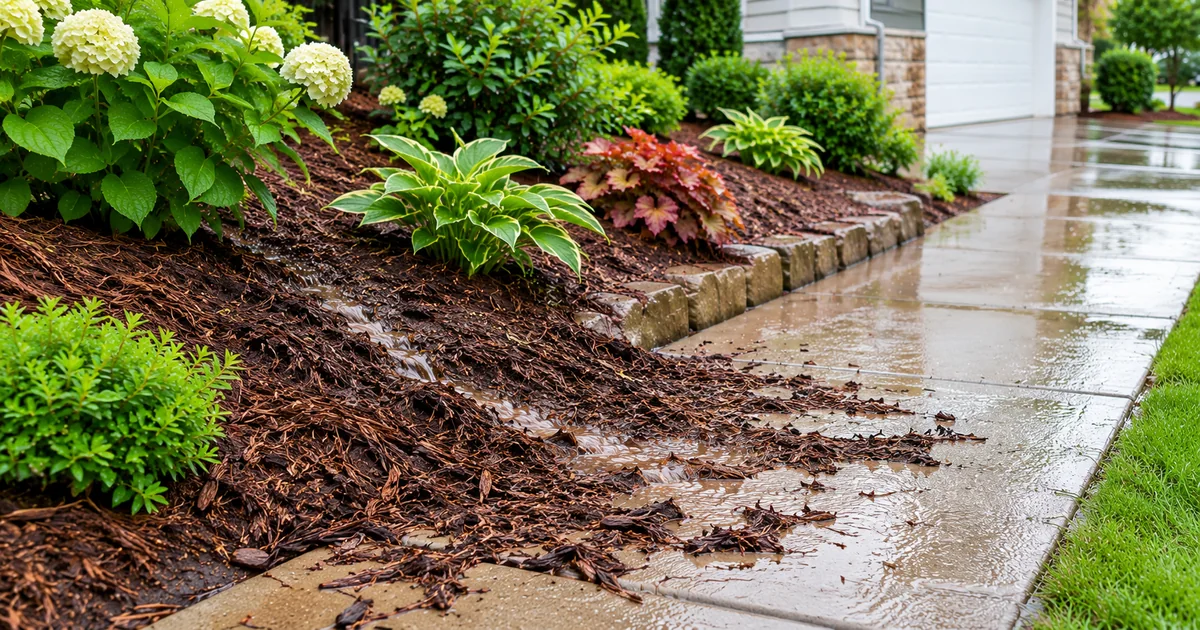
You recently refreshed your landscape beds, and everything looked neat and well-maintained. Then a heavy rain came through, leaving mulch scattered across your sidewalk or driveway. Now you’re dealing with exposed soil, uneven coverage, and another cleanup you weren’t expecting.
If mulch keeps washing out of your landscape beds, rain might not be the only problem. The slope of your yard, drainage patterns, edging, and type of mulch can all influence how easily it moves.
Before adding another layer, it’s worth figuring out why the material isn’t staying where it belongs. A few targeted improvements may help you avoid dealing with the same problem after every storm.
Quick Answer: Why Is Mulch Washing Out of My Beds?
Mulch washes onto sidewalks and driveways when rainwater runoff carries loose material out of landscape beds. Sloped ground, concentrated downspout discharge, inadequate edging, and lightweight mulch can make the problem worse. While proper installation helps, repeated washout often indicates a drainage or grading issue that should be corrected rather than simply adding more mulch.
How Slope and Runoff Move Mulch
The slope of your landscape bed plays a major role in how water and mulch move during rainfall.
On relatively level ground, rainwater has more opportunities to soak into the soil. On a slope, excess water naturally travels downhill, potentially carrying loose landscaping materials with it.
The steeper the grade, the more force runoff may develop as it moves across the surface.
Why mulch moves downhill
Mulch is designed to rest on top of the soil rather than being firmly anchored to it.
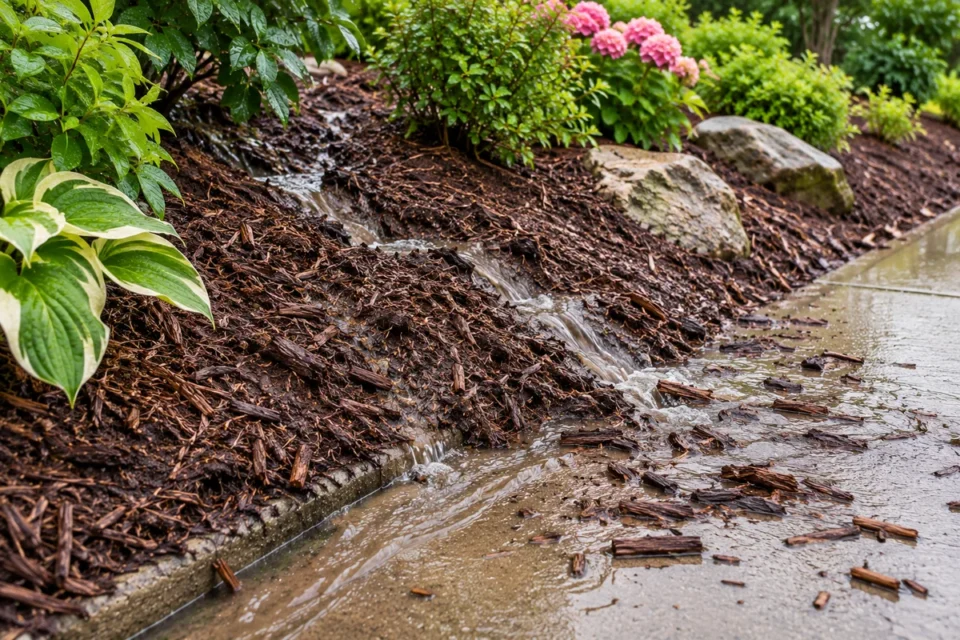
During heavy rainfall, moving water can lift individual pieces, push them downhill, or carry them toward the nearest hard surface.
You might notice:
- Mulch collecting at the bottom of a sloped bed
- Bare soil appearing near the upper portion
- Small channels forming through the mulch
- Material spreading across nearby concrete
- Uneven mulch coverage after storms
These patterns often reveal the direction water travels through your property.
Concentrated runoff creates bigger problems
Not every sloped bed experiences significant washout.
A gently sloped landscape bed with good drainage may hold mulch reasonably well.
However, when water flows through a narrow channel instead of spreading evenly, it can become strong enough to move substantial amounts of material.
If your mulch repeatedly washes onto the same section of sidewalk, follow the runoff path uphill. You may discover that the problem begins somewhere outside the landscape bed.
Can Heavy Rain Push Mulch Onto Hardscapes?
Yes. Heavy rainfall can displace mulch even when the material has been installed correctly.
During intense storms, rain may fall faster than the soil can absorb it. The excess water flows across the ground, carrying loose mulch toward lower areas.
Sidewalks and driveways frequently become collection points because they are positioned beside or below landscape beds.
Why mulch collects on concrete
Hard surfaces don’t absorb water the way soil does.
When runoff reaches a sidewalk or driveway, it may continue moving across the pavement while leaving mulch behind.
Material often collects near:
- Driveway edges
- Sidewalk corners
- Garage entrances
- Low spots along walkways
- Storm drain openings
- Areas where concrete meets landscape edging
If the mulch reaches a storm drain, it can contribute to blockages and carry organic debris into the drainage system.
Does one storm mean there’s a drainage problem?
Not necessarily.
An unusually intense downpour can move mulch from an otherwise stable landscape bed.
However, if washout happens during ordinary rainfall or repeatedly affects the same location, the underlying drainage deserves closer attention.
The difference is whether you’re dealing with an occasional weather event or a recurring pattern.
How Bed Edges Affect Mulch Retention
The boundary between your landscape bed and surrounding pavement can influence how easily mulch escapes.
A poorly defined edge may allow material to move onto the sidewalk during rainfall, irrigation, or routine maintenance.
Why shallow or uneven edges cause problems
If mulch sits level with or above the sidewalk, there may be little to stop loose pieces from moving onto the concrete.
This is especially common when new mulch is added repeatedly without removing excess material or adjusting the bed surface.
Over time, the mulch level can become higher than the surrounding hardscape.
When water moves through the bed, material may spill directly over the edge.
Can landscape edging help?
Yes. Proper edging can provide a physical boundary that helps contain mulch.
Common edging options include:
- Metal landscape edging
- Brick borders
- Natural stone
- Concrete landscape borders
- Flexible landscape edging
For minor movement, these barriers may be enough to keep the material contained.
Edging isn’t a substitute for drainage
A border can also create problems if it blocks the natural movement of water.
For example, installing a solid barrier across a drainage path may cause water to pool behind it.
During heavy rainfall, that water could eventually overflow and carry even more mulch onto the pavement.
Before adding edging, consider where the water needs to go.
The goal is to contain the mulch without creating unwanted standing water or redirecting runoff toward your home.
Does Mulch Type Make a Difference?
Absolutely. Different mulch materials behave differently when exposed to flowing water.
The size, shape, and texture of the pieces affect how easily they move.
Pine bark nuggets
Large pine bark nuggets can be attractive, but they may float when water collects.
If runoff flows through a landscape bed, these pieces can be carried downhill and deposited onto nearby pavement.
This makes them less suitable for some sloped beds or areas receiving concentrated runoff.
Shredded hardwood mulch
Shredded hardwood mulch contains fibrous pieces that can settle together and partially interlock.
This structure may help the material resist movement better than large, loose bark nuggets.
However, shredded mulch can still wash away when runoff becomes strong enough.
Wood chips
Wood chips vary in size and texture.
Irregular, fibrous chips may remain more stable than smooth, rounded pieces, but performance depends on the product and drainage conditions.
Pine straw
Pine needles overlap and interlock, making them useful for certain sloped planting beds.
However, concentrated runoff can still wash pine straw out of place.
Which material should you choose?
If your landscape bed frequently experiences runoff, fibrous mulch that settles together may offer better retention than large bark nuggets.
NC State Extension notes that pine bark nuggets can float and wash away near drainage areas, while fibrous mulches are generally more stable on slopes.
Still, changing materials alone won’t necessarily solve a significant drainage problem.
Can Downspouts or Drainage Paths Cause Washout?
Yes. Concentrated water from downspouts is a common reason mulch repeatedly disappears from landscape beds near homes.
Your roof collects rainwater across a large surface area. Gutters direct that water into downspouts, which release it at specific locations.
If a downspout empties directly onto mulch, the resulting flow may push the material out of the bed.
Signs a downspout may be responsible
Look for:
- A bare patch near the downspout outlet
- Mulch pushed outward in a fan-shaped pattern
- Small erosion channels through the soil
- Material collecting near the driveway
- Exposed soil around the foundation
If you notice these patterns, investigate the downspout before replacing the missing mulch.
Other drainage sources to check
Downspouts aren’t the only possible cause.
Runoff may also enter landscape beds from:
- Sloped driveways
- Walkways positioned above planting areas
- Neighboring sections of the yard
- Irrigation systems applying water too quickly
- Poorly graded soil around the home
What can help?
Depending on the conditions, solutions may include a splash block, a properly directed downspout extension, or improvements that distribute and slow runoff.
Any drainage adjustments should direct water away from the foundation without creating new erosion problems or sending concentrated flow onto neighboring properties.
Why Adding More Mulch May Not Fix the Problem
When mulch washes away, the natural response is to replace what disappeared.
That may restore your landscape bed temporarily, but it won’t necessarily prevent another washout.
If the underlying cause remains, the replacement material can follow the same path during the next storm.
Too much mulch can create additional problems
Repeatedly adding mulch without checking the existing depth may create an excessively thick layer.
This can:
- Trap unnecessary moisture around plant stems
- Reduce air movement near plant crowns
- Bury exposed tree root flares
- Raise the bed surface above surrounding pavement
- Leave additional loose material available for runoff to carry away
For many ornamental landscape beds, approximately 2 to 3 inches of organic mulch is a reasonable target, although appropriate depth varies by material and planting type.
Avoid piling mulch against tree trunks or the base of shrubs.
Address the cause before replacing the material
If you find mulch on your sidewalk after nearly every rainfall, ask a few questions.
Where does the water enter the bed? Is the soil sloped toward the pavement? Does a downspout discharge nearby? Is the mulch already higher than the sidewalk?
Answering these questions can help you determine whether the problem involves installation, drainage, or both.
How to Improve Mulch Retention Long Term
Reducing repeated washout usually requires a combination of proper material selection, installation, and water management.
Start with the areas where mulch escapes most frequently.
1. Trace the path of water
After rainfall, inspect where mulch has moved.
Look for exposed soil, small channels, and debris patterns that reveal the direction of runoff.
Avoid entering flooded areas or working on unstable, saturated slopes.
2. Maintain an appropriate mulch depth
Spread mulch evenly rather than creating thick piles near bed edges.
Keep the material slightly below adjacent hardscape edges where practical, allowing room for the mulch without blocking drainage.
3. Choose a more stable mulch
If large bark nuggets repeatedly float away, consider whether shredded hardwood or another fibrous material would perform better.
Match the material to the slope and expected water flow.
4. Improve edging where necessary
A well-defined border can help contain mulch during light runoff and normal maintenance.
Make sure the edging doesn’t trap water or interfere with drainage.
5. Redirect concentrated runoff
Check gutters, downspouts, and nearby paved surfaces.
Reducing the amount and speed of water flowing directly through the mulch bed can improve retention.
6. Stabilize exposed soil
If runoff has already created erosion channels, simply covering them with mulch may not be enough.
The soil may need stabilization through appropriate plantings, erosion-control measures, or other site-specific improvements.
7. Monitor the next rainfall
After making adjustments, inspect the area following a storm.
If mulch still washes out along the same route, additional drainage corrections may be needed.
The objective isn’t to prevent every piece of mulch from moving. It’s to reduce repeated losses and protect the soil beneath your landscape beds.
When Landscape Design Changes May Be Needed
Some washout problems can’t be solved through routine mulching or edging improvements alone.
If your landscape bed receives significant runoff, sits on a steep slope, or has visible soil erosion, changes to the property’s layout may be necessary.
Regrading the bed
Minor grading adjustments can sometimes help distribute water more evenly or move it away from vulnerable areas.
However, grading should be planned carefully to protect foundations, neighboring properties, and existing drainage patterns.
Installing drainage features
Depending on the site, drainage improvements may include swales, appropriately designed drains, or other stormwater management features.
These systems should address water movement without transferring the problem to another part of the property.
Adding groundcover plants
Established groundcover plants can help hold soil in place through their root systems.
On certain slopes, a combination of suitable plants and mulch may provide more dependable erosion protection than mulch alone.
Using terracing or retaining structures
Steeper planting beds may benefit from properly designed terraces or retaining features.
These can reduce slope length and help manage soil movement, but drainage and structural considerations are important.
Not every property needs major improvements.
However, if the same landscape bed loses mulch after nearly every storm, it’s worth considering whether the existing design is contributing to the problem.
Mulching Services in Charlotte, NC
Heavy rain can create challenges for landscape beds throughout Charlotte, NC, especially when planting areas sit beside sloped driveways, sidewalks, or roof drainage outlets.
At Performance Lawn & Landscape, we help homeowners and commercial property owners maintain attractive, functional landscapes through professional mulching and landscape maintenance services.
We understand that mulch should do more than make a planting bed look finished. Proper coverage helps protect exposed soil, retain moisture, and support the growing conditions around trees and shrubs.
If mulch repeatedly washes onto your driveway or sidewalk, our team can help you review your landscape maintenance needs and discuss whether a different material, edging improvements, or broader landscape adjustments may be appropriate.
We provide mulching services and landscape maintenance throughout Charlotte and surrounding North Carolina communities.
Whether you’re refreshing existing planting beds or dealing with recurring mulch movement, we’ll help you determine a practical approach for your property.
Tired of finding mulch scattered across your driveway after every storm?
Contact Performance Lawn & Landscape at 704-363-1499 to discuss your landscaping needs and request a quote for mulching services in Charlotte, NC.
FAQs About Mulch Washing Out of Beds
Why does mulch wash onto my driveway every time it rains?
Repeated washout usually indicates that runoff is moving through your landscape bed toward the driveway. Sloped soil, downspouts, inadequate edging, or lightweight mulch can contribute. Identifying where the water comes from is the first step toward correcting the problem.
What type of mulch is least likely to wash away?
Fibrous mulches, such as shredded hardwood, generally resist movement better than large pine bark nuggets. Pine straw can also stay in place reasonably well because the needles interlock. However, no loose mulch is completely resistant to concentrated runoff.
Will landscape edging stop mulch from washing onto my sidewalk?
Edging can help contain mulch during minor movement, especially along level planting beds. However, strong runoff may carry mulch over the barrier. If drainage is the underlying problem, edging alone may not be enough.
Should mulch be lower than the sidewalk?
Keeping mulch slightly below the surrounding sidewalk or driveway edge can help reduce spillover. However, the appropriate bed level depends on drainage, edging, and surrounding soil conditions. Avoid creating a depression that traps excessive water.
Can heavy rain wash away freshly installed mulch?
Yes. Newly installed mulch may shift during heavy rainfall, particularly when it hasn’t settled or the landscape bed receives concentrated runoff. Proper depth and material selection help, but drainage conditions remain important.
Should I replace mulch immediately after it washes away?
First, inspect the bed for runoff patterns, exposed soil, and drainage problems. You can restore coverage where needed, but correcting the cause of repeated washout should take priority. Otherwise, replacement mulch may disappear during the next storm.
Finding mulch scattered across your sidewalk or driveway after every storm is frustrating, but repeatedly replacing it isn’t always the best solution.
The problem may come from sloped ground, concentrated runoff, ineffective edging, or a mulch material that doesn’t suit your landscape.
By addressing those conditions first, you can improve mulch retention and reduce unnecessary cleanup.
At Performance Lawn & Landscape, we help Charlotte homeowners maintain landscape beds that look attractive and function properly. Contact our team to discuss mulching and landscape improvements suited to your property.