Grass often grows faster in certain parts of a yard because those areas receive more water, fertilizer, sunlight, or access to better soil conditions. Differences in irrigation coverage, drainage, shade, mowing height, and nutrient distribution can all create sections of lawn that grow at noticeably different rates.
If you are wondering why grass grows faster in some parts of the yard, the best approach is to compare the conditions in the fast-growing areas with the rest of the lawn. Identifying the cause first helps prevent overwatering, overfertilizing, or making other adjustments that could create new lawn problems.
Why Does Grass Grow Faster in Some Parts of the Yard?
Uneven grass growth usually means growing conditions are not identical across the entire property.
Even lawns that appear flat and uniform can contain major differences below the surface.
One area may have:
- More moisture
- Better irrigation coverage
- Higher soil fertility
- More organic matter
- Better drainage
- More sunlight
- Less foot traffic
- A different soil depth
- A slightly different grass variety
- More fertilizer from previous applications
The location of faster growth can offer useful clues.
For example, grass that grows rapidly near sprinkler heads may be receiving more water. A dark green strip along a fertilizer spreader path may indicate overlapping fertilizer coverage. Faster growth near a downspout could be related to additional moisture.
The important point is that faster growth is a symptom, not necessarily the problem itself.
Before changing your lawn-care routine, determine what is different about that part of the yard.
How Do Moisture Differences Affect Grass Growth?
Water availability has a major influence on grass growth.
An area receiving consistent moisture may grow faster than a section that dries out between watering cycles.
This can happen because of:
- Uneven sprinkler coverage
- Downspout runoff
- Low spots
- Poor grading
- Shade that slows evaporation
- Soil that holds more water
- Leaking irrigation components
Grass needs water to move nutrients through the plant and support active growth. When moisture is available consistently, turf may remain greener and grow more rapidly.
However, more water is not always better.
Constantly wet soil can create problems such as:
- Shallow root development
- Fungal disease
- Soil compaction
- Reduced oxygen around roots
- Increased weed pressure
If a fast-growing area also feels wet long after irrigation or rain, excessive moisture may be part of the issue.
On the other hand, a slower-growing area may simply be drying out faster because of full sun, compacted soil, a slope, or poor sprinkler coverage.
Comparing soil moisture across several parts of the lawn can help narrow down the cause.
Can Uneven Fertilizer Application Cause Faster Growth?
Yes.
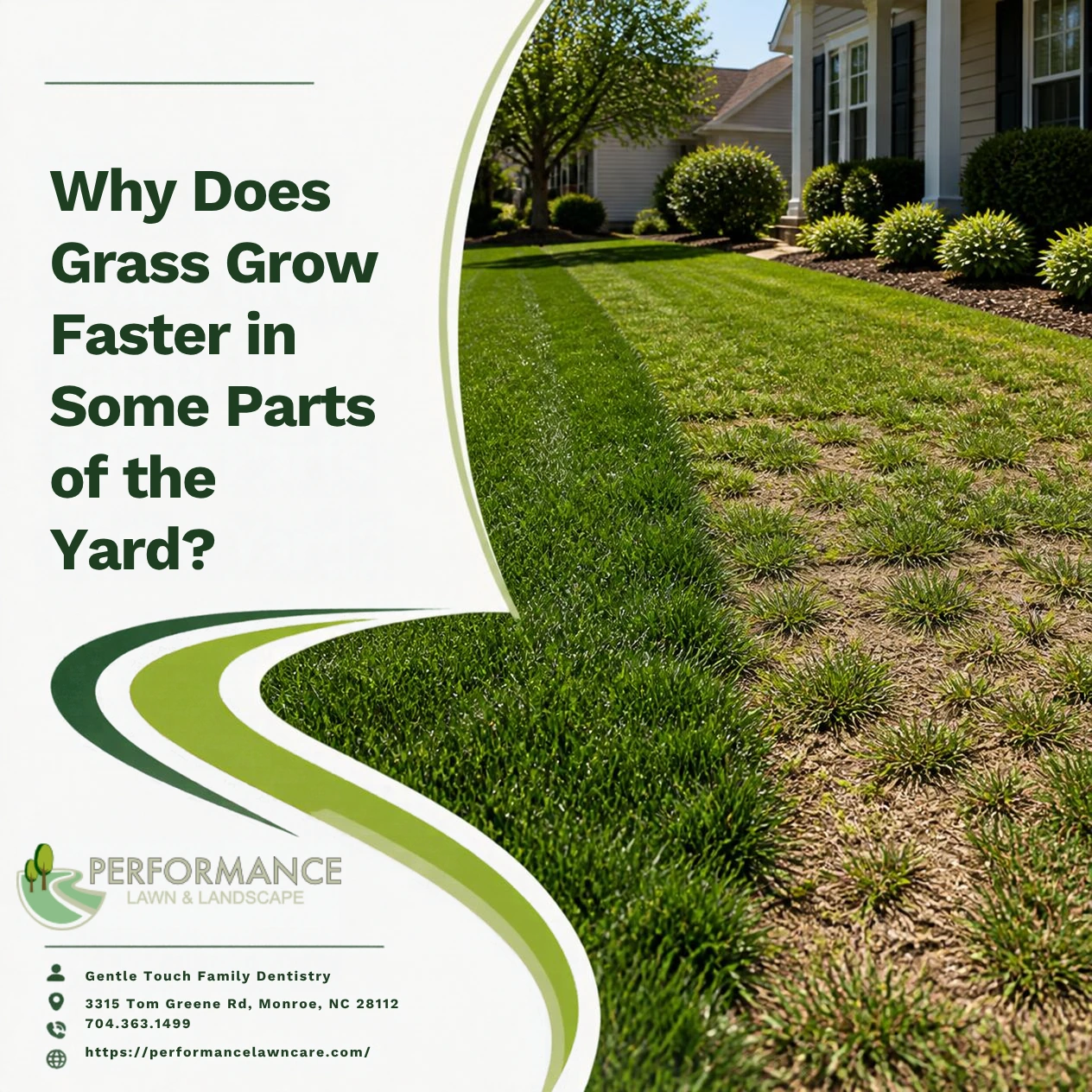
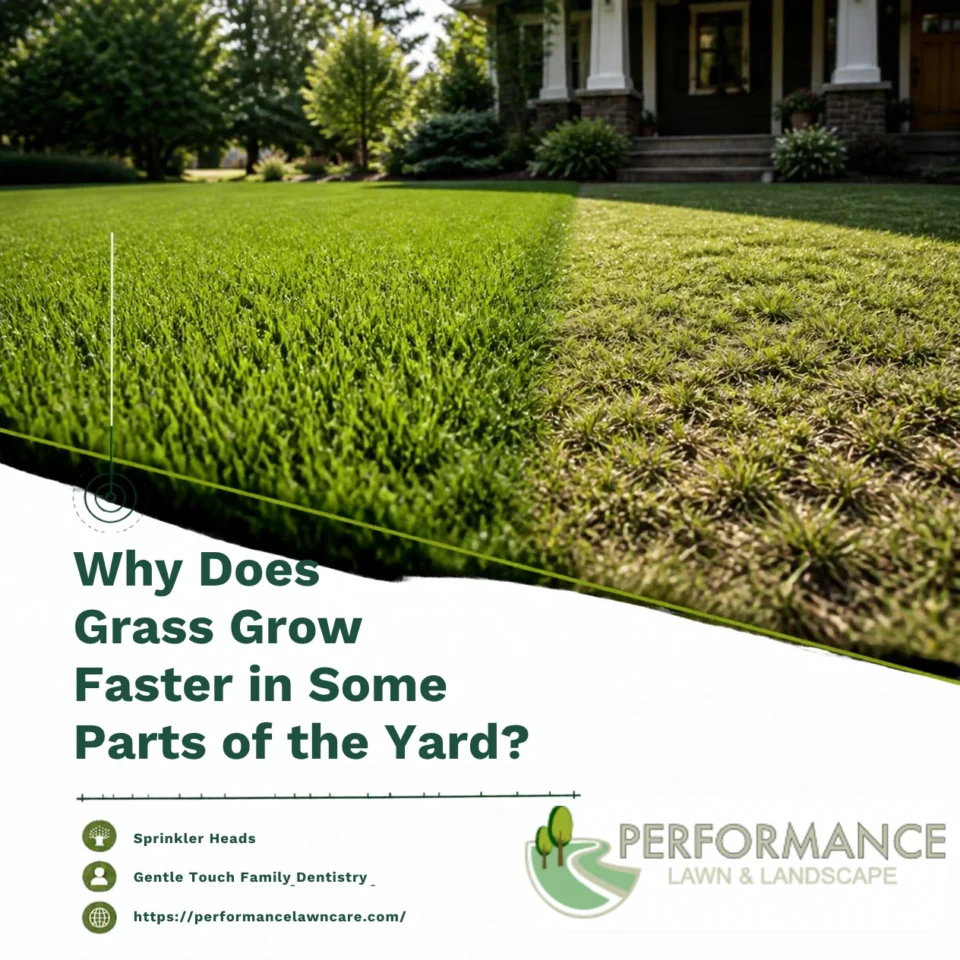
Uneven fertilizer distribution is one of the most common reasons some areas become darker green and grow faster than others.
This often occurs when:
- Spreader passes overlap
- Fertilizer spills during loading
- A spreader distributes unevenly
- Certain areas receive extra hand application
- Granules collect near pavement edges
- One section is fertilized more frequently
Nitrogen is especially important because it encourages leaf growth and green color.
If one area receives significantly more nitrogen, it may grow quickly and require more frequent mowing.
Typical signs of excess fertilizer in one area include:
- Darker green grass
- Rapid vertical growth
- Distinct stripes
- Growth following spreader patterns
- Burned areas in severe cases
Avoid immediately fertilizing slower-growing sections simply to make them match.
If fertilizer is not the real issue, adding more nutrients could worsen the imbalance.
It is better to consider recent application patterns and soil conditions first.
How Do Sun and Shade Change Lawn Growth Rates?
Sunlight affects photosynthesis, soil temperature, evaporation, and overall turf density.
Grass growing in full sun often behaves differently from grass under trees, beside buildings, or along fences.
Full-Sun Areas
Grass receiving plenty of sunlight may grow vigorously when water and nutrients are available.
However, full sun also dries soil faster during hot weather.
If irrigation is inadequate, sunny sections may actually grow more slowly than shaded areas.
Light Shade
Moderately shaded areas may stay cooler and hold moisture longer.
Under the right conditions, this can support steady growth.
Heavy Shade
Too much shade usually reduces grass growth.
Turf in deeply shaded areas may become:
- Thin
- Weak
- Pale
- Sparse
- More susceptible to disease
Grass species and varieties also differ in shade tolerance.
That means one part of a lawn may perform well while another struggles simply because of differences in daily sunlight.
Pay attention to how shade changes throughout the day and across the seasons.
Trees, fences, homes, and other structures can create very different growing environments within the same lawn.
Can Soil Conditions Make Some Areas Grow Faster?
Absolutely.
Soil conditions can vary significantly across a yard, even within relatively short distances.
Some areas may contain:
- More organic matter
- Deeper topsoil
- Better drainage
- Less compaction
- More favorable pH
- Better nutrient availability
- Different soil texture
Construction history can also create uneven soil.
One part of a lawn may contain quality topsoil while another may have compacted subsoil, buried construction debris, or heavily disturbed ground.
Soil Compaction
Compacted soil limits the movement of:
- Air
- Water
- Nutrients
- Grass roots
Grass growing in compacted areas may remain shorter, thinner, or less vigorous.
Soil Depth
Grass generally performs better where roots have enough usable soil.
Shallow soil over rock, hard clay, or construction material may limit growth.
Organic Matter
Areas containing more organic matter may hold water and nutrients more effectively.
This can result in healthier, faster-growing turf.
Soil pH
If soil pH differs significantly across the property, nutrient availability can change.
Testing the soil can help determine whether the growth difference is related to chemistry rather than simply water or fertilizer.
Does Irrigation Coverage Create Uneven Growth?
Yes, and irrigation problems are often easy to overlook.
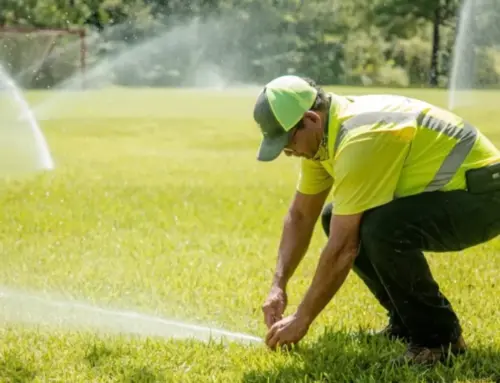
A sprinkler system may appear to be watering the entire yard while certain areas actually receive much more water than others.
Common causes include:
- Misaligned sprinkler heads
- Blocked spray patterns
- Uneven sprinkler spacing
- Low water pressure
- Damaged nozzles
- Different irrigation zones
- Overspray from neighboring heads
- Water running downhill
One area may receive overlapping coverage from two or three sprinkler heads while another receives only the outer edge of a spray pattern.
The result can be noticeable differences in growth.
Fast-growing areas may appear:
- Dark green
- Dense
- Frequently wet
- In need of mowing sooner
Underwatered sections may look:
- Dull green
- Thin
- Wilted
- Slow-growing
- Dry between watering cycles
A simple irrigation check can help identify uneven coverage.
Observe the system while it is running rather than assuming every sprinkler is performing correctly.
How Can Mowing Habits Affect Different Parts of the Lawn?
Mowing can influence how quickly different areas appear to grow.
Uneven mowing height is one possible cause.
This can happen when:
- The mower deck is uneven
- Tires sink into softer soil
- Slopes change cutting height
- Scalping occurs on high spots
- Different areas are cut in different directions
- Grass is allowed to grow too long before mowing
A section cut shorter than the rest may initially appear slower-growing simply because more leaf tissue was removed.
Meanwhile, grass left slightly taller can seem to grow faster because it reaches noticeable height sooner.
Mowing frequency also matters.
Removing too much of the grass blade at once can stress turf and temporarily slow growth.
Repeated scalping can weaken grass over time.
Using a consistent mowing height and keeping mower blades sharp can help support more uniform lawn growth.
What Should You Check When One Area Grows Much Faster?
If one section of the lawn consistently grows faster, inspect that area systematically.
Start with these questions.
Is the Area Wetter?
Check the soil after irrigation and rain.
Look for runoff, downspouts, sprinkler overlap, or low spots.
Is the Grass Darker Green?
Very dark green grass may indicate additional nitrogen or fertilizer.
Does the Pattern Follow Straight Lines?
Striping or rectangular growth patterns may point to fertilizer or irrigation coverage.
Is the Area Sunnier?
Compare the number of hours of direct sunlight with slower-growing sections.
Is the Soil Softer or Deeper?
Probe several areas to compare soil depth and compaction.
Is the Fast Growth Near Landscaping?
Mulch beds, compost, garden areas, or previous plantings may have contributed additional organic matter or nutrients.
Is There a Septic or Drainage Feature Nearby?
Certain underground features or moisture patterns can influence turf growth.
Does the Area Match an Irrigation Zone?
If faster growth follows the boundary of a sprinkler zone, watering frequency or coverage may explain the difference.
The shape and location of the growth pattern often provide more useful information than the grass itself.
How Can You Encourage More Even Lawn Growth?
Once the cause is identified, corrections should target that specific issue.
Possible solutions include:
Adjust Irrigation
Repair, reposition, or recalibrate sprinkler heads to improve coverage.
Avoid increasing the watering time for the entire lawn just because one dry area needs attention.
Improve Fertilizer Distribution
Use consistent spreader settings and avoid excessive overlap between passes.
Address Soil Compaction
Core aeration may help improve air, water, and root movement in compacted areas.
Improve Soil Conditions
Depending on testing results, the lawn may benefit from appropriate amendments or improved organic matter.
Correct Drainage Problems
Standing water, excessive runoff, or consistently wet areas may require drainage improvements.
Match Grass to Sunlight
Areas with heavy shade may need a more shade-tolerant turf variety or an alternative landscape approach.
Improve Mowing Consistency
Maintain a uniform mowing height and avoid removing excessive growth at once.
Changes should be gradual.
Trying to force slower-growing grass to catch up through heavy fertilizer or excessive irrigation can cause more damage than improvement.
When Should You Consider Professional Lawn Care?
Professional help can be useful when uneven growth continues despite basic adjustments.
Consider scheduling an evaluation when:
- One area stays consistently greener or taller
- Grass growth changes suddenly
- Irrigation coverage appears uneven
- Fertilizer results are inconsistent
- Soil is heavily compacted
- Large bare or weak areas are developing
- Drainage problems are present
- The lawn contains multiple grass types
- Previous treatments have not corrected the issue
At Performance Lawn and Landscape, lawn problems are evaluated based on the conditions affecting the property rather than assuming every uneven area needs more fertilizer or water.
A professional assessment can help distinguish between irrigation problems, soil conditions, nutrient issues, mowing patterns, shade, and other factors.
That matters because different causes require very different solutions.
For example, adding fertilizer will not fix a sprinkler coverage problem, and additional watering will not solve heavily compacted soil.
By identifying the underlying issue first, homeowners can make more targeted changes and work toward healthier, more consistent turf across the entire yard.
FAQs
Why is one patch of my grass growing much faster than the rest?
The area may be receiving more water, fertilizer, sunlight, or nutrients. Soil differences and irrigation overlap are also common causes.
Does dark green, fast-growing grass mean too much fertilizer?
It can. Excess nitrogen often produces rapid, dark green growth. Look for patterns that match fertilizer application paths before adding more fertilizer.
Can a sprinkler system cause uneven grass growth?
Yes. Overlapping sprinkler coverage can cause some areas to receive more water, while blocked or poorly positioned heads may leave other sections too dry.
Why does my grass grow faster near the house?
The area may receive runoff, irrigation overspray, shade, additional moisture, or different soil conditions. Observe the area throughout the day and after watering to identify the likely cause.
Does grass grow faster in sun or shade?
It depends on the grass variety and conditions. Moderate sunlight usually supports healthy growth, while excessive shade can weaken turf. Sunny areas may also dry faster and grow slowly if they do not receive enough water.
Can compacted soil cause slower grass growth?
Yes. Compaction limits root growth and reduces how easily water, air, and nutrients move through the soil.
Should I fertilize the slower-growing parts of my lawn?
Not until you know why they are growing slowly. Watering, shade, soil compaction, drainage, or irrigation coverage may be the real problem.
How do I make my lawn grow at the same rate everywhere?
Start by correcting differences in watering, fertilizer distribution, soil condition, sunlight, and mowing height. Completely uniform growth may not always be possible because conditions naturally vary across a property.