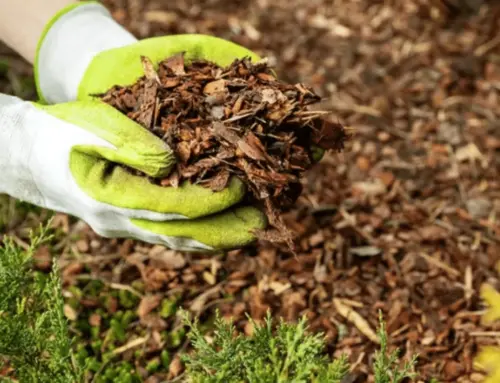

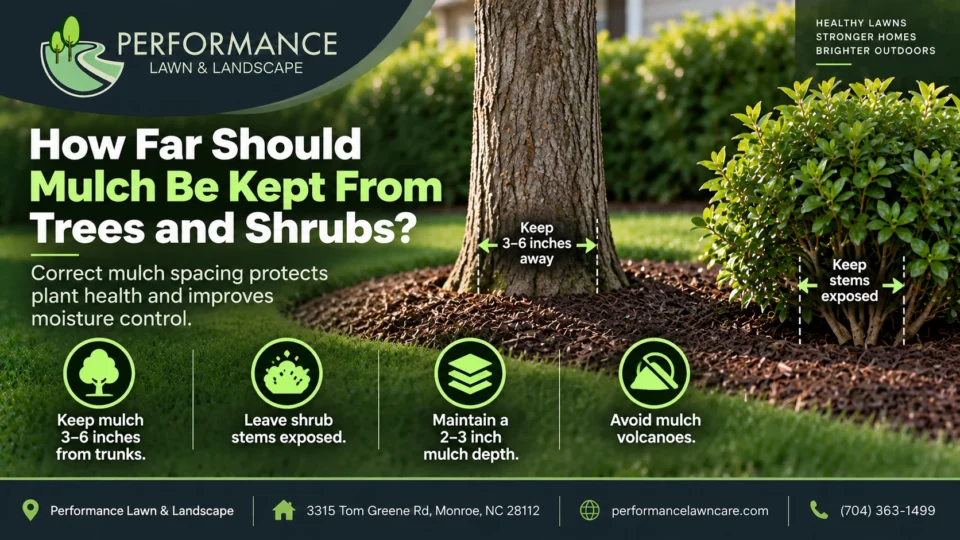
Mulch should be spread around trees and shrubs without being piled directly against their trunks or stems. As a practical rule, leave a few inches of open space around the base of the plant while keeping the mulch layer roughly 2 to 3 inches deep across the surrounding root zone.
The goal is to cover the soil, not the plant itself. Properly placed mulch helps conserve soil moisture, reduce weed competition, moderate soil temperatures, and protect roots. When mulch becomes too deep or is pushed against bark and stems, however, those same benefits can turn into moisture, root, pest, and disease problems.
Why Does Mulch Spacing Matter Around Trees and Shrubs?
Mulch works best when it protects the soil around a plant while allowing the trunk, root flare, or shrub stems to remain exposed to air.
Organic mulch can provide several useful benefits, including:
- Reducing moisture loss from the soil
- Moderating soil temperatures
- Limiting weed competition
- Protecting soil from erosion
- Reducing competition from turfgrass
- Helping protect trunks from mower and string-trimmer damage
Clemson Extension recommends organic mulch around shrubs partly because it helps retain moisture, moderate soil temperature, suppress weeds, and add organic matter as it decomposes.
Problems begin when homeowners treat mulch as something that should surround the trunk itself.
Tree bark and shrub stems are not designed to remain buried beneath damp mulch. Keeping a small gap around them allows air circulation and reduces the amount of time bark stays wet.
Think of mulch as a wide, shallow blanket over the soil rather than a mound around the plant.
How Far Should Mulch Be Kept From a Tree Trunk?
For most landscape trees, keeping mulch several inches away from the trunk is a good starting point.
Guidance varies somewhat according to tree age and site conditions. Penn State recommends keeping mulch roughly 3 to 5 inches away from young trees and farther away from mature trunks when correcting excessive mulching. Other Extension recommendations commonly advise leaving at least 2 to 3 inches between mulch and the trunk.
The exact measurement is less important than the basic principle:
Mulch should not be touching or covering the tree trunk.
A properly mulched tree should have a visible base rather than looking as though the trunk disappears vertically into a mound of mulch.
Ideally, you should also be able to see the tree’s root flare, the area where the trunk broadens as major roots begin spreading into the soil.
If you cannot see that flare because mulch is stacked around the trunk, gently pull the mulch outward.
For larger established trees, it is usually more beneficial to spread mulch farther across the root zone than to pile additional material near the trunk.
How Far Should Mulch Be Kept From Shrub Stems?
Shrubs also benefit from having mulch pulled back from their stems.
Clemson Extension recommends keeping mulch approximately 2 to 3 inches away from shrub trunks or stems rather than allowing it to touch them.
You do not need to create a perfectly measured circle around every shrub. The main objective is to prevent mulch from remaining packed tightly around the crown and stems.
For a multi-stemmed shrub, gently spread mulch around the outside of the plant rather than stuffing it between all the stems.
This becomes particularly important with shrubs that have dense branching near ground level. It is easy for workers or homeowners adding new mulch to accidentally bury the base because the soil line is difficult to see.
Periodically move the lower branches aside and check where the stems actually enter the soil.
If several inches of decomposed mulch have accumulated around the base over multiple seasons, simply adding another layer may eventually bury portions of the stems.
What Is the Correct Mulch Depth Around Plants?
For many trees and shrubs, approximately 2 to 3 inches of organic mulch provides a useful general target.
Some Extension guidance allows up to roughly 4 inches depending on the mulch material and site, but deeper is not automatically better. Penn State recommends approximately 2 to 4 inches around trees, while Clemson commonly recommends a 2- to 3-inch layer around shrubs and newly planted woody plants.
Mulch material also matters.
Coarse wood chips allow air and water to move differently than very fine shredded mulch. Pine straw behaves differently from hardwood bark. Soil type, drainage, slope, climate, and plant species can also affect how much mulch makes sense.
That is why homeowners should avoid treating a single depth measurement as an absolute rule for every landscape.
A good way to check is to push your fingers through the mulch until you reach soil. You may discover that a bed that appears to have only two inches of fresh mulch actually contains six inches of older material underneath.
Before ordering more mulch each season, check what is already there.
Why Is Piling Mulch Against Tree Trunks a Problem?
Piling mulch high around a tree trunk is commonly called volcano mulching because the mulch forms a cone or volcano shape around the tree.
It may look tidy from a distance, but it is not considered proper tree care.
Penn State specifically advises against volcano mulching because excessive mulch can interfere with oxygen availability around roots, keep trunk tissue excessively moist, encourage decay, contribute to disease problems, and interfere with normal root development.
One major issue is prolonged moisture against the bark.
Roots are adapted to functioning in soil. Trunk bark is different. When the lower trunk remains buried in wet organic material, the environment around the bark changes.
Over time, excessively deep mulch may also encourage roots to develop higher than they normally would. Roots growing within a deep mulch mound can sometimes circle the trunk or create other structural problems.
Penn State notes that adventitious roots forming in excessive mulch may eventually contribute to girdling roots that restrict normal transport within the tree.
Instead of building mulch upward, spread it outward.
A wide mulch ring generally provides more useful root-zone coverage than a tall mulch pile.
What Are the Signs of Too Much Mulch?
One of the easiest signs is simply that you cannot see where the trunk or stems naturally meet the soil.
Other potential warning signs include:
- Mulch piled several inches up the trunk
- A cone-shaped “mulch volcano”
- Tree trunks entering the mulch like telephone poles
- Constantly damp bark near ground level
- Soft, discolored, or deteriorating bark
- Roots growing visibly within the mulch
- Mushrooms or fungal activity around persistently damp areas
- Mulch that smells sour or remains saturated
- Declining or yellowing foliage without another obvious explanation
- New mulch repeatedly added over older layers
Do not assume that every mushroom or yellow leaf means mulch is responsible. Trees and shrubs can decline for many reasons.
Instead, look at the overall condition of the planting bed.
Dig carefully through the mulch in several locations. If the material is dramatically deeper than expected, pull some back and inspect the base of the plant.
Sometimes the correction is surprisingly simple. Penn State notes that excess mulch can often be redistributed outward instead of being removed entirely.
Can Excess Mulch Cause Root or Moisture Problems?
Yes.
Mulch is helpful because it slows moisture loss, but excessive mulch can keep the soil and plant base wetter for much longer than intended.
Roots require both moisture and oxygen.
When conditions remain excessively wet, oxygen availability within the soil can decline. Penn State identifies oxygen starvation, root decline, persistently wet bark, disease, and root problems among the potential consequences associated with excessive mulch.
Too much mulch can also make watering more confusing.
A homeowner may see dry mulch at the surface and assume the plant needs water, while the soil underneath is still very wet. Conversely, thick or compacted mulch can sometimes interfere with water reaching the soil evenly.
Instead of judging moisture by appearance alone, move the mulch aside and check the actual soil several inches below the surface.
The correct watering schedule depends on:
- Plant species
- Soil type
- Drainage
- Temperature
- Rainfall
- Sun exposure
- Plant age and establishment
- Mulch depth
Mulch helps manage moisture, but it should not replace checking what is happening in the root zone.
How Should Mulch Be Spread Around Newly Planted Trees?
Newly planted trees can benefit significantly from a properly sized mulch ring because their roots are still establishing.
Start by making sure the tree itself has been planted at the correct depth. The root flare should be visible rather than buried under soil or mulch.
Then:
- Spread mulch across the root-zone area.
A wider circle generally provides more benefit than a narrow ring piled deeply near the tree. - Aim for roughly 2 to 3 inches of mulch.
Keep the application relatively even rather than building a mound. - Pull mulch away from the trunk.
Leave several inches of open space so mulch does not directly contact the bark. - Keep the root flare visible.
Do not use mulch to cover a tree that appears planted too high or too low. - Water based on soil conditions.
Mulch reduces evaporation, so the soil may remain moist longer than exposed soil. - Expand the mulch ring when practical.
Keeping turfgrass away from the immediate root zone reduces competition and protects the trunk from mowing equipment.
The University of Minnesota Extension describes proper tree mulching as a wide “donut” rather than a volcano, with approximately 2 to 3 inches of mulch kept away from the trunk.
The difference in shape is simple but important.
A donut protects the soil.
A volcano buries the tree.
When Should Old Mulch Be Removed or Refreshed?
Mulch does not necessarily need to be replaced every year.
Organic materials gradually break down, fade, settle, and become part of the soil surface. That decomposition is normal.
Before adding new mulch, rake through the existing material and check its depth.
If you still have a healthy layer, you may only need to loosen or redistribute it. Penn State notes that lightly raking existing mulch may be enough to refresh its appearance and break up crusted or compacted areas.
Consider refreshing mulch when:
- The layer has decomposed significantly
- Bare soil is becoming exposed
- Weed suppression is declining
- Mulch has washed downhill or out of the bed
- The material has become badly compacted
- Appearance has noticeably deteriorated
Consider removing or redistributing some mulch when:
- The total depth has become excessive
- Mulch is piled against trunks or stems
- Several annual applications have accumulated
- The root flare has disappeared beneath mulch
- The base of shrubs has become buried
Do not automatically add two or three new inches simply because the mulch has faded.
Sometimes all that is needed is to turn or rake the existing material and add a thin fresh layer where necessary.
How Proper Mulching Supports Landscape Health
Mulching is one of the simpler landscape maintenance jobs, but the way it is done matters.
The ideal mulch bed should look broad and relatively flat, not like individual mountains surrounding every tree.
When properly placed, mulch can help maintain more consistent soil moisture, moderate temperature fluctuations, reduce weeds, protect soil, and keep lawn equipment farther away from trunks.
Just remember three basic principles:
Keep it shallow. Keep it wide. Keep it off the trunk and stems.
It is also worth checking established beds every year. Landscapes change over time, mulch decomposes, tree trunks expand, shrub bases become denser, and repeated applications can gradually raise the soil surface.
A bed that was mulched correctly five years ago may now have far more material than it needs.
Give Your Trees and Shrubs a Healthier Foundation
A fresh layer of mulch can instantly make a landscape look more finished, but good mulching should do more than improve curb appeal.
At Performance Lawn & Landscape, we look at mulch placement as part of the overall health of your landscape. Proper depth, clean bed edges, appropriate spacing around plants, and attention to drainage and soil conditions can help trees and shrubs perform better while giving your property a well-maintained appearance.
If mulch has built up around your trees, your shrub beds need refreshing, or you are unsure how much material your landscape actually needs, our team can help evaluate the beds and apply mulch where it provides the most benefit without burying the plants underneath it.
FAQs
Should mulch touch the trunk of a tree?
No. Mulch should cover the surrounding soil rather than being packed against the tree trunk. Leaving several inches of separation helps keep the trunk dry and allows the root flare to remain visible.
Is 4 inches of mulch too much?
Not necessarily, but it is near the upper end of commonly recommended depths for many landscape trees. Approximately 2 to 3 inches is often sufficient. Material type, soil conditions, drainage, and the amount of existing mulch should all be considered before adding more.
How close should mulch be to bushes?
A practical guideline is to leave approximately 2 to 3 inches between mulch and the shrub’s main stems or crown. The important point is that mulch should not remain tightly packed against living stems. Clemson Extension recommends maintaining this type of separation when mulching shrubs.
What does proper mulch around a tree look like?
Properly applied mulch usually looks like a wide, relatively flat ring around the tree. The mulch should be only a few inches deep, and the trunk and root flare should remain visible. It should resemble a donut rather than a volcano.
Should you remove old mulch before adding new mulch?
Not every time. First check the existing depth. If plenty of mulch remains, rake or redistribute it rather than automatically adding another full layer. Add enough new material only to restore an appropriate overall depth.
Why is volcano mulching bad for trees?
Volcano mulching keeps mulch piled against the trunk and can maintain excessive moisture around bark, interfere with root-zone oxygen conditions, contribute to decay and disease, and encourage abnormal root development. Extension horticulture guidance consistently recommends spreading mulch outward instead of piling it around the trunk.