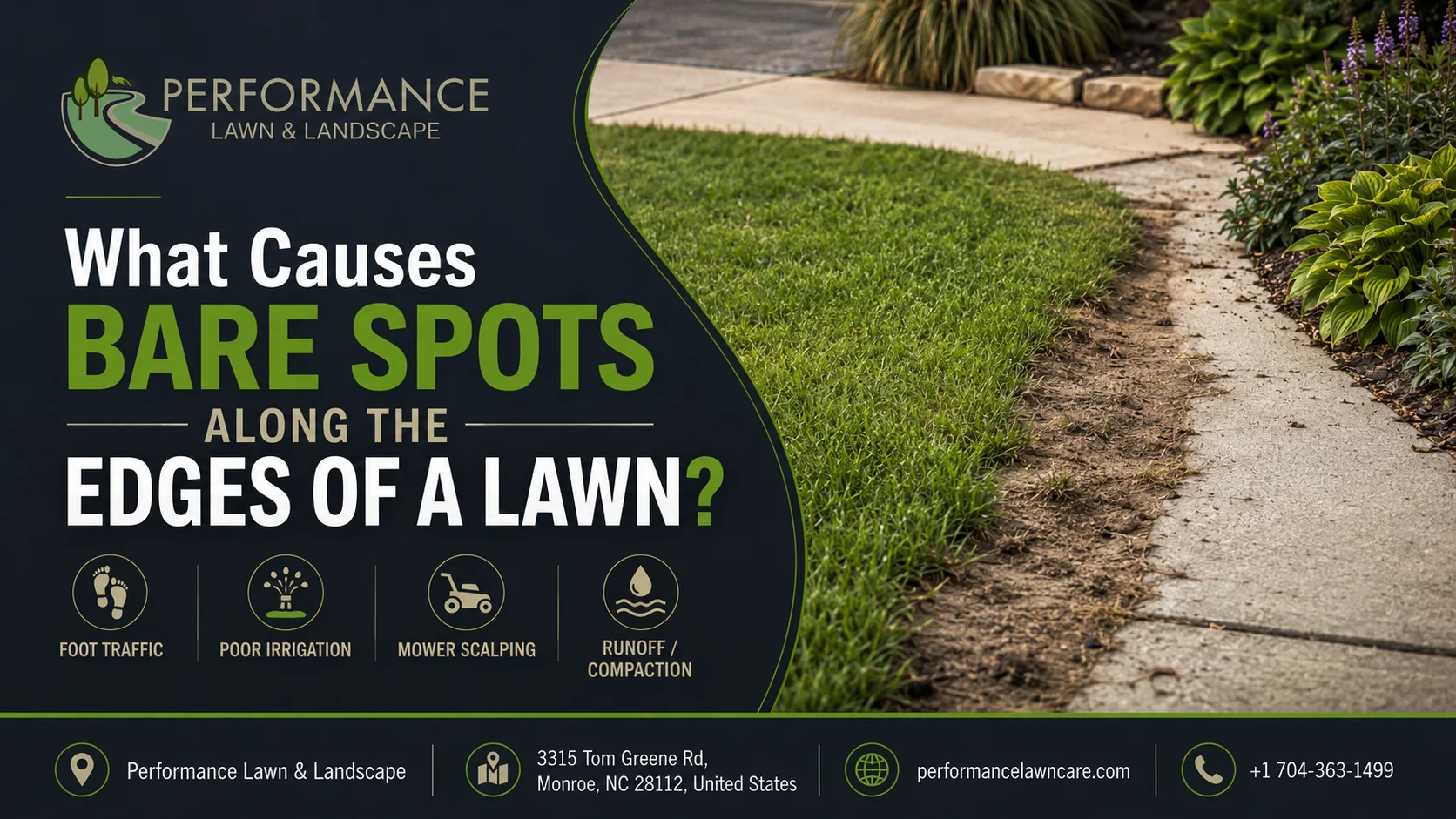
Bare spots along edges of lawn are often caused by heat, dry soil, uneven sprinkler coverage, string-trimmer damage, foot traffic, soil compaction, shade, or nearby landscape features.
The pattern of the damage often provides the best clue. A narrow strip beside pavement may point to heat, irrigation, or trimming issues, while bare grass near a gate may be more closely related to repeated traffic.
Before reseeding, fertilizing, or replacing the turf, identify what is stressing the grass. Otherwise, the same bare spots may return.
At Performance Lawn & Landscape, we recommend evaluating the conditions around the damaged area before deciding how to repair it.
Why Do Bare Spots Along Edges of Lawn Develop?
Grass along lawn borders often faces more stress than turf farther into the yard.
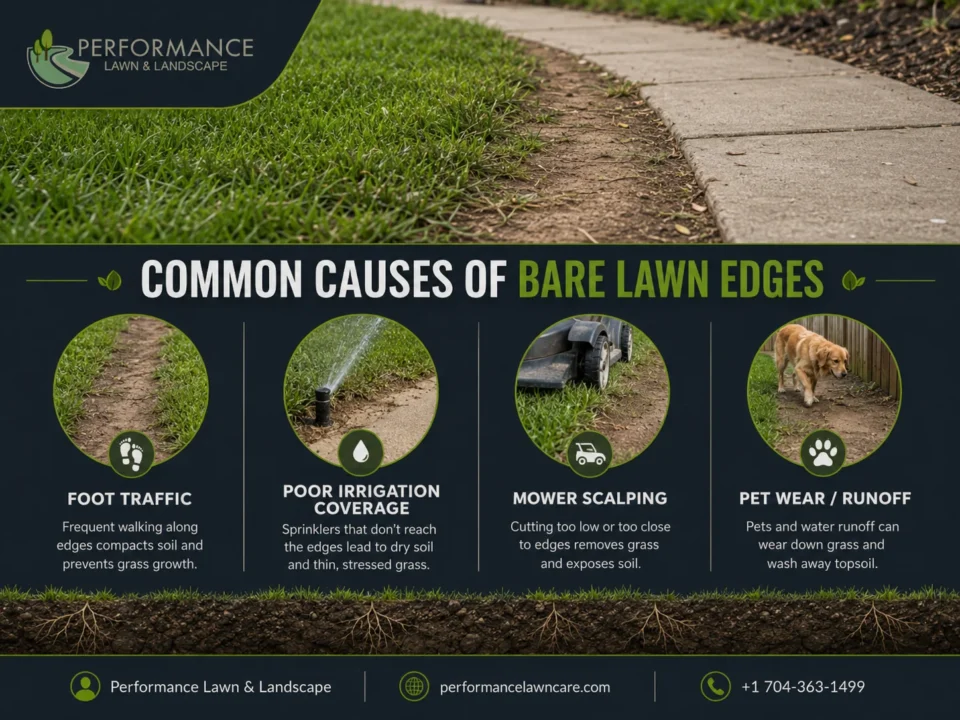
Common causes of bare spots along edges of lawn include:
- Faster soil drying
- Heat from concrete or asphalt
- Uneven irrigation coverage
- String-trimmer damage
- Foot traffic
- Lawn equipment
- Soil compaction
- Mulch covering nearby turf
- Shade from fences or structures
- Competition from tree or shrub roots
- Poor soil conditions
- Nutrient limitations
The location and shape of the damage can help narrow down the cause.
A thin strip of brown or bare grass directly beside a driveway may indicate heat, dry soil, poor sprinkler coverage, or trimming damage.
A worn area near a gate may be caused by repeated foot traffic.
Grass thinning beside a landscape bed may be affected by shade, roots, mulch, irrigation differences, or disturbed soil.
Instead of assuming every bare edge has the same problem, look closely at what is happening around that specific section of lawn.
Why Does Grass Near Pavement Dry Out Faster?
Grass beside driveways, sidewalks, curbs, and other hard surfaces can dry more quickly than grass farther into the lawn.
Hard surfaces do not retain moisture the way soil does, and they can contribute to warmer conditions around nearby turf.
Irrigation coverage can also be less effective near pavement.
Sprinkler systems are often positioned to avoid excessive overspray onto sidewalks and driveways. If the spray pattern falls slightly short, the grass closest to the pavement may consistently receive less water than the rest of the lawn.
You may notice:
- Green grass farther from the pavement
- Thinning grass closer to the edge
- Brown or bare turf directly beside the hard surface
- Soil near the edge drying faster than surrounding areas
Soil beside pavement may also be shallower or contain construction material beneath the surface, causing it to lose moisture more quickly.
Before assuming disease or a nutrient problem is responsible, compare soil moisture near the bare edge with soil farther into the lawn.
Can Heat From Driveways and Sidewalks Cause Bare Lawn Edges?
Yes. Hard surfaces can contribute to heat stress in nearby grass.
Concrete, asphalt, brick, and stone can absorb heat during sunny weather and release it around the lawn edge.
Grass growing immediately beside pavement may therefore experience hotter and drier conditions than turf only a short distance away.
Signs may include:
- Wilting
- Browning
- Dry soil
- Thinning turf
- Reduced turf density
Heat stress may be more noticeable beside dark pavement or in areas exposed to strong afternoon sun.
Heat is often only part of the problem.
If the same area also receives poor sprinkler coverage or has shallow soil, the combined stress can cause the grass to decline more quickly.
When bare spots along edges of lawn repeatedly appear beside pavement, evaluate heat exposure, soil moisture, irrigation coverage, and soil depth together.
Can String Trimmers Cause Bare Spots Along Edges of Lawn?
Yes.
String trimmers are useful for creating clean lawn borders, but repeated trimming too close to the ground can damage turf.
Damage occurs when the trimmer line repeatedly cuts too low and injures the grass instead of only trimming the blades.
Signs of string-trimmer damage may include:
- A narrow bare strip
- Damage following the exact edge of a sidewalk or landscape bed
- Grass that appears scalped
- Exposed soil immediately beside the border
- Similar damage appearing after routine trimming
String-trimmer damage is especially common around curbs, fence posts, trees, and landscape edging where trimming happens in a tight area.
The pattern is the key clue.
If the bare strip follows the border almost perfectly, repeated trimming damage becomes a strong possibility.
Can Foot Traffic and Soil Compaction Cause Bare Lawn Edges?
Yes.
Areas beside driveways, sidewalks, gates, and other lawn borders often receive repeated foot traffic.
People may step onto the same strip of grass when getting out of vehicles, walking through a gate, carrying items across the yard, or moving between outdoor spaces.
Repeated pressure can wear away the grass and make the soil underneath denser.
Compacted soil can make it harder for:
- Roots to grow deeper
- Water to enter the soil
- Air to move through the root zone
- Turf to recover from stress
Lawn equipment can also contribute.
Mower tires, wheelbarrows, trailers, and landscaping equipment may repeatedly travel along the same borders.
Compaction is not the only possible cause of bare spots along edges of lawn. Dry soil, heat, poor irrigation, and disturbed construction soil can create similar symptoms.
Look for hard soil, repeated traffic, poor water absorption, and weak turf occurring together.
Why Does Grass Struggle Near Fences and Landscape Beds?
Grass beside fences and landscape beds faces different challenges from turf near open lawn areas.
Shade
Fences, shrubs, and structures can reduce the amount of sunlight reaching the grass. Turf that does not receive enough light may become thin even when water and nutrients are adequate.
Root competition
Trees, shrubs, and ornamental plants can compete with nearby grass for water and nutrients. Turf closest to the landscape bed may struggle more during dry conditions.
Mulch movement
Mulch can spread beyond the edge of a landscape bed and cover nearby grass. If turf remains covered, it may receive less light and gradually weaken.
Different soil conditions
Soil near landscape beds may have been disturbed during installation or may contain different amounts of topsoil, fill material, or construction debris.
These conditions can create a noticeable change in turf quality along the lawn border.
Can Poor Sprinkler Coverage Cause Bare Spots Along Lawn Edges?
Yes. Uneven irrigation is one of the first things worth checking when lawn edges become thin or bare.
Sprinkler systems do not always distribute water evenly across every part of a yard.
The center of the lawn may receive adequate coverage while the outer edge receives significantly less.
Common irrigation-related clues include:
- Dry soil only near the border
- Green turf farther from the edge
- Grass that improves after rainfall but declines during dry periods
- Sprinkler patterns stopping short of the damaged area
- Water hitting pavement while nearby grass remains dry
Sprinkler heads can also become blocked, tilted, damaged, or obstructed by growing plants.
Avoid assuming that running the irrigation system longer will solve the problem.
If coverage is uneven, increasing watering time can overwater parts of the lawn while the edge still receives too little.
The first step is determining whether the damaged area is actually receiving enough water.
Can Fertilizer Fix Bare Spots Along Lawn Edges?
Not always.
Nutrient problems can contribute to weak, pale, or thin grass, but they usually do not explain a narrow bare strip unless soil conditions along the border are different.
Fertilizer will not correct damage caused by:
- Heat stress
- Poor sprinkler coverage
- String-trimmer damage
- Heavy traffic
- Severe soil compaction
- Excessive shade
- Mulch covering the turf
Soil near a driveway, sidewalk, or landscape bed may also differ from soil in the rest of the yard.
Topsoil may be shallower, construction material may be present beneath the surface, or nearby plants may compete with the grass.
Fertilization is most useful when nutrients are actually limiting growth and the turf also has suitable sunlight, moisture, and soil conditions.
How Can You Repair Bare Spots Along Lawn Borders?
Repair should begin with identifying the cause.
Before reseeding, plugging, replacing sod, or applying fertilizer, determine why the grass disappeared.
Check the following:
- Sunlight
Does the area receive enough light for the grass type? - Water coverage
Does irrigation reach the entire lawn edge? - Soil moisture
Is the soil near the bare spot significantly drier than nearby turf? - Traffic
Are people, pets, or equipment repeatedly crossing the area? - Trimming practices
Is the grass being cut too aggressively along the border? - Soil condition
Does the soil feel unusually hard, shallow, or filled with debris? - Nearby landscaping
Are mulch, roots, plants, or landscape materials affecting the turf?
Once the cause is corrected, repair the area using a method appropriate for the grass type, season, and size of the bare spot.
Some small areas may recover naturally as surrounding turf spreads. Other sections may require seed, plugs, or sod.
Repairing the grass without correcting the original stress often leads to the same bare area returning.
How Can You Prevent Bare Lawn Edges From Returning?
Long-term prevention depends on reducing the stress that caused the problem.
If the lawn edge dries out because sprinkler coverage is poor, irrigation distribution should be corrected.
If trimming damage is responsible, the trimming technique should change.
If repeated foot traffic is wearing down the same strip, redirecting traffic may help protect the turf.
Useful preventive practices include:
- Checking sprinkler coverage periodically
- Avoiding repeated scalping with string trimmers
- Limiting unnecessary foot or equipment traffic
- Keeping mulch inside landscape beds
- Monitoring grass beside hot pavement
- Maintaining an appropriate mowing height
- Addressing soil compaction when it is present
- Maintaining appropriate lawn fertilization
- Watching for increasing shade as trees and shrubs grow
Pay particular attention to lawn borders during hot or dry weather.
Edges often show stress sooner than the center of the lawn because they may experience more heat, less moisture, and greater physical wear.
What Matthews Homeowners Should Know About Bare Lawn Edges
Bare spots along edges of lawn in Matthews can develop from several overlapping conditions.
Hot pavement, dry soil, repeated foot traffic, irrigation differences, trimming practices, fences, landscape beds, and soil conditions can all affect grass growing along property borders.
A useful first step is comparing the damaged area with healthy turf nearby.
Ask:
- Is the soil noticeably drier near the pavement?
- Does irrigation reach the damaged area?
- Does the bare strip follow trimming or traffic patterns?
- Are shade, mulch, or nearby landscaping affecting the grass?
Those differences can help narrow down what is stressing the lawn.
At Performance Lawn & Landscape, we recommend identifying the conditions affecting the area before assuming every bare spot needs the same treatment.
Lawn maintenance, fertilization, irrigation, soil conditions, sunlight, and traffic can all influence turf health. The right solution begins with determining why the grass is struggling.
Correcting the cause first gives repaired or recovering turf a better chance of staying healthy.
Frequently Asked Questions
Why is grass dying along my sidewalk?
Grass beside a sidewalk may experience more heat, faster soil drying, poor sprinkler coverage, trimming damage, or repeated foot traffic. Check the pattern of the damage along with soil moisture and irrigation coverage before assuming one specific cause.
Can sidewalk heat cause bare grass?
Yes. Concrete and other hard surfaces can absorb and release heat, increasing stress on nearby turf during hot weather. The effect may be stronger when the grass also receives limited water or grows in shallow soil.
Can a string trimmer kill grass along the edge?
Repeated trimming too close to the ground can injure grass and create thin or bare strips. Damage that closely follows the exact shape of the lawn border is a common clue.
Why does my sprinkler miss the edge of the lawn?
Sprinkler heads may be positioned to limit water spraying onto pavement, or the spray pattern may be blocked, damaged, or poorly aligned. Check actual water coverage instead of assuming the lawn edge receives the same amount as the center.
Will fertilizer fix bare spots along a driveway?
Not necessarily. Fertilizer may help when nutrients are limiting growth, but it will not correct heat stress, poor irrigation, trimming damage, shade, traffic, or severe soil compaction.
Why is the grass bare near my fence?
Grass near a fence may receive less sunlight, compete with nearby plant roots, experience repeated traffic, or grow in disturbed soil. Mulch and irrigation differences can also contribute to bare or thin turf.
Should I reseed a bare lawn edge immediately?
It is usually better to identify and correct the underlying problem first. New grass may fail again if heat, poor irrigation, traffic, trimming damage, or another source of stress remains.
When should I call a lawn professional about bare edges?
Consider a professional evaluation when bare spots keep returning, continue spreading despite routine care, or appear to involve several possible causes such as irrigation, soil conditions, traffic, and nutrient management. Identifying the underlying problem can help determine what should be corrected before the turf is repaired.