
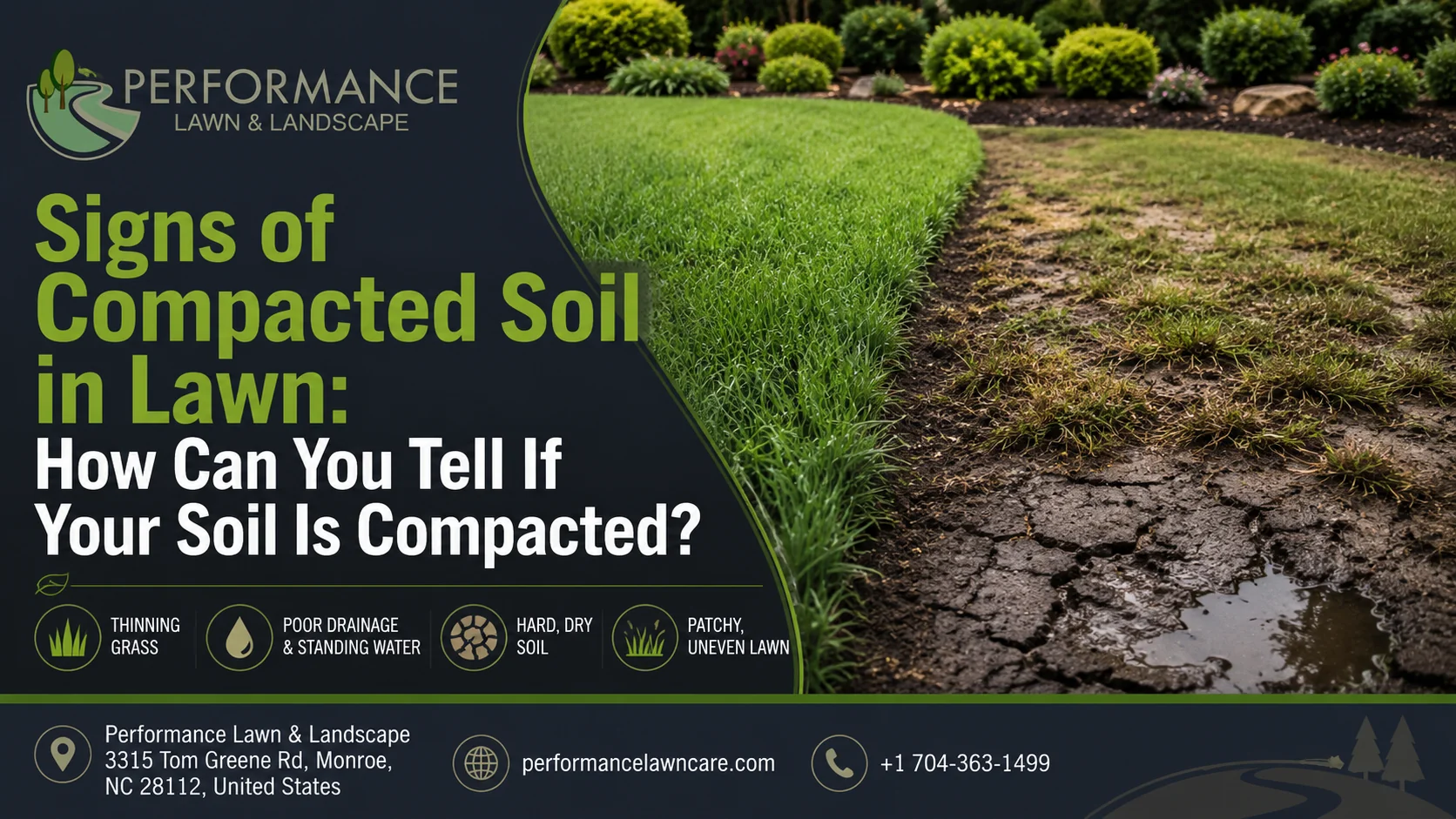
Compacted soil can make a lawn look thin, dry, or stressed by limiting root growth and reducing how easily water and air move through the soil. Common signs of compacted soil in lawn include hard ground, shallow roots, weak turf, bare patches in high-traffic areas, and water running across the surface instead of soaking in.
These symptoms do not always mean compaction is the problem. Shade, drainage issues, disease, improper watering, nutrient deficiencies, and other lawn conditions can create similar symptoms.
The best way to identify possible soil compaction is to look for several signs occurring together and pay attention to where the problems appear.
At Performance Lawn & Landscape, we recommend evaluating the overall condition of the lawn before assuming one treatment will solve the problem.
What Is Compacted Soil?
Soil compaction happens when soil particles are pressed tightly together.
Healthy soil contains spaces between particles that allow air and water to move through the ground. Grass roots use these spaces to grow deeper and spread through the soil.
When repeated pressure compresses the soil, those spaces become smaller. The ground can become denser, harder, and more difficult for roots to penetrate.
Compaction does not always affect an entire lawn evenly. One section may be heavily compacted while another remains relatively loose.
Common problem areas include:
- Frequently used walking paths
- Areas where children or pets regularly play
- Sections near gates or entrances
- Places where lawn equipment repeatedly travels
- Areas where vehicles have crossed the lawn
- Soil disturbed during construction or landscaping
Where the problem occurs can provide an important clue when looking for signs of compacted soil in lawn.
What Are the Signs of Compacted Soil in Lawn?
Several lawn conditions may indicate that the soil has become compacted.
One sign alone does not confirm compaction, but several appearing in the same area make it more likely.
Hard or Difficult-to-Penetrate Soil
One of the most common signs of compacted soil in lawn is ground that feels unusually hard.
If pushing a screwdriver, soil probe, or similar garden tool into the ground takes considerable effort, the soil may be dense.
Extremely dry soil can also become hard, so this test is most useful when you compare different areas of the lawn under similar moisture conditions.
Thin or Weak Grass
Grass growing over compacted soil may become thin because its roots cannot grow as freely.
You may notice sections where the turf remains sparse or weak even though nearby areas receive similar sunlight, irrigation, and routine lawn care.
Bare Areas in High-Traffic Locations
Bare or thinning patches near walkways, gates, patios, play areas, or other heavily used parts of the lawn can indicate repeated pressure.
Foot traffic may damage grass directly while also compressing the soil underneath.
When grass repeatedly struggles in the same high-traffic area, compaction may be contributing to the problem.
Shallow Roots
Compacted soil can restrict downward root growth.
If you inspect a small section of turf and notice that most of the roots remain close to the surface, dense soil may be one possible cause.
A shallow root system can also make grass more vulnerable during periods of heat or limited rainfall.
Slow Water Absorption
Water that remains on the surface or takes a long time to soak into the soil can be another sign of compaction.
Dense soil has less open space for water to enter and move through the root zone.
Increased Runoff
If irrigation or rainfall regularly moves across the surface instead of soaking into the lawn, compaction may be contributing.
Runoff can also result from slopes, clay-heavy soils, excessive irrigation, or drainage problems, so it should be considered alongside other signs.
Compaction becomes more likely when hard soil, weak turf, shallow roots, poor water absorption, and heavy traffic occur in the same area.
How Can You Check Your Lawn for Soil Compaction?
Homeowners can make several simple observations before deciding whether a more detailed evaluation is necessary.
One method is to compare how easily a screwdriver or similar tool enters different sections of the lawn.
Choose one area where the grass appears healthy and another where you suspect compaction.
If the tool enters the healthy area relatively easily but meets much more resistance in the struggling area, denser soil may be contributing.
Try to make the comparison when soil moisture is reasonably similar. Very dry ground can be difficult to penetrate even when severe compaction is not present.
You can also observe how water behaves after moderate rainfall or irrigation.
Ask:
- Does water soak into the soil within a reasonable period?
- Does it collect on the surface?
- Does it run toward sidewalks, driveways, or lower areas?
- Do some parts of the lawn absorb water more slowly than others?
Location matters as well.
If thin or bare turf follows a walking path or appears where equipment repeatedly travels, soil compaction becomes a more likely explanation.
These observations are useful indicators, but they should not be treated as definitive tests on their own.
Why Does Compacted Soil Make It Harder for Grass to Grow?
Grass roots need space to grow through the soil.
As soil becomes denser, roots have a harder time moving between tightly packed particles. In heavily compacted areas, roots may remain closer to the surface rather than extending deeper into the ground.
Shallow roots have access to less moisture and fewer nutrients during stressful conditions.
Roots also need oxygen. When pore space in the soil is reduced, air movement can become more limited, creating a less favorable environment for healthy root growth.
The result may be grass that appears:
- Thin
- Weak
- Slow-growing
- Less resilient during dry weather
- More difficult to establish in problem areas
This is why adding more fertilizer or watering more frequently may not correct a lawn problem when compacted soil is limiting root development.
How Does Soil Compaction Affect Water and Drainage?
Compacted soil can change the way water moves through a lawn.
When soil particles are tightly compressed, water may enter the ground more slowly. Instead of moving into the root zone, rainfall or irrigation may stay near the surface or travel sideways.
You may notice:
- Puddling after watering
- Water running toward sidewalks or driveways
- Certain areas staying wet on the surface
- Dry-looking turf despite frequent irrigation
- Uneven moisture across the lawn
A compacted lawn can sometimes have water sitting on the surface while grass roots underneath still struggle to access adequate moisture.
However, standing water or runoff does not automatically mean the soil is compacted.
Poor grading, low spots, heavy clay soil, excessive irrigation, and other drainage problems can create similar conditions.
Look at water behavior together with other signs of compacted soil in lawn before deciding that compaction is the primary cause.
What Causes Soil Compaction in a Lawn?
Soil compaction is usually caused by repeated pressure.
Occasional traffic may have little effect, but repeated pressure on the same area can gradually make the soil denser.
Common causes include:
- Frequent foot traffic
- Children playing in the same area
- Pets running along established routes
- Riding lawn equipment
- Heavy landscaping equipment
- Vehicles driving or parking on the lawn
- Construction activity
- Repeated wheelbarrow or equipment paths
Traffic-related compaction often develops along predictable routes.
A path between the driveway and backyard, the area around a gate, or the lawn surrounding a play space may receive much more pressure than other sections.
Construction can also create long-term soil problems.
Heavy machinery, grading equipment, vehicle traffic, and material storage may compress the soil before the lawn is established. Once grass is installed, the surface may appear normal even though the soil underneath remains dense.
Soil type can also influence how easily compaction develops. Some soils are more likely to become dense when repeatedly subjected to pressure.
How Can You Tell Compaction From Other Lawn Problems?
One challenge with identifying signs of compacted soil in lawn is that many symptoms overlap with other problems.
Thin grass may result from excessive shade.
Weak turf may be related to irrigation or nutrient issues.
Bare patches can result from insects, disease, pet activity, heavy wear, or environmental stress.
Standing water may result from grading, drainage, or soil conditions unrelated to compaction.
The overall pattern is more useful than any single symptom.
Compaction becomes more likely when several conditions occur together, such as:
- Hard soil
- Shallow roots
- Thin turf
- Heavy traffic
- Slow water absorption
- Runoff in the same area
Location can provide another clue.
If thin grass appears beneath a heavily shaded tree but the soil remains relatively loose, sunlight may be a more important factor.
If weak turf appears along a frequently traveled path where the ground is noticeably harder and water struggles to soak in, compaction becomes a stronger possibility.
Accurate lawn diagnosis requires looking at the complete set of conditions rather than focusing on one symptom.
When Can Aeration Help Compacted Soil?
Core aeration is commonly used when soil compaction is interfering with healthy turf growth.
The process removes small plugs of soil from the lawn, creating temporary openings that can improve access for air and moisture while giving roots more room to grow.
Aeration is most useful when compaction is actually contributing to the lawn problem, not simply because the turf looks unhealthy.
A lawn struggling because of deep shade, improper irrigation, disease, or another unrelated issue may not improve simply because it is aerated.
Timing also matters.
Warm-season and cool-season grasses have different periods of active growth, so they should not automatically be aerated on the same schedule.
The first step is confirming whether soil compaction is actually contributing to the problem.
When Should You Consider a Professional Lawn Evaluation?
Some signs of compacted soil in lawn are easy to recognize. Others can be difficult to separate from drainage, irrigation, soil, or turf problems.
A professional lawn evaluation may be useful when:
- Large sections of the lawn remain thin despite routine care
- Water consistently fails to absorb properly
- The soil feels hard across multiple areas
- Turf repeatedly struggles in heavily traveled sections
- The property recently experienced construction or grading
- Previous lawn treatments have produced little improvement
- You are unsure whether the problem involves compaction, drainage, irrigation, soil conditions, or another issue
Looking at the property as a whole can be particularly important when water problems are involved.
Standing water, poor infiltration, and runoff may result from compaction, grading, soil type, irrigation practices, or several factors working together.
Identifying the likely cause can help avoid unnecessary treatments.
What Weddington Homeowners Should Know About Soil Compaction
Lawn conditions in Weddington can vary considerably based on construction history, soil characteristics, landscape design, traffic, irrigation, and how the property is used.
Compaction may appear in obvious locations such as pathways, gates, and play areas. In other cases, it may be related to earlier construction or grading activity beneath an established lawn.
A useful starting point is comparing healthy areas of the lawn with struggling sections.
Ask yourself:
- Does the problem area feel noticeably harder?
- Does water soak into one section but run off another?
- Do bare or thin areas follow regular traffic patterns?
Those differences can provide useful clues about whether compaction may be contributing.
At Performance Lawn & Landscape, we recommend identifying the conditions affecting a lawn before assuming that one treatment will solve every problem.
Compacted soil can contribute to weak turf, poor water absorption, and limited root growth, but similar symptoms may also come from shade, irrigation, drainage, disease, or other environmental conditions.
Understanding the likely cause gives you a better foundation for deciding what your lawn actually needs.
Frequently Asked Questions
What are the main signs of compacted soil in lawn?
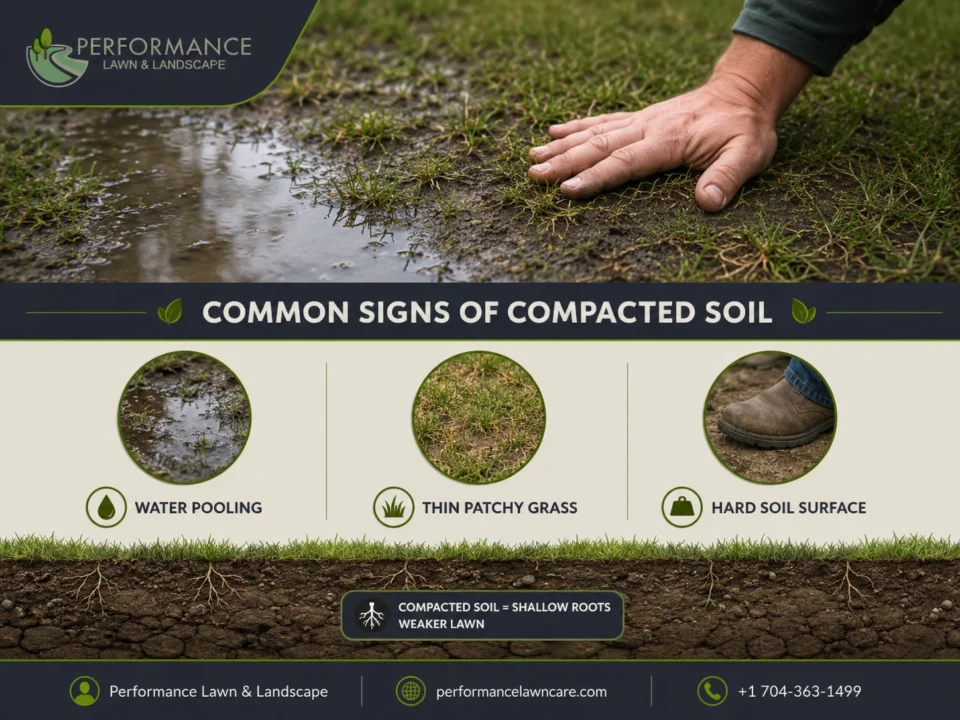
Common signs of compacted soil in lawn include hard ground, thin or weak grass, shallow roots, bare areas in high-traffic locations, slow water absorption, and increased runoff. Because these symptoms can have other causes, compaction is more likely when several signs appear together.
How can I check my lawn for soil compaction at home?
Try pushing a screwdriver or similar tool into several parts of the lawn and comparing the resistance. You can also observe whether water soaks into the soil or runs across the surface. These observations can indicate possible compaction but should not be treated as definitive tests.
Can walking on a lawn compact the soil?
Yes. Repeated foot traffic along the same route can gradually compress the soil. Paths near gates, patios, play areas, and other frequently used sections of a lawn are common locations for traffic-related compaction.
Does standing water always mean my soil is compacted?
No. Compaction can reduce water infiltration, but standing water can also result from grading problems, low areas, heavy soil, excessive irrigation, or other drainage issues. Look for additional signs of compacted soil in lawn before identifying the cause.
Does hard soil automatically mean it is compacted?
Not necessarily. Very dry soil can feel hard even when severe compaction is not present. Soil type can also affect how firm the ground feels, so compare several parts of the lawn and look for other symptoms.
Will aeration help compacted lawn soil?
Core aeration can be useful when compaction is limiting root growth, water movement, or air movement through the soil. However, aeration will not correct every cause of thin or unhealthy grass, which is why identifying the underlying problem is important.
Can new construction cause soil compaction?
Yes. Construction equipment, grading, vehicle traffic, and material storage can compress soil before a lawn is established. In some properties, that underlying compaction can continue affecting turf long after construction is complete.
When should I call a lawn professional about compacted soil?
Consider a professional evaluation when the problem affects large areas, repeatedly returns despite routine care, or could involve several possible causes such as compaction, drainage, irrigation, and soil conditions. A broader evaluation can help determine what is actually affecting the lawn.