Water collecting on a paver patio usually points to a drainage, grading, or base issue rather than a problem with the pavers themselves. A patio should be built so rainwater moves away from structures and does not remain trapped in low areas for long periods.
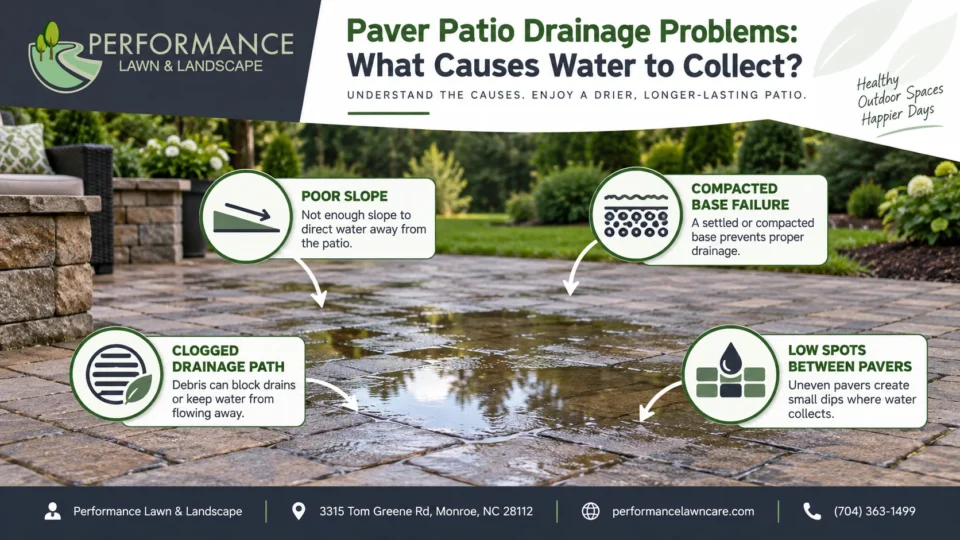
Common paver patio drainage problems include an incorrect slope, settling beneath the pavers, clogged drains, shifting soil, and uneven areas that develop over time. Some problems can be corrected with localized repairs, while others may require a larger portion of the patio to be lifted and regraded. Identifying where the water comes from and why it is not draining properly is the first step.
Why Is Water Collecting on My Paver Patio?
Standing water develops when water reaches the patio faster than it can move away or soak into the surrounding drainage system.
Possible causes include:
- Low spots in the patio surface
- An insufficient or incorrect slope
- Settled base material
- Soil movement beneath the patio
- Clogged drains or drainage channels
- Downspouts directing water toward the patio
- Poor grading around the patio
- Pavers that have shifted out of position
- Drainage outlets that are too high, blocked, or poorly located
The location of the water can provide useful clues.
A small puddle confined to one area may indicate localized settling. Water covering a large section of the patio may suggest that the overall slope or surrounding grade is incorrect.
Homeowners should also pay attention to what happens during rainfall. Water flowing onto the patio from the lawn, roof, or another hardscape area may indicate that the problem is larger than the patio surface itself.
How Does Incorrect Patio Slope Cause Drainage Problems?
A paver patio normally needs a slight slope so gravity can move water toward an appropriate drainage area.
If the patio is too flat, water may remain on the surface instead of flowing away. If it slopes in the wrong direction, water may collect near the house, foundation, steps, or retaining walls.
Drainage issues can occur when:
- The original slope was insufficient
- The patio was installed completely level
- Part of the patio has settled
- Surrounding landscaping was changed
- Soil was added around the patio
- A nearby walkway or hardscape redirects runoff
Even a patio that originally drained properly can develop slope problems if one section settles more than another.
A professional assessment can determine whether the problem is isolated or whether the overall patio elevation needs to be corrected.
Can a Settling Base Create Low Spots and Standing Water?
Yes. Settlement beneath pavers is one of the most common reasons a patio develops isolated puddles.
A paver patio depends on a stable, properly prepared base. If the base material settles unevenly, the pavers above it can sink and create depressions.
Settlement may be related to:
- Insufficient base preparation
- Poor compaction
- Soft or unstable soil
- Water washing material away
- Repeated saturation
- Underground utility work
- Soil settling around a recently built home
- Heavy loads placed on part of the patio
A low area may initially collect only a small amount of water. Over time, continued settling can make the depression deeper.
If the problem is limited to a small section, the affected pavers may sometimes be removed, the base corrected, and the same pavers reinstalled.
However, widespread settlement can indicate a larger base or grading problem.
How Do Joint Problems Affect Paver Patio Drainage?
The joints between pavers contribute to the stability of the patio.
When joint material washes out or deteriorates, pavers may begin moving slightly. That movement can eventually create uneven surfaces, wider gaps, and small depressions where water collects.
Joint problems may appear as:
- Missing joint material
- Widening gaps
- Loose pavers
- Pavers shifting sideways
- Weeds growing heavily between joints
- Sand repeatedly washing onto nearby surfaces
Joint deterioration alone does not usually explain major standing water across an entire patio. However, it can contribute to movement and unevenness, especially when combined with problems beneath the surface.
Replacing joint material without correcting settled or unstable pavers may only address the visible symptom.
Can Clogged or Poorly Placed Drains Cause Water Buildup?
Yes. Patios that rely on drains, catch basins, or channel drains can develop standing water when those components stop working effectively.
Drainage problems may result from:
- Leaves blocking a drain
- Soil or mulch entering drainage openings
- Debris inside drainage pipes
- A damaged drain line
- An outlet becoming buried
- Drainage pipes that no longer have adequate slope
- Drains installed too high compared with the patio surface
A drain only works when water can reach it.
If the surrounding pavers have settled away from the drain, water may remain in low spots instead of reaching the drainage opening.
Homeowners can sometimes identify obvious surface blockages themselves, but recurring water buildup may require the entire drainage route to be inspected.
How Does Soil Movement Affect Patio Drainage?
The soil beneath and around a patio is not always completely static.
Moisture changes, erosion, poor compaction, tree roots, construction activity, and natural settlement can all affect the ground supporting the patio.
When soil shifts, the base above it can move as well. The result may be:
- Sunken pavers
- Raised sections
- Uneven transitions
- New low spots
- Cracking around patio edges
- Changes in drainage direction
Soil movement can also affect areas surrounding the patio.
For example, if a lawn becomes higher than the edge of the patio, runoff may begin flowing onto the pavers rather than away from them. Likewise, erosion along an edge can remove support and allow the patio to settle.
Correcting the pavers without addressing unstable soil can allow the drainage problem to return.
Can Standing Water Damage Pavers Over Time?
Occasional water on a patio after rainfall does not necessarily mean the pavers are damaged. Persistent standing water, however, may contribute to other problems around the patio.
Possible concerns include:
- Joint material washing out
- Algae or organic growth developing in damp areas
- Soil erosion around patio edges
- Continued base deterioration
- Pavers settling further
- Water repeatedly entering adjacent landscape beds
- Slippery surface conditions
Standing water can be particularly important when it collects near the home.
Water that consistently drains toward a foundation, doorway, or other structure should be evaluated because the patio may be directing runoff in the wrong direction.
The underlying drainage issue is generally more important than the presence of the puddle itself.
When Can a Paver Patio Be Repaired Without Regrading?
Localized repair may be appropriate when the drainage issue affects only a limited area.
For example, a small section of settled pavers may be lifted so the base underneath can be rebuilt or adjusted.
Localized repair may make sense when:
- Only a few pavers have settled
- The overall patio slope remains correct
- The drainage system is working
- The base failure is confined to one area
- A drain needs a minor adjustment
- An edge has lost support
- Joint material needs restoration after the pavers are stabilized
One advantage of interlocking pavers is that individual sections can often be removed and reinstalled without replacing the entire patio.
However, the repair should address why the area settled. Simply adding material beneath a few pavers without checking for erosion, drainage, or base problems may allow the issue to return.
When Is Regrading the Better Solution?
Regrading may be necessary when the drainage problem affects a larger portion of the patio or when water is consistently traveling in the wrong direction.
A more extensive correction may be appropriate when:
- The patio slopes toward the house
- Multiple low spots have developed
- Large areas have settled
- The original patio slope is inadequate
- Runoff cannot reach existing drains
- Surrounding grades send water onto the patio
- Previous localized repairs have not solved the issue
Regrading typically requires lifting a larger section of pavers, correcting elevations and base material, and reinstalling the surface with better drainage in mind.
In some situations, drainage improvements may be needed at the same time. These could include changes to nearby grading, drainage channels, catch basins, or downspout routing.
The right solution depends on where the water originates and where it should ultimately go.
When Should You Request a Professional Patio Assessment?
Persistent standing water is worth evaluating, especially when the cause is not obvious.
A professional patio assessment can look beyond the puddle itself and evaluate how the entire area manages runoff.
An assessment may include checking:
- Patio slope
- Low spots
- Base settlement
- Paver movement
- Joint condition
- Drain locations
- Drainage outlets
- Adjacent landscape grades
- Downspout discharge
- Erosion around patio edges
- Water movement during or after rainfall
Professional evaluation is especially useful when water collects near the home, several areas have begun settling, or previous repairs have not corrected the problem.
Performance Lawn & Landscape can assess paver patio drainage problems and identify whether the issue appears localized or requires a broader grading or hardscape correction. The goal is to address the reason water is collecting rather than repeatedly treating the same low spot.
FAQs
Is it normal for water to sit on a paver patio after rain?
A small amount of temporary surface water immediately after heavy rainfall may occur, but persistent puddles or water that repeatedly collects in the same location may indicate a low spot, drainage restriction, or slope problem.
Why did my paver patio start holding water after several years?
The patio may have settled as soil or base material moved over time. Erosion, repeated saturation, changes in surrounding landscaping, and loss of base support can all alter the patio’s original drainage.
Can you fix a low spot without replacing the whole patio?
Often, yes. If the problem is confined to one area and the rest of the patio is stable, the affected pavers may be lifted, the base corrected, and the pavers reinstalled.
Should water drain through the joints between pavers?
Some water may enter the joints, but a standard paver patio should not depend entirely on water soaking through the surface to solve drainage problems. Proper surface slope and drainage around the patio remain important.
Why is water collecting next to my house after installing a patio?
The patio may be sloped toward the structure, or surrounding runoff may be directed into that area. This should be assessed because hardscape surfaces should generally move water away from the home rather than concentrate it beside the foundation.
Can adding a drain fix standing water on a patio?
Sometimes, but only when a drain is appropriate for the source and direction of the water. If the patio has significant settlement or an incorrect slope, installing a drain alone may not correct the underlying problem.
How do I know whether my patio needs regrading?
Regrading may be worth considering when water collects across a large area, the patio slopes in the wrong direction, multiple low spots are present, or previous localized repairs have failed. A professional assessment can determine whether correcting individual areas or resetting a larger portion of the patio makes more sense.