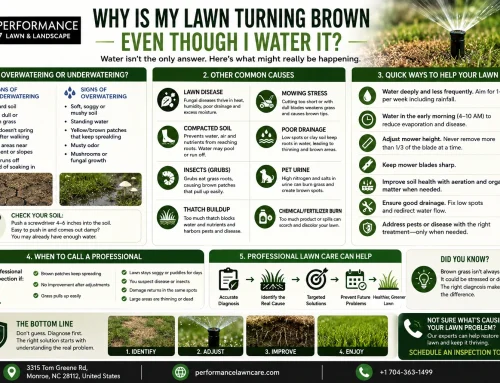

There is no single date when every homeowner should stop watering their lawn in North Carolina. Instead, begin reducing irrigation as temperatures cool, evaporation slows, and rainfall supplies more of the moisture your lawn needs.
Grass type matters, too. Warm-season grasses such as Bermuda and Zoysia generally need less water as they move toward dormancy, while tall fescue may still need supplemental moisture during fall growth, overseeding, or extended dry weather.
The best way to decide when to stop watering lawn in North Carolina is to watch rainfall, soil moisture, grass type, and signs of drought stress rather than leaving your irrigation system on its summer schedule.
At Performance Lawn & Landscape, we recommend adjusting lawn watering according to actual conditions instead of choosing an arbitrary date on the calendar.
When Should You Stop Watering Your Lawn in North Carolina?
Most established North Carolina lawns can stop receiving routine irrigation once cooler temperatures and natural rainfall are keeping the soil adequately moist.
That does not necessarily mean turning your irrigation system off as soon as summer ends.
Instead, think of the seasonal transition in two stages:
- Reduce irrigation as your lawn’s water demand declines.
- Stop scheduled watering once rainfall is consistently providing enough moisture.
If the soil remains moist after rainfall, there is usually little reason to add more water. During an extended dry spell, however, supplemental irrigation may still be appropriate even after summer has ended.
The exact timing depends on several factors, including:
- Grass type
- Recent rainfall
- Soil moisture
- Temperature
- Sun exposure
- Soil composition
- Whether the grass is actively growing or entering dormancy
That is why one North Carolina lawn may stop needing regular irrigation earlier than another lawn just a few miles away.
Why Your Lawn Needs Less Water as Temperatures Cool
Lawns generally lose moisture faster during hot, sunny summer weather.
As fall arrives, temperatures decrease, days become shorter, and moisture usually evaporates more slowly from both the grass and soil. Seasonal rainfall may also provide some or all of the moisture an established lawn needs.
Warm-season grasses also begin slowing their growth as cooler conditions arrive.
Together, these changes usually mean your lawn needs less supplemental irrigation than it did during July or August.
A sprinkler schedule designed for peak summer conditions should not automatically continue through fall.
Instead of watering several days each week simply because your controller is programmed that way, check the lawn and soil first. Autumn rainfall may already be providing sufficient moisture.
How Grass Type Changes When to Stop Watering Your Lawn in North Carolina
Knowing your grass type is one of the most important parts of deciding when to reduce fall irrigation.
North Carolina lawns commonly contain both warm-season and cool-season turf. Their seasonal growth patterns are different, so they should not always be watered the same way.
Bermuda and Zoysia
Bermuda and Zoysia are warm-season grasses that grow most actively during warmer weather.
As temperatures decline in fall, their growth slows and the grass eventually begins moving toward dormancy. Their irrigation needs generally decrease as growth slows.
A Bermuda or Zoysia lawn should not remain on the same watering schedule it followed during the hottest part of summer.
Instead, gradually reduce irrigation while monitoring rainfall and soil conditions.
Once the grass is dormant and natural rainfall is keeping the soil from becoming excessively dry, routine irrigation is generally unnecessary.
Brown Bermuda grass during cooler weather does not automatically mean the lawn needs more water. Browning is often part of its normal transition into dormancy.
Increasing irrigation will not return dormant Bermuda to normal summer growth.
Tall Fescue
Tall fescue behaves differently because it is a cool-season grass.
Fall can be an important period for tall fescue growth and root development. Water may be especially important for lawns that have recently been aerated, seeded, or overseeded.
New grass requires consistent moisture while germinating and becoming established.
Established tall fescue may also need supplemental water during a dry North Carolina fall.
That does not mean a fescue lawn should stay on a fixed summer irrigation schedule. Water according to rainfall, soil moisture, and signs of drought stress.
If your lawn has recently been seeded or overseeded, its establishment needs should take priority over the reduced watering schedule appropriate for mature turf.
How Can You Tell Whether Your Lawn Still Needs Water?
Your irrigation timer should not be the only thing deciding when your lawn gets watered.
Look at the lawn itself.
Possible signs that turf may be experiencing moisture stress include:
- A blue-gray appearance
- Folded or curled grass blades
- Wilting
- Footprints that remain visible after walking across the lawn
- Dry soil beneath the surface
You can also perform a simple soil check.
Push a screwdriver several inches into the soil. If it enters easily and the soil below the surface feels moist, additional irrigation may not be necessary.
If the ground is very dry and difficult to penetrate, check the lawn for additional signs of moisture stress before deciding whether to water.
Soil type also affects how quickly a lawn dries.
Sandy soils usually drain more quickly and may require supplemental moisture sooner. Heavy clay soils hold moisture longer but may absorb water more slowly.
Applying water too quickly to compacted or clay-heavy soil can result in runoff instead of allowing the moisture to reach the root zone.
What Happens If You Overwater Your Lawn in Fall?
Continuing a midsummer irrigation schedule after temperatures cool can provide more water than the lawn actually needs.
Potential problems include:
Saturated soil
When rainfall is already keeping the ground moist, additional irrigation can leave the root zone unnecessarily wet.
Runoff
Some soils cannot absorb water as quickly as an irrigation system applies it. Excess water may run onto sidewalks, driveways, streets, or neighboring areas.
Poor watering patterns
Frequent, shallow irrigation may contribute to less desirable rooting patterns than watering practices that adequately moisten the root zone when water is actually needed.
Disease-friendly conditions
Frequently wet turf and prolonged leaf moisture can create conditions that favor certain lawn diseases.
Unnecessary water use
Running an automatic irrigation system when rainfall has already provided enough moisture wastes water without necessarily improving lawn health.
The goal is not to avoid watering during fall. It is to avoid watering when the lawn does not need it.

Should You Water Your Lawn During a Dry North Carolina Fall?
Yes, when conditions justify it.
Cooler temperatures do not guarantee moist soil.
North Carolina can experience extended periods with limited rainfall during fall. When that happens, inspect both the grass and soil before deciding whether supplemental irrigation is necessary.
Warm-season turf moving toward dormancy generally requires much less water than it did during summer. However, the soil should not remain excessively dry for prolonged periods.
Tall fescue may require more attention because it can remain actively growing during cooler weather.
Recent rainfall should always factor into your decision.
If substantial rain has already moistened the root zone, running your irrigation system the following day simply because it is scheduled to run is usually unnecessary.
On the other hand, an extended dry period may justify supplemental watering even late in the season.
Does Your Lawn Need Water During Winter?
Winter watering needs are usually much lower, but they are not always zero.
Warm-season lawns such as Bermuda and Zoysia typically become dormant as colder weather arrives. Dormancy substantially reduces their water requirements.
Tall fescue may remain green and active through much of the cooler season, although its water demand is generally lower than during hotter weather.
During many North Carolina winters, rainfall may provide everything an established lawn needs.
Extended dry conditions can still reduce soil moisture, however.
Rather than automatically watering throughout winter, monitor rainfall and soil conditions.
If the soil is already damp, leave the irrigation system off.
How to Adjust Your Irrigation System for Fall
As your lawn’s water requirements decline, your irrigation schedule should change with them.
Start by reviewing your controller settings.
A watering program designed for midsummer conditions usually should not continue unchanged throughout fall. Reduce the frequency as cooler temperatures, slower evaporation, and rainfall reduce your lawn’s need for supplemental water.
Fall is also a good time to inspect the irrigation system for:
- Broken sprinkler heads
- Clogged nozzles
- Water spraying onto pavement
- Uneven coverage
- Leaking valves
- Areas of excessive runoff
- Controller schedules that no longer match seasonal conditions
Your watering schedule should account for factors such as soil type, slope, rooting depth, rainfall, and actual turf conditions.
The key is to treat irrigation as a seasonal system rather than a set-it-and-forget-it system.
What Charlotte Homeowners Should Know About Fall Lawn Watering
Charlotte-area lawns commonly include both warm-season and cool-season grasses, so fall watering needs can vary considerably from one property to another.
A Bermuda lawn turning brown during cooler weather may simply be entering its normal dormancy cycle. Extra irrigation will not bring dormant Bermuda back into normal summer growth.
Tall fescue is different.
Fall can be an important growing and establishment period for fescue, particularly after aeration or overseeding. Maintaining adequate soil moisture may still be necessary if rainfall is limited.
For Charlotte homeowners trying to decide when to stop watering lawn in North Carolina, the practical approach is simple:
Watch the lawn, check the soil, and pay attention to rainfall.
Reduce watering as temperatures cool.
Stop routine irrigation when natural rainfall is maintaining adequate soil moisture.
Provide supplemental water during extended dry conditions when the lawn and soil show that additional moisture is needed.
At Performance Lawn & Landscape, we believe lawn care works best when it responds to actual conditions rather than a fixed date on the calendar. Seasonal watering adjustments can help maintain healthier turf while avoiding unnecessary water use, runoff, and overly saturated soil.
If you are unsure how much water your lawn needs as North Carolina temperatures change, Performance Lawn & Landscape can help you develop a seasonal lawn care approach based on your grass type, property conditions, and Charlotte-area growing conditions.
Frequently Asked Questions
What month should I stop watering my lawn in North Carolina?
There is no single month when every North Carolina homeowner should stop watering. Reduce irrigation as temperatures cool and rainfall begins maintaining adequate soil moisture. Routine watering can usually stop once the lawn no longer needs supplemental moisture, although extended dry periods may still require occasional watering.
Should I stop watering Bermuda grass when it turns brown?
Brown Bermuda grass during cooler weather is often entering normal dormancy. Its water requirements are much lower during this period, so summer-style irrigation is generally unnecessary. Continue monitoring soil moisture during unusually dry conditions.
Does tall fescue need watering in fall?
Tall fescue can still need water during fall because it is a cool-season grass. Established fescue should be watered according to rainfall, soil moisture, and signs of drought stress. Newly seeded or overseeded lawns generally require more consistent moisture while becoming established.
Should I water my lawn after it goes dormant?
Dormant grass requires substantially less water than actively growing turf. Natural rainfall may provide enough moisture during much of the cooler season. Supplemental watering may still be appropriate during an extended dry period if the soil becomes excessively dry.
How can I tell if my lawn is too dry?
Look for wilted or folded grass blades, a blue-gray appearance, footprints that remain visible after walking across the lawn, and dry soil beneath the surface. Checking the soil and the turf together is more reliable than assuming the lawn needs water because an irrigation timer is scheduled to run.
Should I completely shut off my irrigation system in fall?
Not necessarily. Begin by reducing how often the system runs. Once rainfall is consistently maintaining adequate soil moisture, routine irrigation can usually be turned off while keeping the system available if extended dry conditions return.
Can watering too much in fall hurt my lawn?
Excessive fall irrigation can contribute to saturated soil, runoff, unnecessary water use, and prolonged wet conditions that may favor certain lawn diseases. Supplemental irrigation is still useful when the lawn genuinely needs moisture.
When should Charlotte homeowners reduce lawn watering?
Charlotte homeowners should begin reducing irrigation as temperatures cool, evaporation decreases, and rainfall begins providing enough moisture for the lawn. The exact timing depends on grass type, soil conditions, rainfall, and whether the turf is still actively growing or entering dormancy.